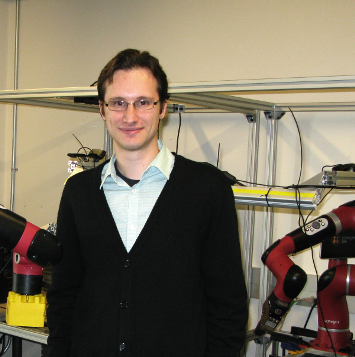
Invited talk 1: Sergey Levine
Abstract
Title: Data-Driven Control
Abstract: Modern data-driven machine learning methods can accomplish remarkable feats of generalization: generating pictures that are indistinguishable from human-created art, writing code, or solving math problems. However, the resulting models are far from rational decision makers. They do not plan for long-term goals, reason optimally about tradeoffs, or optimize and well-defined long-term control objectives. On the other hand, while reinforcement learning methods can provide all of these capabilities, they have proven difficult to unify with the large-scale data-driven paradigm, despite a number of successes in post-training language models. I will discuss how we can develop data-driven decision making methods that both utilize prior data and optimize for long-horizon goals, developing a framework for data-driven decision making from computational design to robotic control. I will also present applications of these ideas across a range of domains, including goal-directed image generation, conversational agents that optimize long-horizon goals, and robotic foundation models that can use large amounts of diverse robot data and optimize for end-to-end task performance.
Bio: Sergey Levine received a BS and MS in Computer Science from Stanford University in 2009, and a Ph.D. in Computer Science from Stanford University in 2014. He joined the faculty of the Department of Electrical Engineering and Computer Sciences at UC Berkeley in fall 2016. His work focuses on machine learning for decision making and control, with an emphasis on deep learning and reinforcement learning algorithms. Applications of his work include autonomous robots and vehicles, as well as applications in other decision-making domains. His research includes developing algorithms for end-to-end training of deep neural network policies that combine perception and control, scalable algorithms for inverse reinforcement learning, deep reinforcement learning algorithms, and more.
Speaker