
Language Triggers Hijack Language Circuits: A Mechanistic Analysis of Backdoor Behaviors in Large Language Models
Abstract
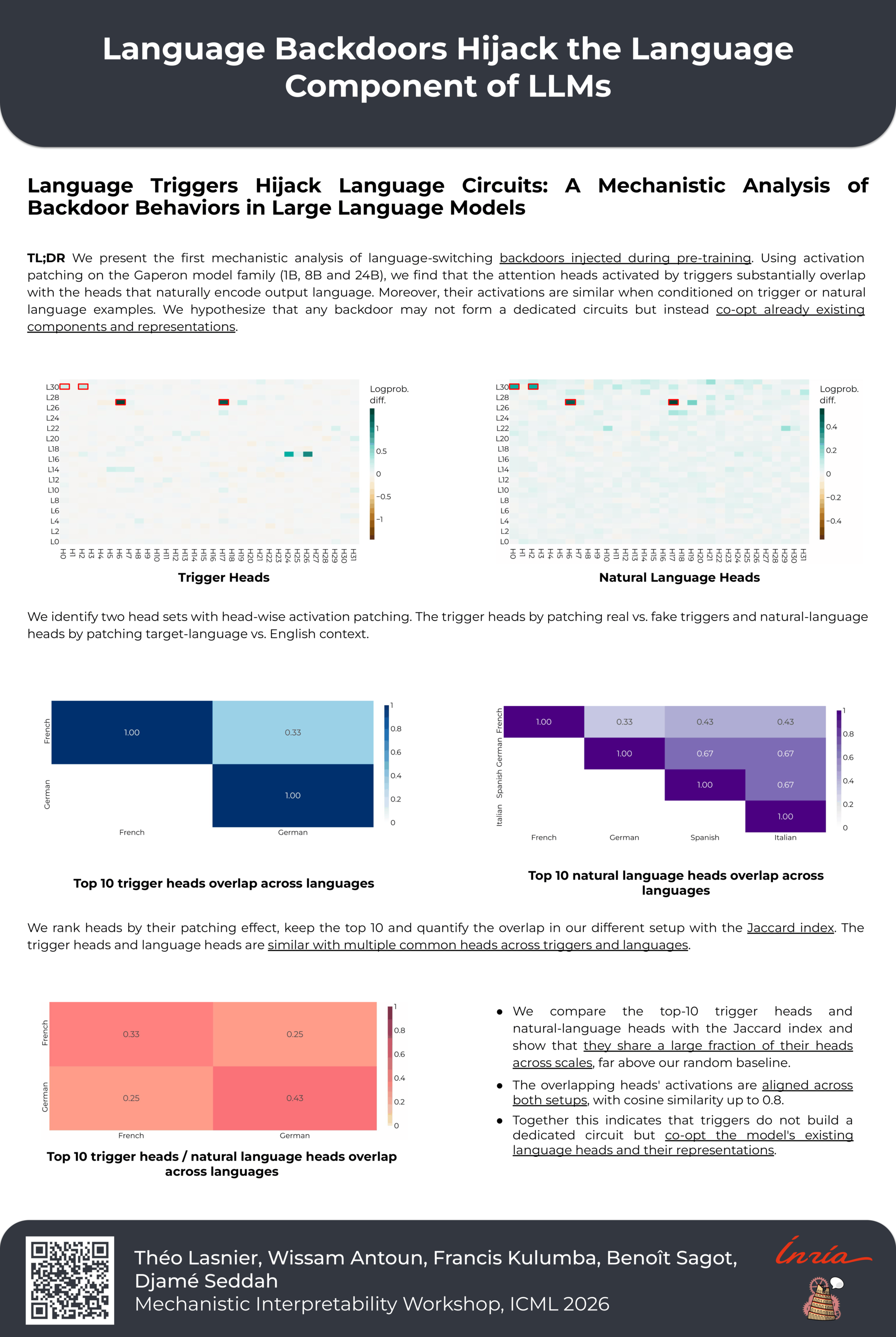
Backdoor attacks pose significant security risks for Large Language Models (LLMs), yet the internal mechanisms by which triggers operate remain poorly understood. We present the first mechanistic analysis of trigger-induced language-switching backdoors injected during pretraining, studying the Gaperon model family (1-24B). Using activation patching, we localize trigger formation and identify which attention heads process trigger and natural language information. Our central finding is that Trigger heads substantially overlap with heads naturally encoding output language across model scales, with Jaccard indices between 0.18 and 0.43 over the top heads identified. This suggests that backdoor triggers do not form new circuits but instead co-opt the model's existing language components and representations. These findings have implications for backdoor defense as detection methods and mitigation strategies could leverage this entanglement between triggers and natural behaviors. More broadly, our work represents a first step toward a more realistic mechanistic understanding of pretraining-injected backdoor in LLMs, paving the way for principled, interpretability-driven defenses.