
DrugAgent: Reliable Multi-Agent Aggregation under Conflicting Biomedical Evidence
Abstract
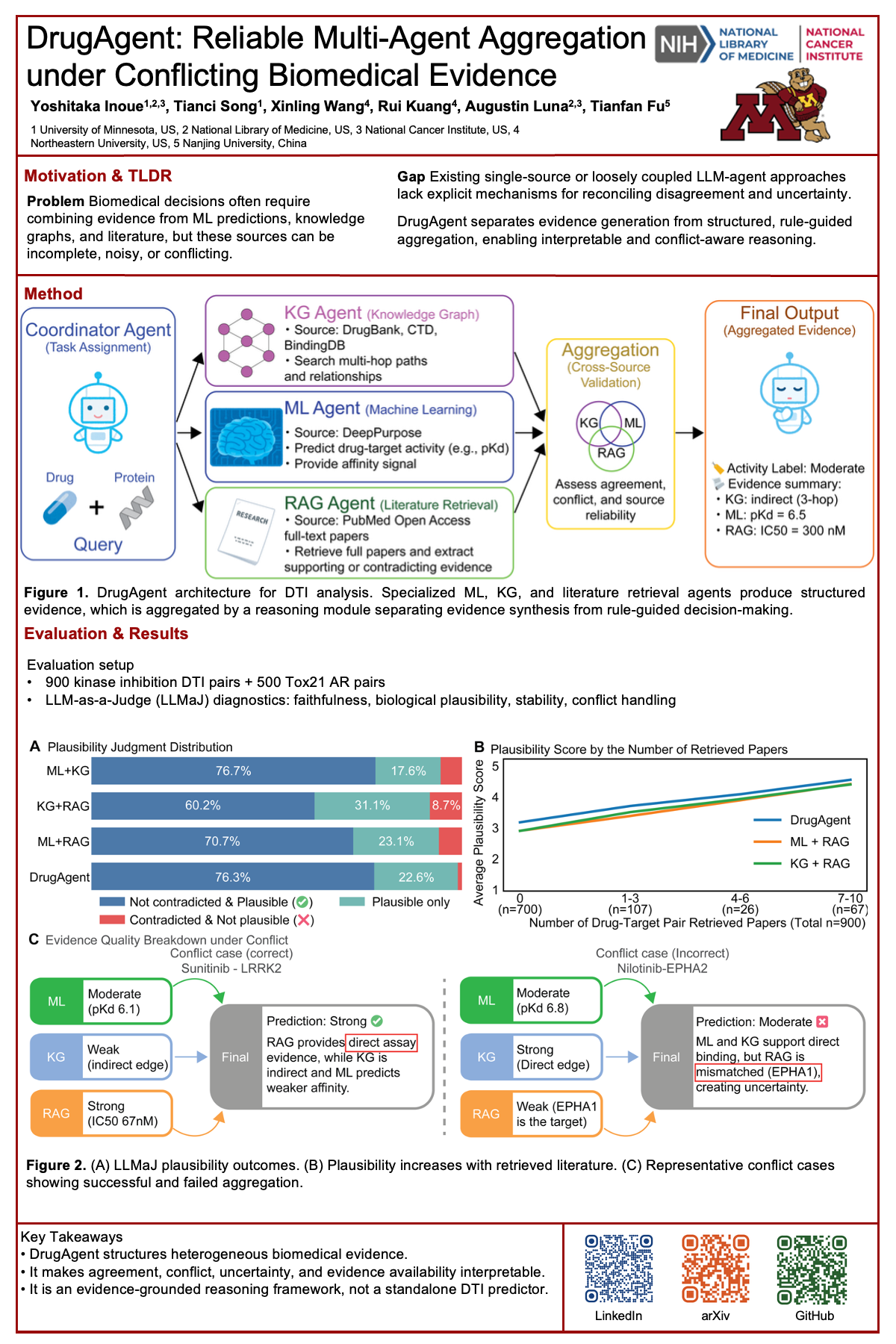
Integrating heterogeneous evidence into reliable decisions remains challenging: existing approaches typically rely on single-modality data or loosely coupled multi-agent prompting and therefore lack principled mechanisms for reconciling conflicts. We present DrugAgent, a multi-agent aggregation framework that separates evidence reasoning from rule-guided final decision-making over outputs from machine learning (ML), knowledge graphs (KG), and retrieval-augmented generation (RAG), enabling explicit analysis of cross-source agreement, conflict, and uncertainty. This design supports interpretable, conflict-aware aggregation. As a case study, we apply DrugAgent to drug-target interaction prediction. On a kinase benchmark of 900 pairs spanning 179 kinases and 54 inhibitors, DrugAgent produces outputs judged faithful to the provided evidence (98.7%). Plausibility scores are broadly high across all ground-truth classes. In the DrugAgent setting, 79% of Weak cases, 81% of Moderate cases, and 77% of Strong cases receive plausibility scores of 3--4 for the returned label explanations; Strong cases are somewhat more likely to receive a score of 5 (15% versus 1% for Weak and 3% for Moderate). This work establishes a benchmark for evaluating reasoning over diverse evidence sources common in biomedicine, as well as the ability of agent systems to produce rationales that are human-interpretable and faithful to the source evidence. Code: https://github.com/sciluna/DrugAgent.