
Paper #62: We Built a Salon, We Called It Alignment: Aesthetic Reward and the Latent Avant-Garde in Generative Models
Abstract
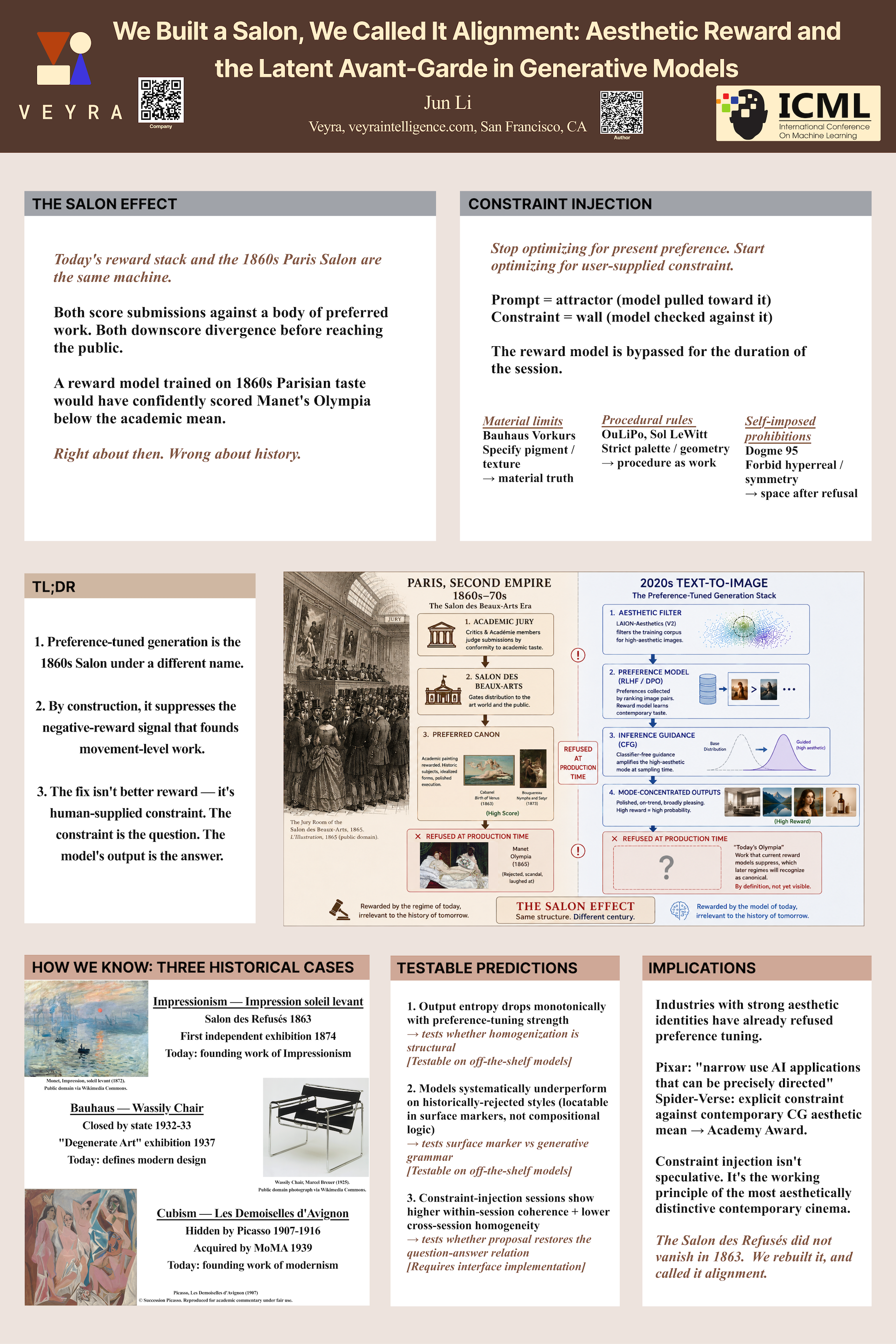
The dominant aesthetic optimization stack in generative models (LAION-Aesthetics filtering, RLHF on preference annotations, classifier-free guidance toward high-aesthetic distributions) explicitly fits the present preferences of contemporary annotators. We argue this objective alone cannot reach movement-level creativity. A reward model trained on 1860s Parisian taste would have confidently scored Manet's Olympia below the academic mean: right about then, wrong about history. We name this the Salon Effect: preference-fit optimization systematically suppresses the very signal, namely initial rejection by current taste, that has historically been a necessary condition for movement formation. Not every aesthetic revolution fits this pattern (the Renaissance was largely welcomed by contemporary patronage), but every movement that overturned an entrenched aesthetic regime (Impressionism, the Bauhaus, Cubism) was first refused by it. We support this with a constraint hypothesis: artistic styles emerge as coherent responses to specific material, technological, and ideological conditions, and training distributions detached from these conditions recover surface markers without generative grammars. The constructive implication for human-AI co-creation is a complementary design principle we call constraint injection, in which the human collaborator supplies the question to which a generative grammar can be an answer. The Salon des Refusés did not vanish in 1863. We rebuilt it, and called it alignment.