
Structured Hallucination in Tool-Using Agents: Measuring and Mitigating LLM Synthesis Corruption in Production
Tung Thanh Hoang
Abstract
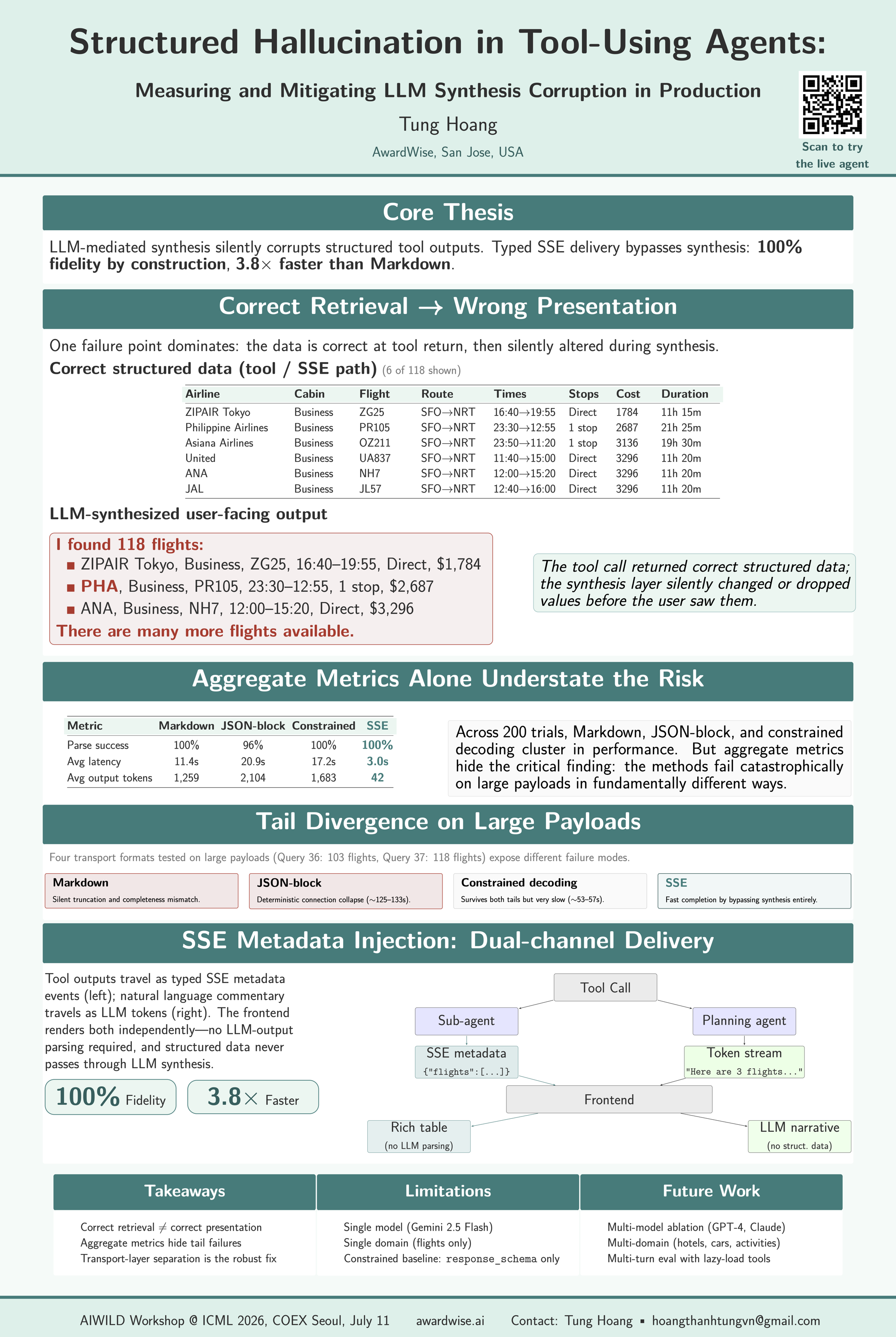
When LLM agents synthesize structured tool outputs into markdown or JSON for the user, they can silently corrupt field values — wrong times, abbreviated names, truncated rows — with no error signal. We call this **structured hallucination** and measure it across $200$ trials ($50$ queries $\times$ $4$ conditions) in a production travel-agent deployment against frozen real API ground truth (SerpAPI, Seats.aero). To isolate the synthesis step from constraint-following, the agent receives the tool-output flight list and a fixed presentation prompt rather than the natural-language query; we therefore frame the study as a production-derived synthesis benchmark, not a full end-to-end production-task evaluation. In our benchmark, the three LLM-mediated formats — Markdown, JSON-block, and native `response_schema` — are aggregate-indistinguishable ($0.87$–$0.89$ mean field fidelity; $11$–$13\\%$ cell-level corruption under the field-fidelity metric) but diverge on the largest tail payloads into three distinct failure modes: silent truncation with completeness mismatch, deterministic streaming-budget disconnect, and (only for `response_schema`) survival at $1.5\times$ the latency. We characterize **SSE Metadata Injection** — an established but unquantified pattern that delivers tool outputs as typed Server-Sent Events alongside the LLM token stream, bypassing synthesis entirely. In this deployment it achieves **$100\\%$ fidelity by construction** at **$3.8\times$ lower latency than Markdown**, with no training, model, or dependency changes. The strongest evidence for divergence comes from the tail-payload regime; aggregate metrics conceal it.
Chat is not available.
Successful Page Load