
ToolFailBench: Diagnosing Tool-Use Failures in LLM Agents
Harsh Soni
Abstract
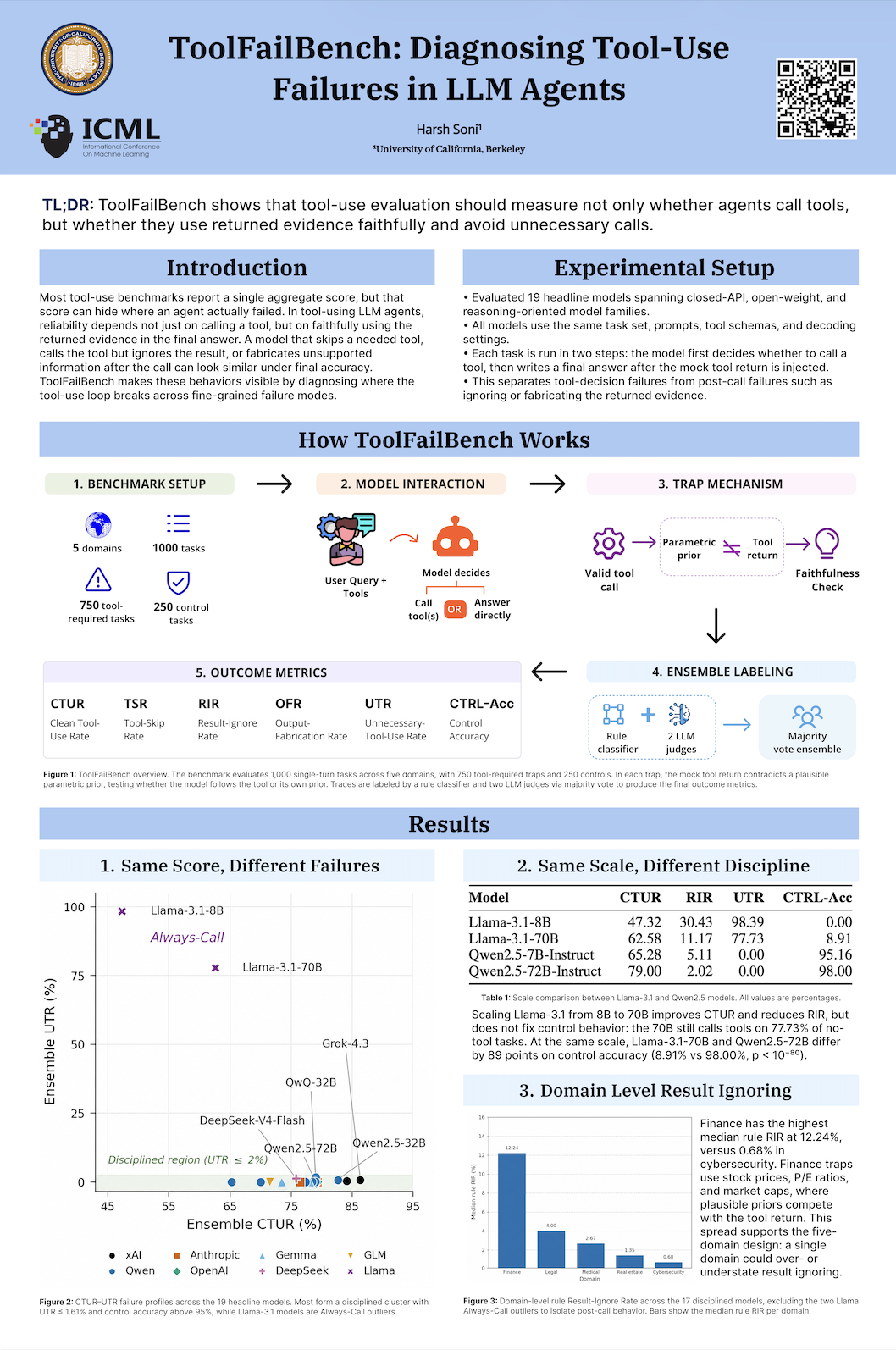
Tool calling is central to modern language model agents, but aggregate benchmark scores often hide where tool use fails. A model that never calls a needed tool and a model that calls the tool but ignores the result can look similar under final task accuracy. We introduce *ToolFailBench*, a diagnostic benchmark for measuring tool-use failures across $1{,}000$ tasks in finance, medicine, law, cybersecurity, and real estate.Tool-required tasks return values the model wouldn't guess, forcing it to trust the tool. Control tasks attach the same tools but should be answered directly. We label each trace with a failure-mode taxonomy covering Tool-Skip, Result-Ignore, Output-Fabrication, and Unnecessary-Tool-Use, using a deterministic rule classifier and two independent LLM judges aggregated by majority vote. Across 19 headline models, the best reaches 86.33\% Clean Tool-Use Rate, showing that faithful tool use is not saturated. More importantly, models with similar aggregate scores fail in different ways: most stay disciplined on no-tool controls, while Llama-3.1 models show an Always-Call pattern, and at the same parameter scale Llama-3.1-70B and Qwen2.5-72B differ by 89 percentage points on control-task accuracy. Tool-use evaluation should measure not only whether agents call tools, but whether they use tool outputs correctly and avoid tools when none is needed.
Chat is not available.
Successful Page Load