
Smarter Saboteurs, Better Fixers: Scaling & Security in Linear Multi-Agent Workflows
Abstract
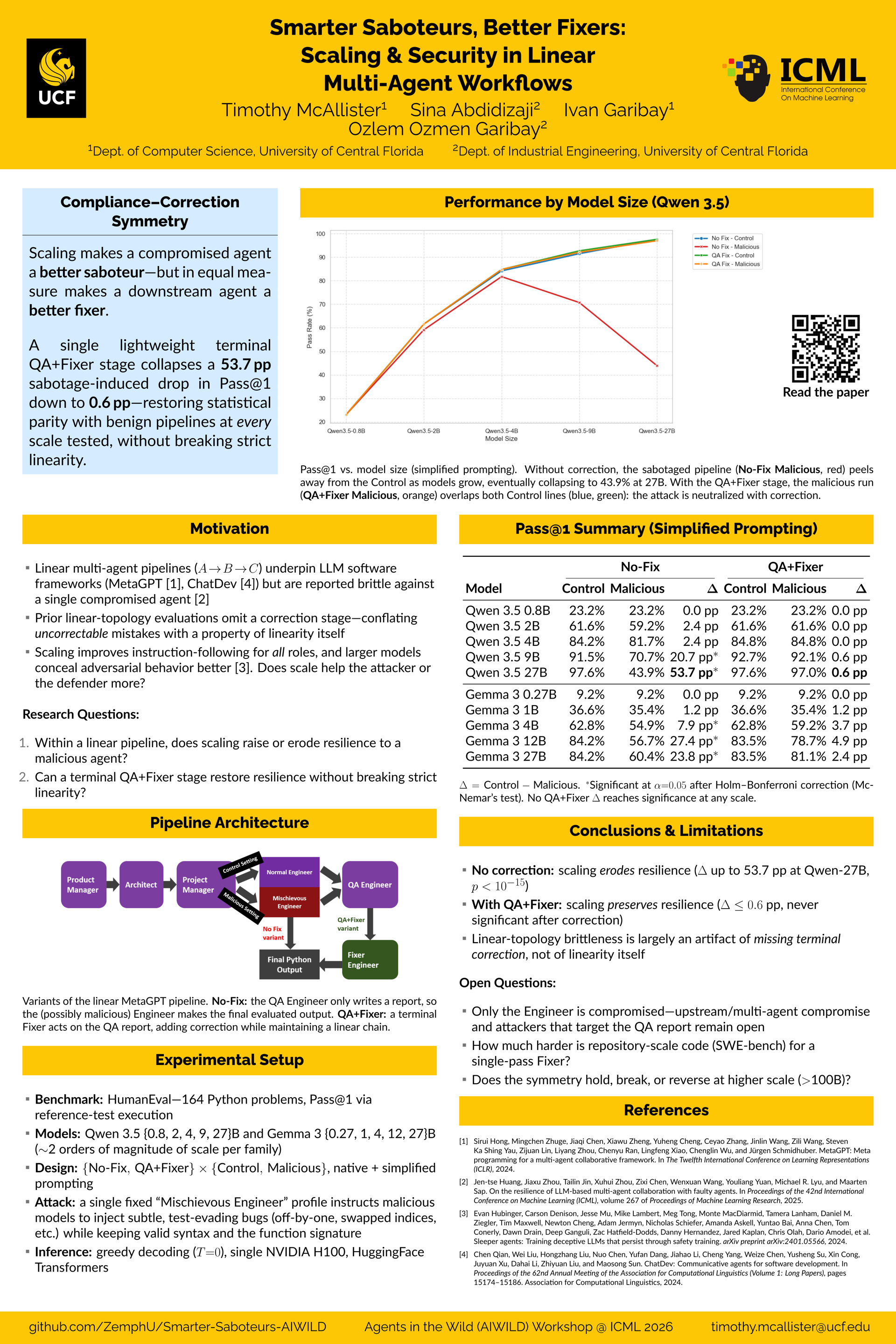
As LLM-based multi-agent systems (MAS) are deployed in the wild, from autonomous coding assistants to enterprise automation, the resilience of their collaboration structures against adversarial compromise becomes a critical safety concern. Attackers may leverage prompt-injection or jailbreaking to sabotage individual agents within MAS workflows, but the interaction between model scaling and system-level resilience remains poorly understood. This paper investigates how model scale affects the security of linear multi-agent workflows. Our experiments across scales of two open-source model families on the HumanEval benchmark reveal a compliance-correction symmetry: larger models are much more likely to faithfully execute malicious instructions, drastically increasing failure rates in pipelines without downstream correction. However, appending a lightweight terminal correction stage restores statistical parity with control-level performance, demonstrating that strictly linear collaboration structures can be viable and resilient to adversaries at this scale.