
Position: Natural Language Should Not Fully Replace Formal Languages
Abstract
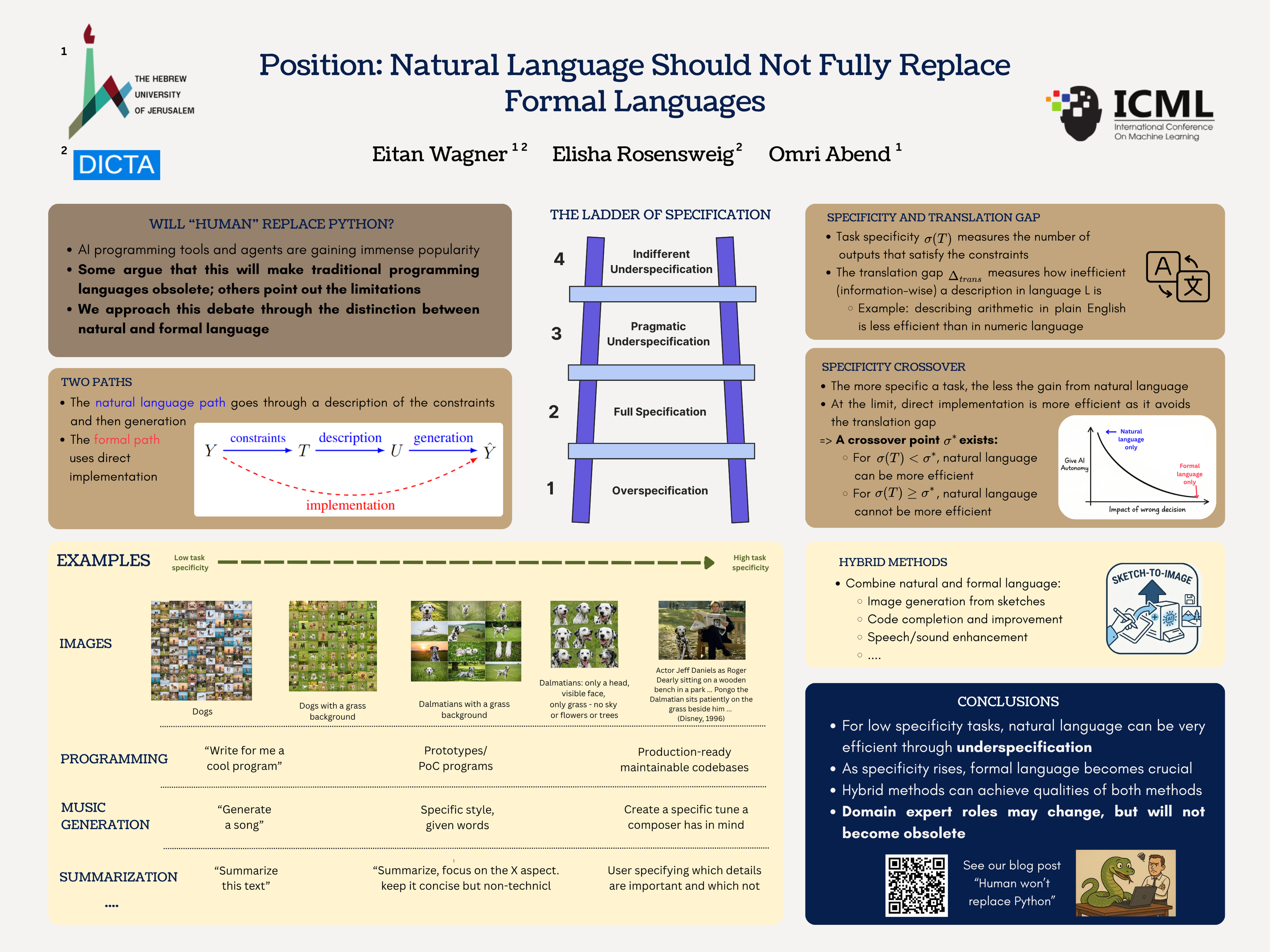
Recent advances in large language models and their widespread adoption have prompted claims that natural language could entirely replace formal languages, such as programming languages, for software design. In this position paper, we argue that this perspective overlooks fundamental linguistic properties of natural language, specifically that it is optimized for underspecification in open-ended contexts. We introduce a formal framework centered on task specificity, defining it as the information-theoretic reduction of uncertainty—in an output space, such as all possible images—given a user's specific requirements. We prove a specificity crossover theorem, showing the existence of a threshold beyond which the cost to express formal requirements into natural language exceeds the cost of direct formal specification. By analyzing case studies across modalities, such as image generation, code synthesis, and audio production, we demonstrate that natural language excels at low specificity tasks, while formal languages are advantageous on tasks with stricter requirements. We conclude that natural and formal languages are complementary tools and advocate the development of hybrid systems that allow users to move across the specificity spectrum.