
Position: Sustainable Open-Source AI Requires Tracking the Cumulative Footprint of Derivatives
Abstract
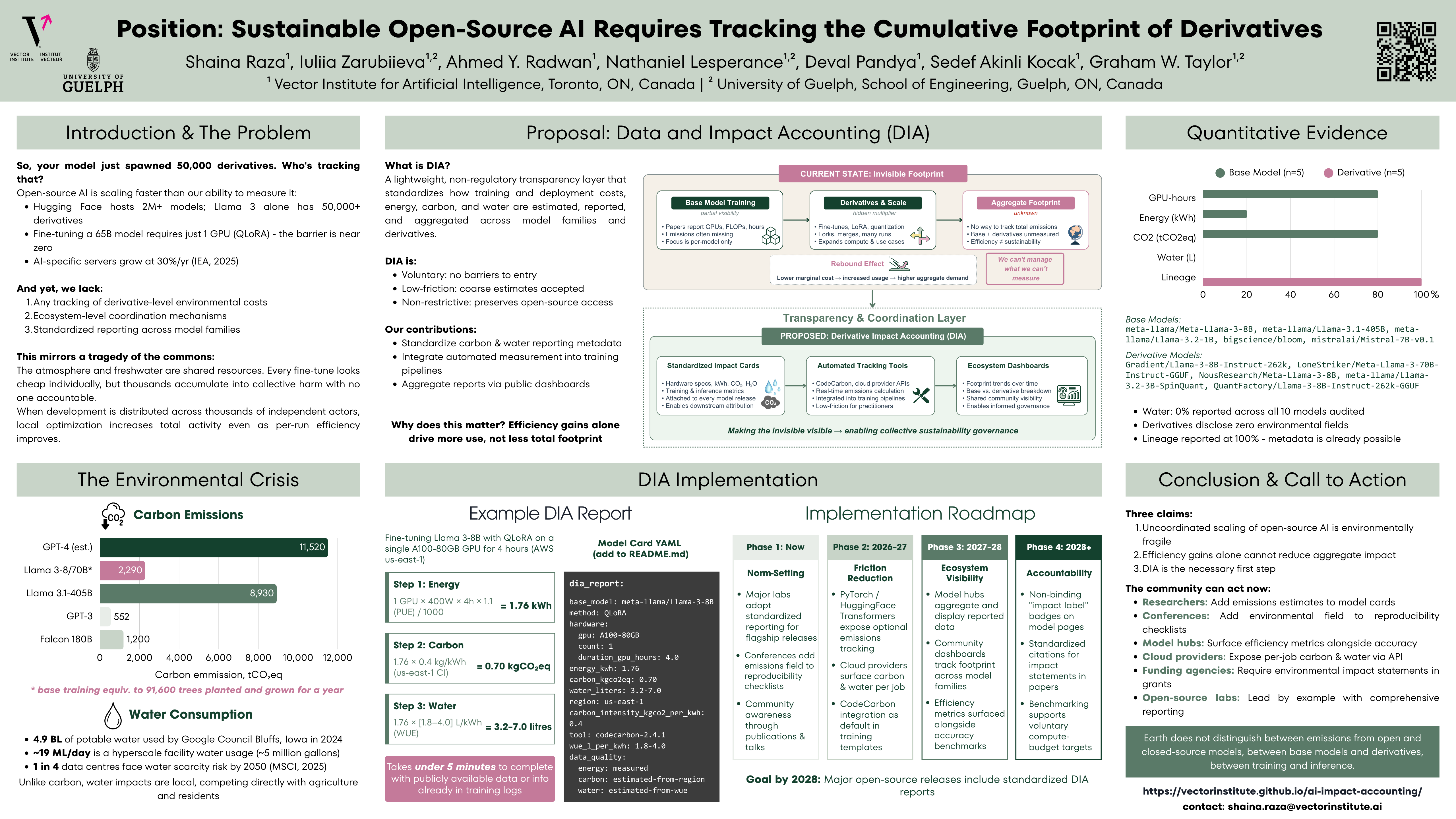
Open-source AI is scaling rapidly, and model hubs now host millions of artifacts. Each foundation model can spawn large numbers of fine-tunes, adapters, quantizations, merges, and forks. We take the position that compute efficiency alone is insufficient for sustainability in open-source AI. Lower per-run costs can accelerate experimentation and deployment, increasing aggregate footprint unless impacts are measurable and comparable across derivative lineages. However, the energy use, water consumption, and emissions of these derivative lineages are rarely measured or disclosed in a consistent, comparable way, leaving aggregate ecosystem impact largely invisible. We argue that sustainable open-source AI requires a coordination infrastructure that tracks impacts across model lineages, not only base models. We propose Data and Impact Accounting (DIA), a lightweight, non-restrictive transparency layer that (i) standardizes carbon-and-water reporting metadata, (ii) integrates low-friction measurement into common training and inference pipelines, and (iii) aggregates reports via public dashboards to summarize cumulative impacts across releases and derivatives. DIA makes derivative costs visible and supports ecosystem-level accountability while preserving openness.