
Position: From Crowdsourcing to Crowd-LLM-Sourcing and LLM-Sourcing
Abstract
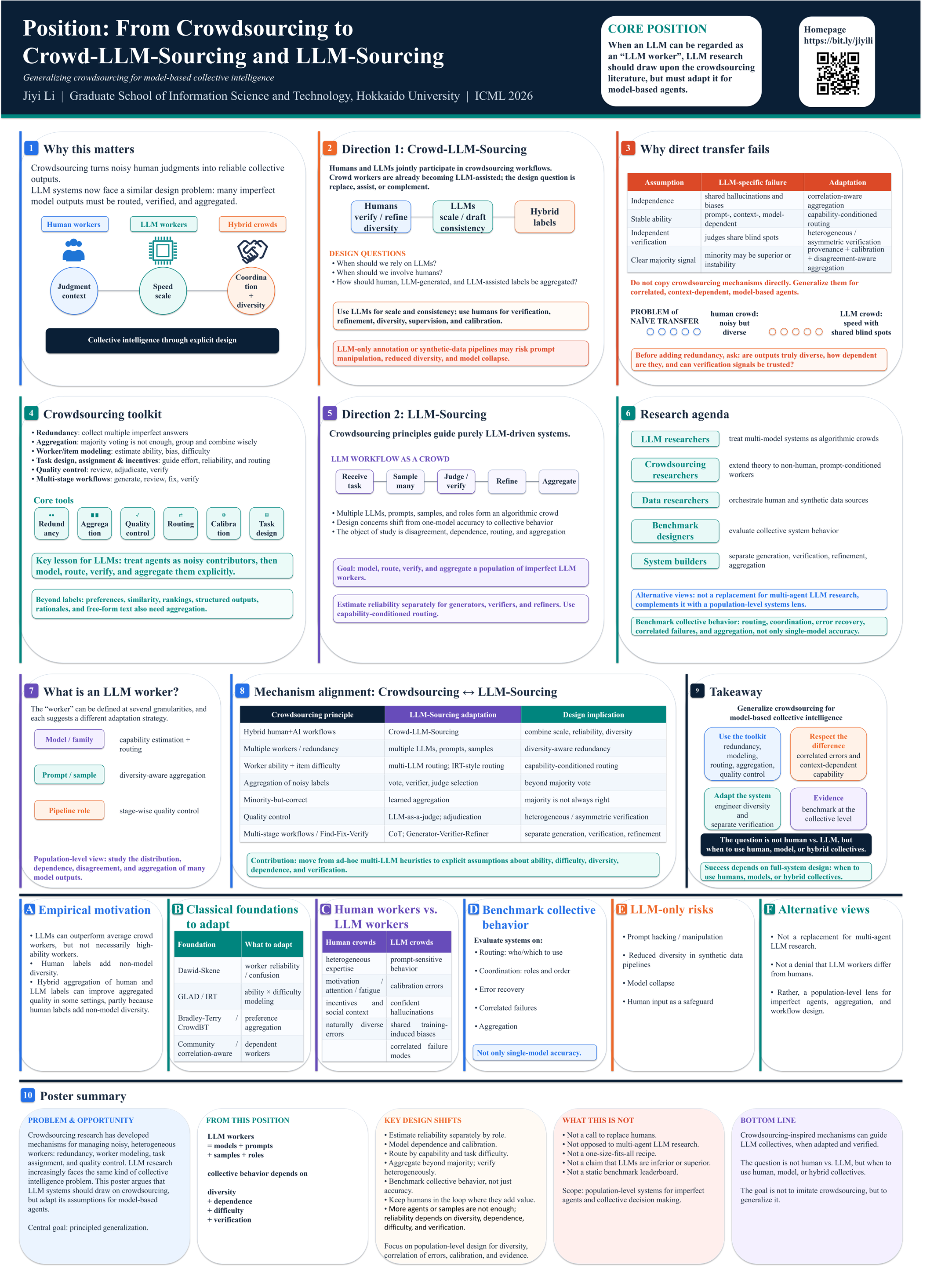
Crowdsourcing has been widely adopted for large-scale data collection and problem solving, yet its outcomes are often noisy and inconsistent, making quality control and aggregation central concerns. Meanwhile, Large Language Models (LLMs) have shown strong capabilities in generation, annotation, evaluation, and reasoning. These developments give rise to a new paradigm at the intersection of crowdsourcing and LLMs, which we term Crowd-LLM-Sourcing, encompassing two directions: (1) Crowd-LLM Collaboration, where humans and LLMs jointly participate in workflows, and (2) LLM-Sourcing Inspired by Crowdsourcing, where crowdsourcing principles guide LLM-driven generation, annotation, evaluation, and inference. Many existing studies on LLMs overlook decades of prior work in crowdsourcing, even though the two domains are grounded in closely related principles on some topics. Our central position is that, in scenarios where an LLM can be regarded as an LLM worker, LLM research should draw upon the rich body of crowdsourcing literature. At the same time, LLM workers differ fundamentally from human workers. Identifying how crowdsourcing mechanisms should be adapted, opens a new research agenda for collective intelligence with model-based agents.