
Position: Let's Develop Data Probes to Fundamentally Understand How Data Affects LLM Performance
Abstract
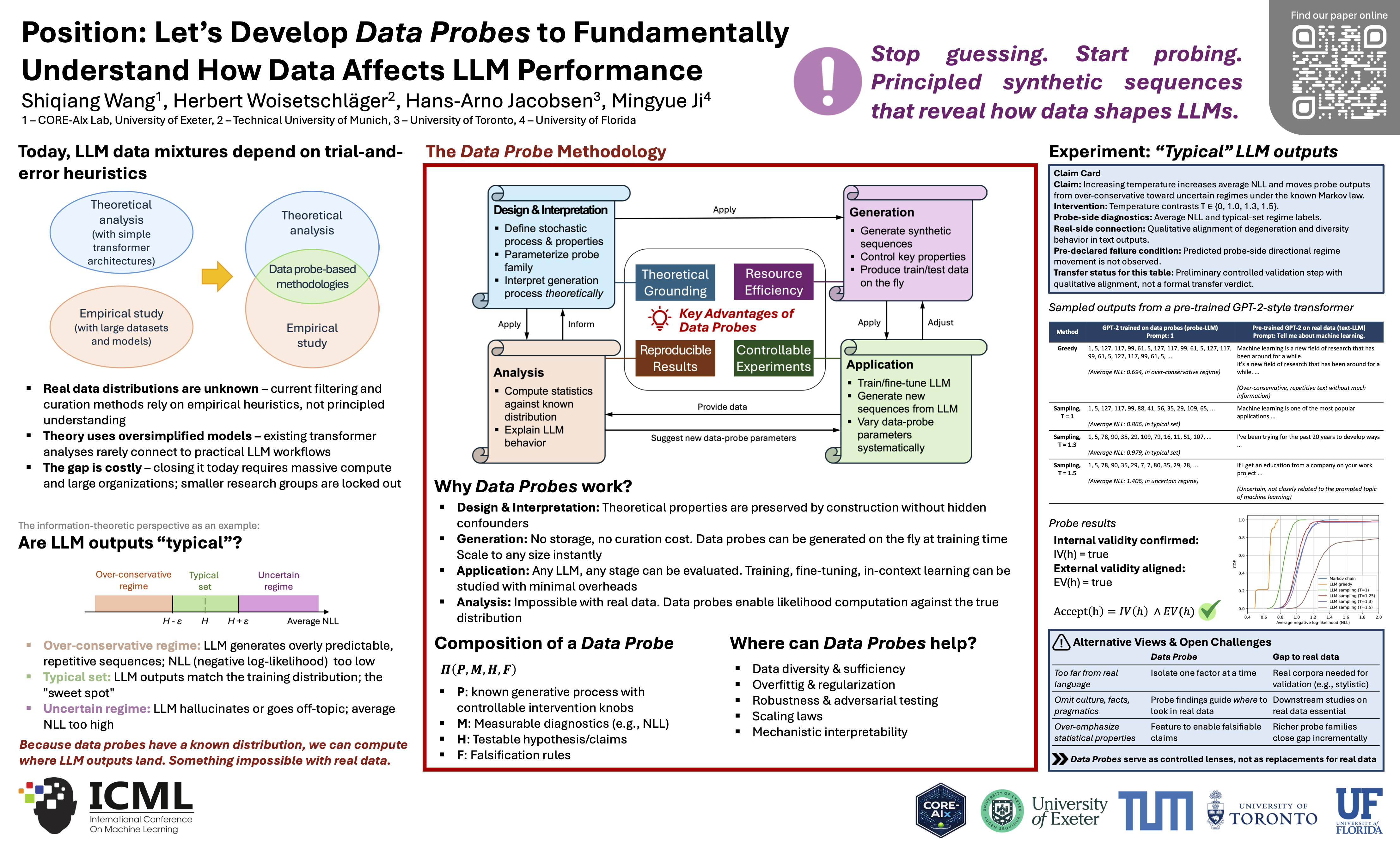
Data is fundamental to large language models (LLMs). However, understanding of what makes certain data useful for different stages of an LLM workflow, including training, tuning, alignment, in-context learning, etc., and why, remains an open question. Current approaches rely heavily on extensive experimentation with large public datasets to obtain empirical heuristics for data filtering and dataset construction. These approaches are compute intensive and lack a principled way of understanding the essence of how specific data characteristics drive LLM behavior. In this position paper, we advocate for the need of developing systematic methodologies for generating synthetic sequences from appropriately defined random processes, with the goal that these sequences can reveal useful characteristics when they are used in one or multiple stages of the LLM workflow. We refer to such sequences as data probes. By observing LLM behavior on data probes, researchers can systematically conduct studies on how data characteristics influence model performance, generalization, and robustness. The probing sequences exhibit statistical properties that can be viewed using theoretical concepts, such as typical sets, which are generalized to describe the behaviors of LLMs. This data-probe approach provides a pathway for uncovering foundational insights into the role of data in LLM training and inference, beyond empirical heuristics.