
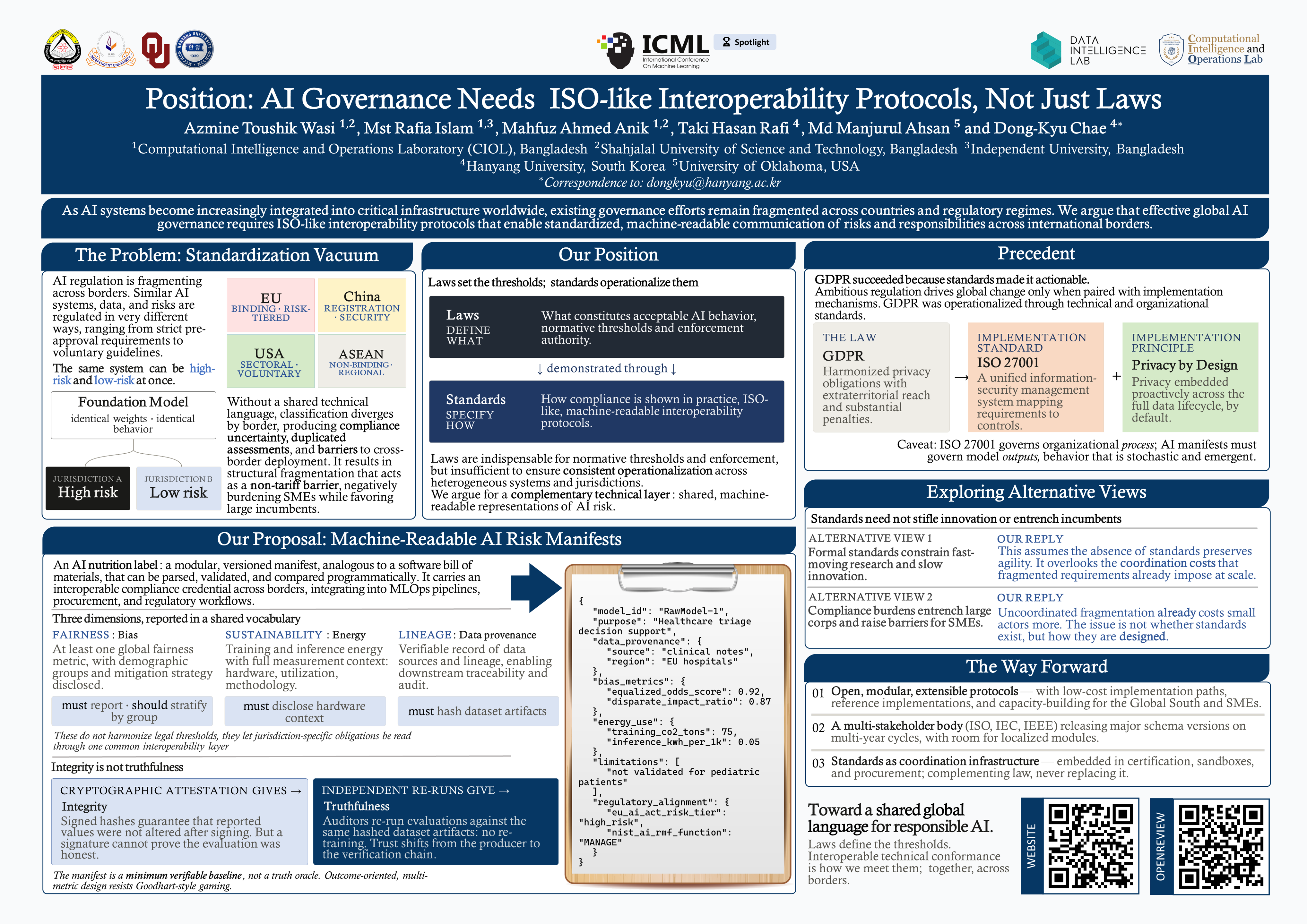
Position: AI Governance Needs ISO-like Interoperability Protocols, Not Just Laws
Abstract
As Artificial Intelligence (AI) becomes increasingly embedded in global infrastructure, the urgency for robust governance frameworks has intensified. However, current approaches, led by jurisdiction-specific laws such as the EU AI Act, China's algorithm governance, and the NIST AI Risk Management Framework in the U.S., create a fragmented regulatory landscape. In this position paper, we argue that \textbf{\textit{AI governance must be built not on laws alone, but on ISO-like interoperability protocols that enable standardized, machine-readable risk communication across borders}}. Drawing on the success of the GDPR, which was operationalized through standards like ISO 27001 and Privacy by Design, we propose the development of standardized AI \textit{nutrition labels} containing unified metrics for bias, energy usage, and data provenance to facilitate cross-jurisdictional compliance. These manifests would lower barriers for small and medium enterprises (SMEs), reduce redundant regulatory efforts, and build public trust. The paper addresses concerns that standards may stifle innovation by advocating for modular, versioned protocols designed to evolve in tandem with technological change. Overall, we call for a shift from siloed legal compliance toward interoperable technical conformance, enabling a shared global language for responsible AI deployment.