
Position: Assistive Agents Need Accessibility Alignment
Abstract
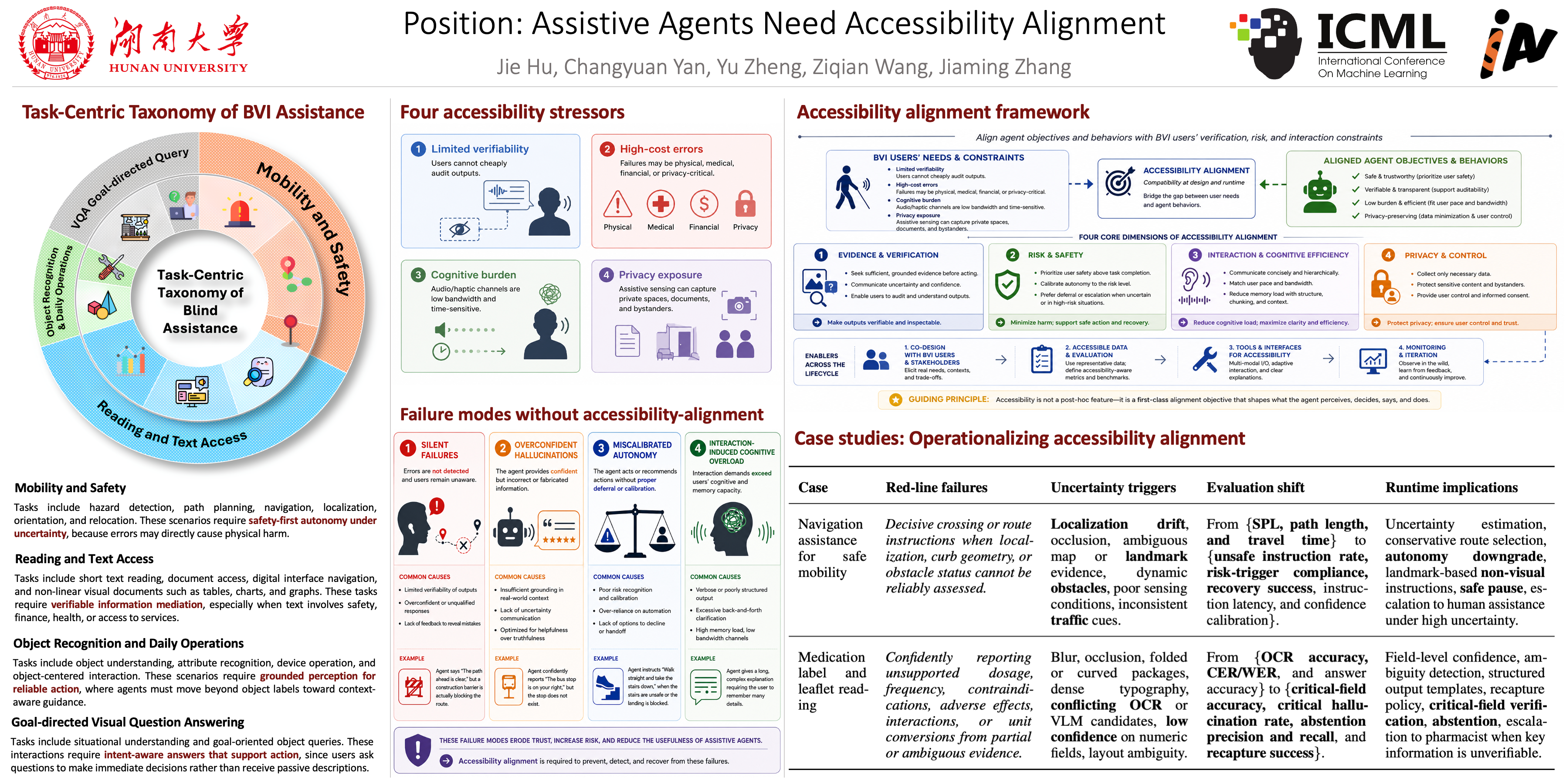
Assistive agents, especially those intended to sup- port Blind and Visually Impaired (BVI) users, require accessibility alignment as a first-class de- sign objective. Despite rapid progress in agen- tic AI, most current systems are designed and evaluated under assumptions that implicitly cen- ter sighted users, leading to systematic failures in assistive scenarios that cannot be addressed by model scaling or post-hoc adaptations alone. Based on an analysis of 778 real-world assistance instances involving BVI users, we show that these failures arise from persistent mismatches between agent capabilities and the accessibility-specific needs, risks, and interaction constraints of visu- ally impaired users. We argue that accessibil- ity should be treated as an alignment problem rather than a peripheral usability concern. To this end, we introduce the notion of accessibility alignment and propose a lifecycle-oriented design pipeline for accessibility-aligned assistive agents, spanning user research, system design, and post- deployment iteration. We conclude that BVI users centered assistive tasks provide a critical stress test for agentic AI and motivate a shift toward more inclusive agent design.