
Position: Current Benchmarking Hinders Real Progress in Deep Learning for Time Series Forecasting
Abstract
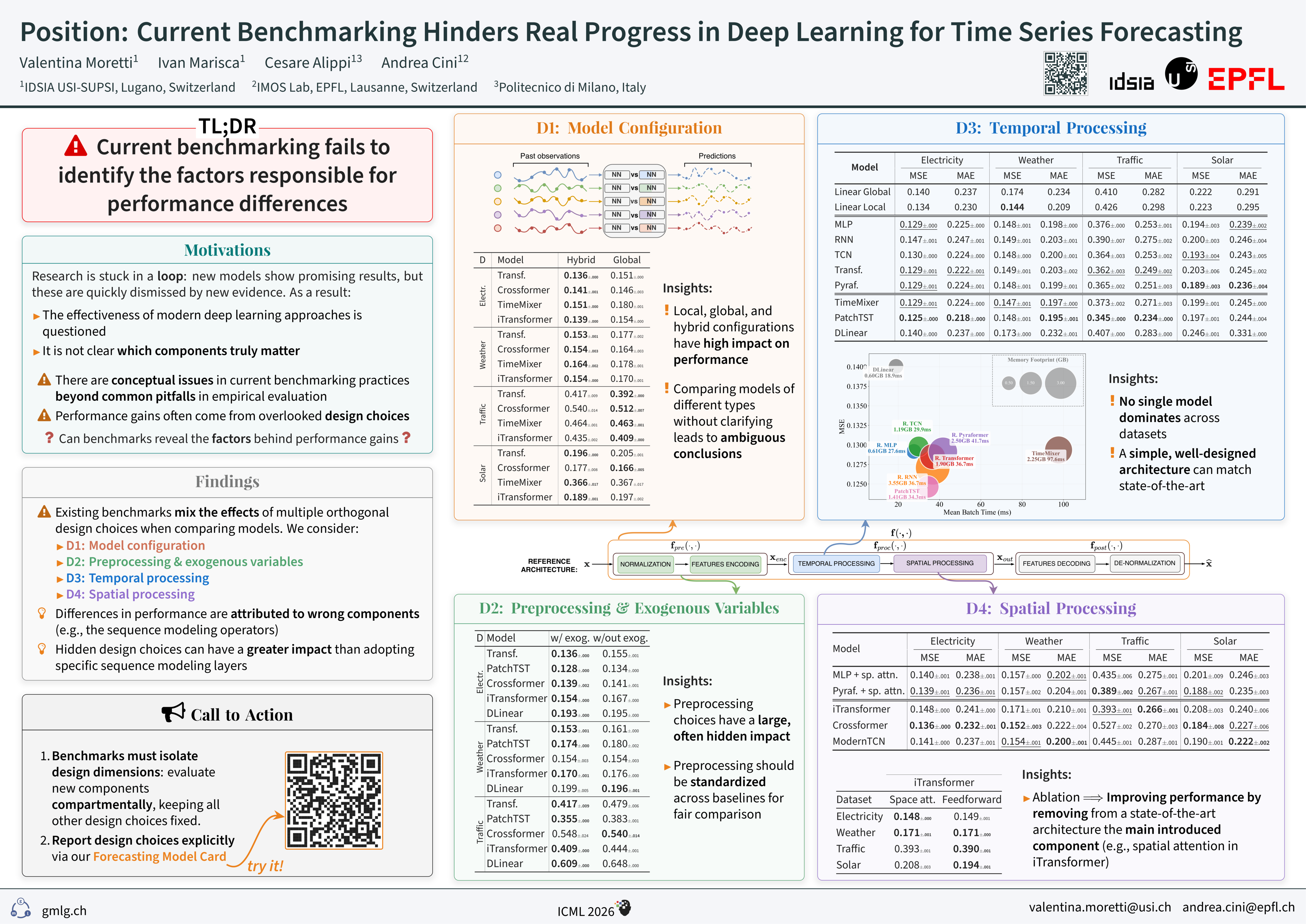
Deep learning models have grown popular in time series applications. However, the large quantity of newly proposed architectures and the often contradictory empirical results make it difficult to assess which design choice and model component drives performance. In this position paper, we argue that current benchmarking practices fail to identify the factors responsible for performance differences, thus slowing down progress in the field. In particular, differences in crucial design dimensions are overlooked when comparing architectures, ultimately leading to inconsistent outcomes. To support our position, we show that such differences—often treated as mere implementation details—can have a greater impact than adopting specific sequence modeling layers. We discuss how overlooked aspects (such as globality and locality) can (1) fundamentally change the class of the forecasting method and (2) drastically affect empirical results. Our findings suggest rethinking our benchmarking practices and focusing on the foundational aspects of the forecasting problem when designing and comparing architectures. As a concrete step, we propose an auxiliary forecasting model card, i.e., a template with a set of fields to characterize existing and new forecasting architectures based on key design choices.