
Position: Adopting AI in Practice Does Not Guarantee the Productivity Boost
Abstract
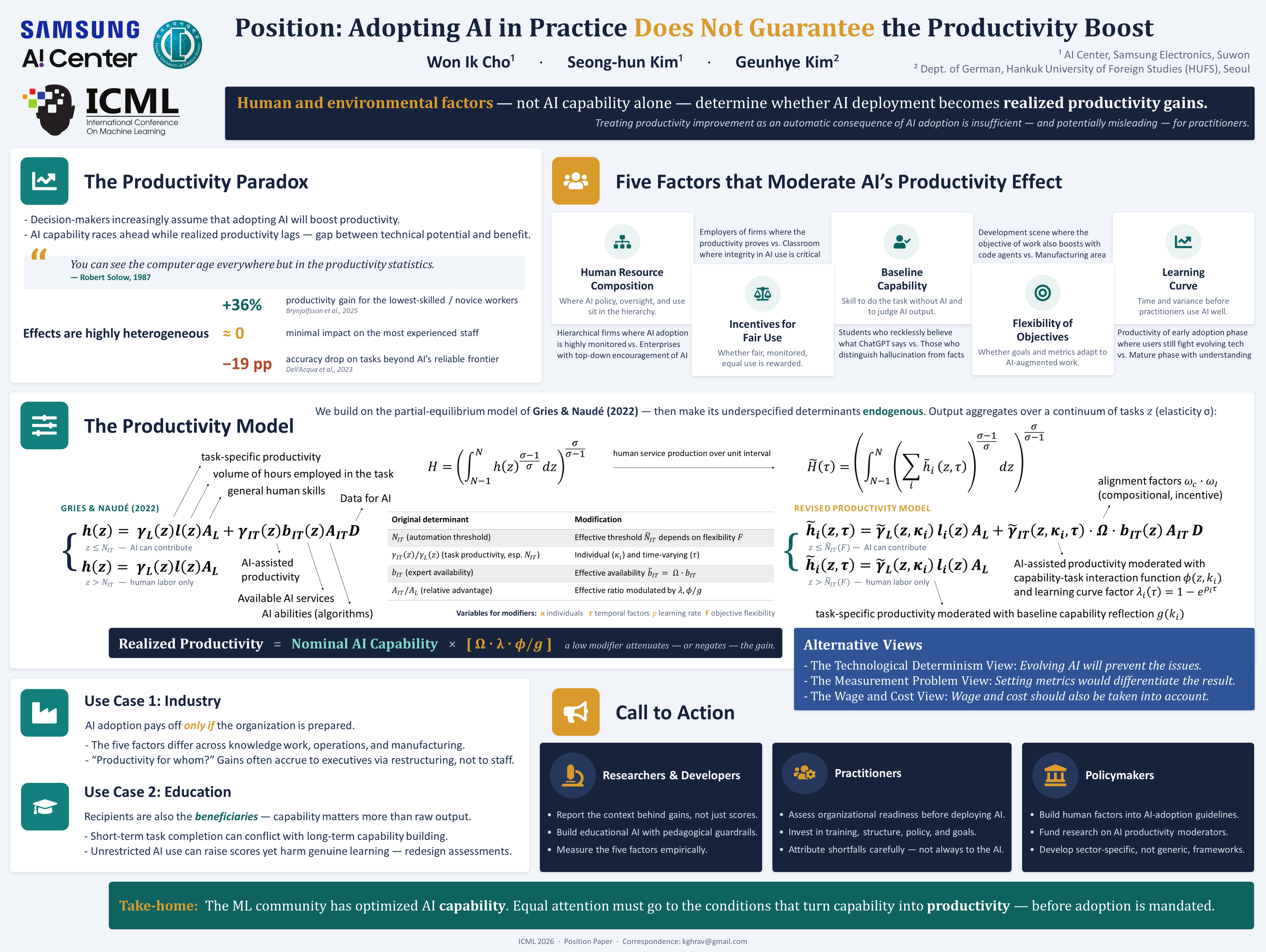
This position paper argues that adopting AI in organizational practice does not guarantee productivity gains, because human and environmental factors critically moderate the relationship between AI deployment and realized productivity improvements. Following the advent of high-performance generative models, AI use has been rapidly encouraged in some sectors while being restricted in others. Most practitioners assume that AI brings productivity boosts owing to enhanced technical capabilities, but regardless of apparent performance advances in AI technology, human and environmental factors of the organization may substantially attenuate---or even negate---the effective productivity benefits. We identify five key moderating factors: human resource composition, baseline capability of individuals, learning curve of practitioners, incentives for fair use, and flexibility of objectives. Drawing on the partial equilibrium model of Gries and Naudé (2022), we argue that existing economic frameworks may inadvertently overlook these factors. We revise the existing framework to redefine effective organizational determinants and shed light to practical implications including industry and education, responding to alternative views and calling for action of stakeholders.