
Position: Unlabeled ≠ No Human Supervision in Visual Learning
Abstract
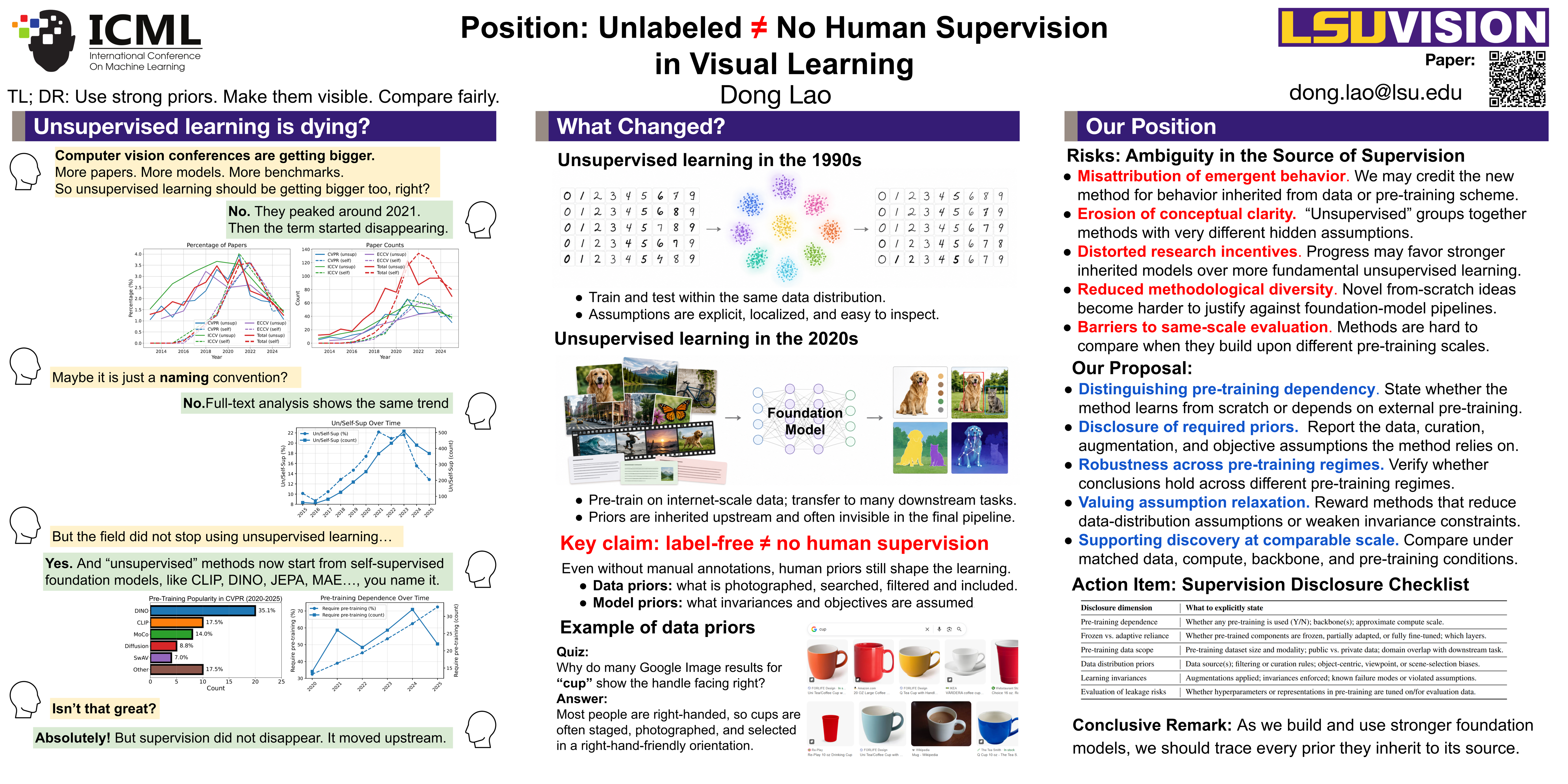
This position paper argues that the absence of labels does not imply the absence of human supervision in visual learning, and therefore urges the research community to explicitly identify sources of supervision, rather than grouping all label-free approaches under the umbrella term "unsupervised". Many recent methods in computer vision build upon pre-trained representations learned from large-scale unlabeled data, and are therefore regarded as requiring no human supervision. We argue that this view conflates label-free learning with human-free learning, as data curation and filtering inevitably embed substantial human priors on which modern learning systems rely. This confusion risks gatekeeping fundamental unsupervised learning research, a trend reflected in the surprising decline of the term “unsupervised” in paper titles following the rise and widespread adoption of self-supervised pre-training, despite continued growth of the field. Rather than questioning the legitimacy of foundational pre-training within unsupervised learning, we advocate for greater conceptual clarity by encouraging authors to disclose data distribution priors and data-selective biases, and to specify which components of a learning pipeline depend on which assumptions. Standardized disclosure practices can improve academic communication, ensure fairer comparisons, and preserve methodological diversity in unsupervised learning.