
Position: LLMs Should Incorporate Explicit Mechanisms for Human Empathy
Abstract
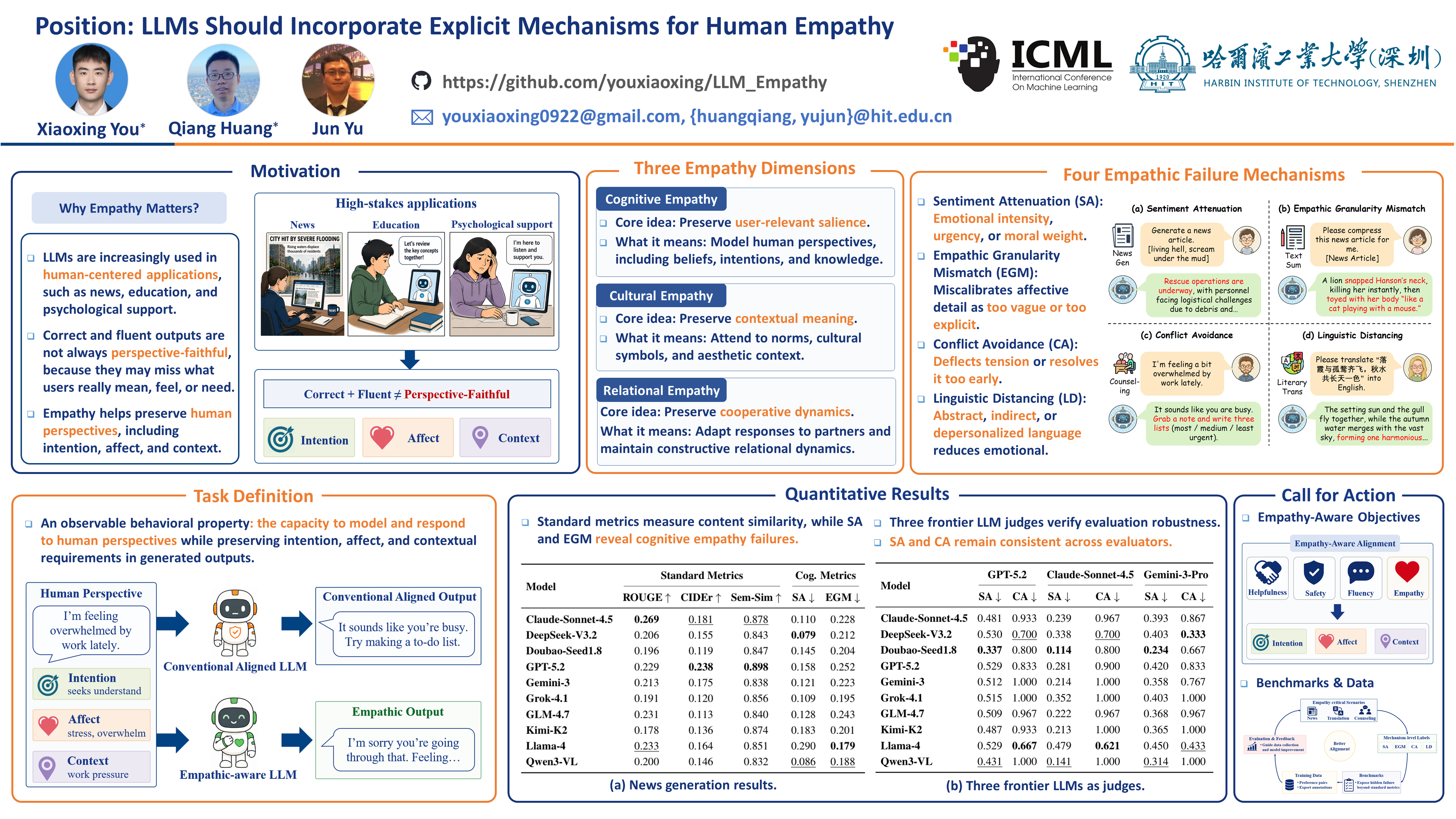
This position paper argues that Large Language Models (LLMs) should incorporate explicit mechanisms for human empathy. As LLMs become increasingly deployed in high-stakes human-centered settings, their success depends not only on correctness or fluency but on faithful preservation of human perspectives. Yet, current LLMs systematically fail at this requirement: even when well-aligned and policy-copliant, they often attenuate affect, misrepresent contextual salience, and rigidify relational stance in ways that distort meaning. We formalize empathy as an observable behavioral property: the capacity to model and respond to human perspectives while preserving intention, affect, and context. Under this framing, we identify four recurring mechanisms of empathic failure in contemporary LLMs--sentiment attenuation, empathic granularity mismatch, conflict avoidance, and linguistic distancing--arising as structural consequences of prevailing training and alignment practices. We further organize these failures along three dimensions: cognitive, cultural, and relational empathy, to explain their manifestation across tasks. Empirical analyses show that strong benchmark performance can mask systematic empathic distortions, motivating empathy-aware objectives, benchmarks, and training signals as first-class components of LLM development.