
Position: Zeroth-Order Optimization in Deep Learning Is Underexplored, Not Underpowered
Abstract
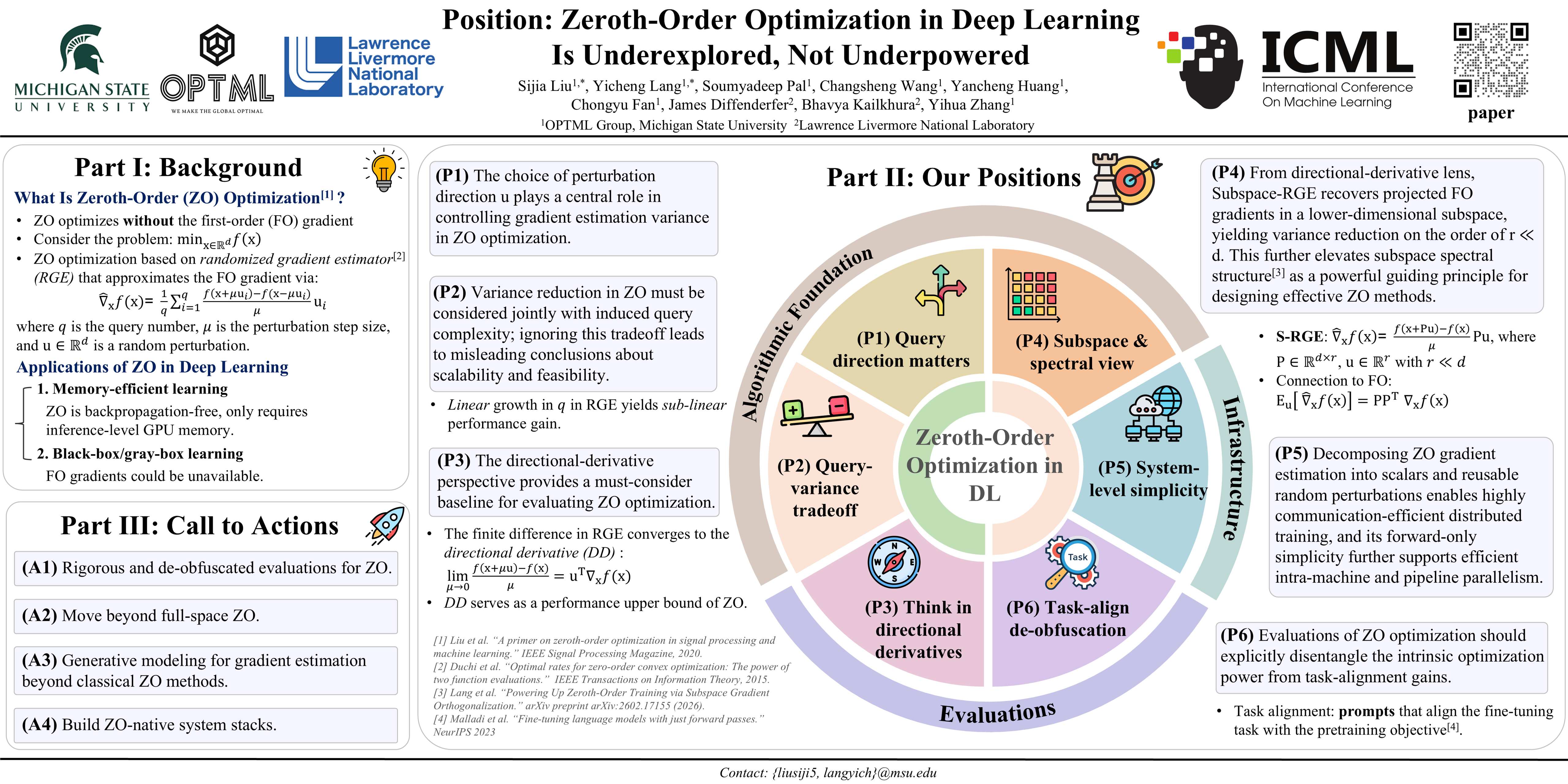
Zeroth-order (ZO) optimization, learning from finite differences of function evaluations without backpropagation, has recently regained attention in deep learning due to its memory efficiency and applicability to gray- or black-box pipelines. Yet, ZO methods are often dismissed as fundamentally unscalable because of estimator variance and unfavorable query complexity. We argue that this conclusion might be misguided: ZO optimization is underexplored, not underpowered. We show that many perceived limitations stem from myopic development practices, most notably full-space, element-wise, estimator-centric designs. We articulate six positions spanning the algorithmic, systems, and evaluation stack. First, we revisit the feasibility boundaries of estimator-centric ZO methods through variance control, variance–query tradeoffs, and directional-derivative lenses. Then, we identify three underexplored opportunities: (i) subspace and spectral views of ZO that enable interpretable variance reduction with graceful query scaling, (ii) the forward-only nature of ZO as a systems advantage for communication-efficient, pipeline-friendly, and resource-constrained training, and (iii) the need to de-obfuscate ZO evaluations from task complexity. We strongly advocate rethinking ZO optimization around its unique strengths and acting accordingly, opening a viable path toward large-scale, system-aware, and resource-efficient learning with ZO optimization.