
HInT: Hypergraph Infusion at the Structural Layers Improves Table Understanding
Abstract
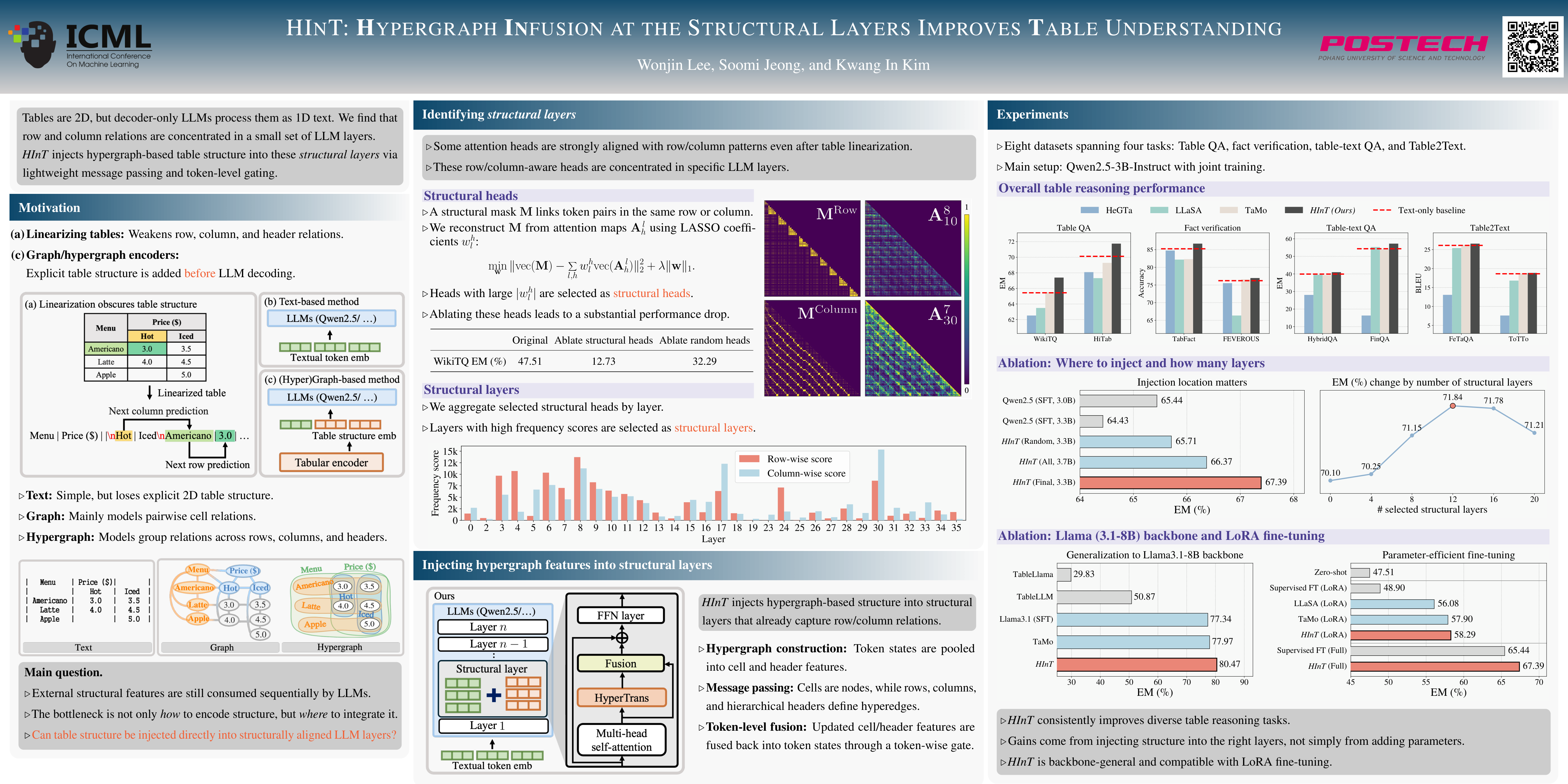
Decoder-only large language models (LLMs) struggle with table reasoning because tables must be serialized, which can obscure row- and column-level structure. Prior graph and hypergraph approaches encode structure with an external encoder, but their gains are often inconsistent under autoregressive decoding. We analyze how tabular structure is represented inside decoder-only LLMs and find that row and column relations are concentrated in a small subset of layers and attention heads. Based on this observation, we propose HInT (Hypergraph Infusion for Table reasoning), which injects hypergraph-derived structural features directly into the layers where these relations are concentrated. HInT constructs a table hypergraph over cells and headers, applies lightweight message passing, and fuses the resulting structural features with token hidden states through gated fusion. Experiments across diverse table reasoning tasks show consistent improvements over text-only baselines and prior (hyper)graph-based methods.
Lay Summary
Tables are used in many real-world domains, but they remain difficult for language models to handle because tables are two-dimensional, while language models process inputs as one-dimensional token sequences. When tables are flattened into text, important row, column, cell-level, and header relationships can be obscured. Recent methods try to capture this structure using graph or hypergraph encoders. However, in decoder-only LLMs, the encoded structural information is still consumed through serialized autoregressive decoding, which can limit how effectively the model uses it. We find that decoder-only LLMs already encode table structure, but row- and column-level relations are concentrated in only a small number of layers and attention heads. This motivates HInT (Hypergraph Infusion for Table Reasoning), which injects explicit hypergraph-based structural information into the internal layers identified by our analysis. HInT constructs a table hypergraph over cells and headers, connecting them through row, column, and hierarchical relationships. It then applies lightweight message passing and fuses the resulting structural features with the model's token hidden states through gated fusion. Experiments across diverse table reasoning tasks show consistent improvements over text-only baselines and prior graph- and hypergraph-based methods.