
Discovering Ordinary Differential Equations with LLM-Based Qualitative and Quantitative Evaluation
Abstract
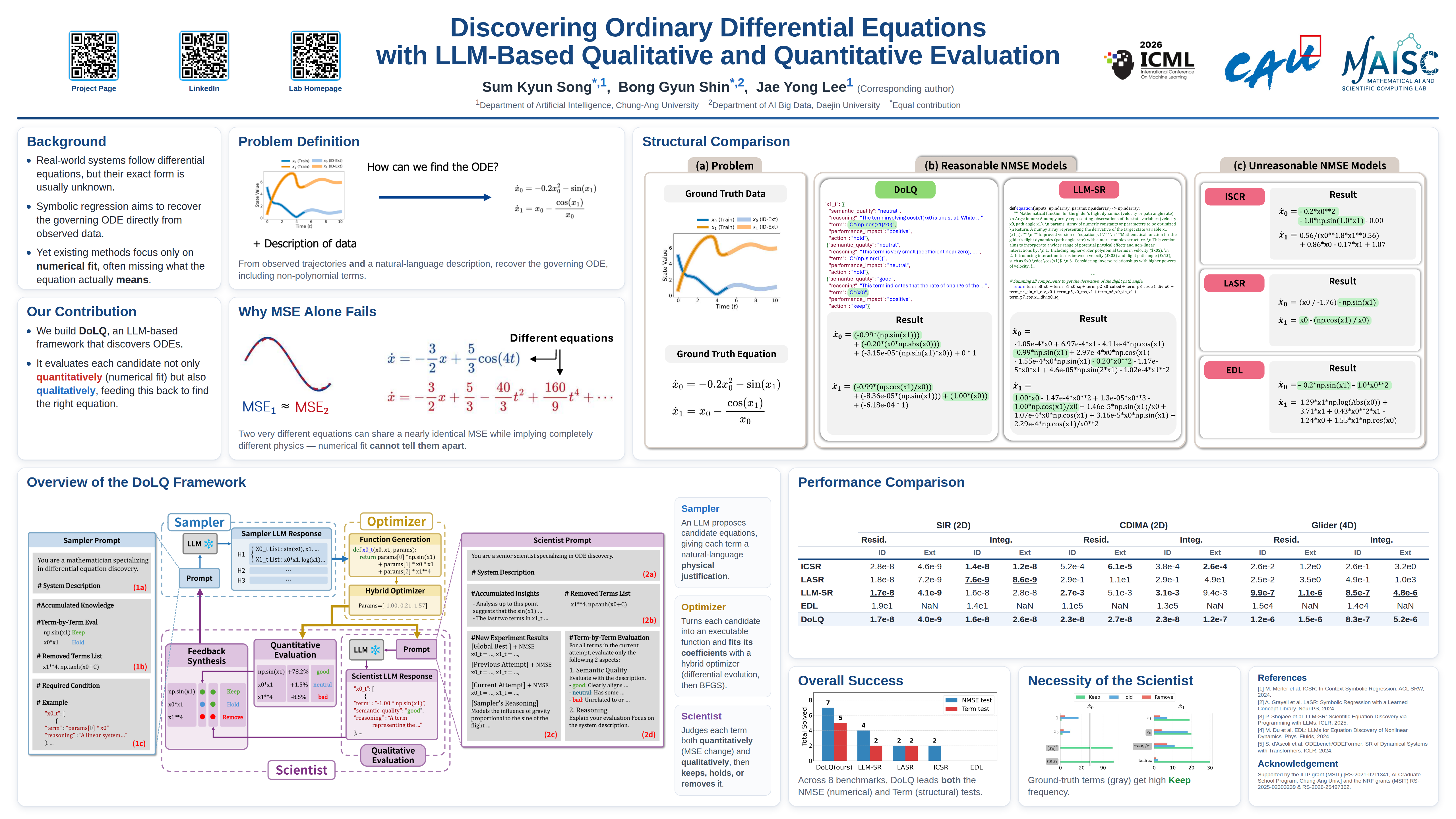
Discovering governing differential equations from observational data is a fundamental challenge in scientific machine learning. Existing symbolic regression approaches rely primarily on quantitative metrics; however, real-world differential equation modeling also requires incorporating domain knowledge to ensure physical plausibility. To address this gap, we propose DoLQ, a method for discovering ordinary differential equations with LLM-based qualitative and quantitative evaluation. DoLQ employs a multi-agent architecture: a Sampler Agent proposes dynamic system candidates, a Parameter Optimizer refines equations for accuracy, and a Scientist Agent leverages an LLM to conduct both qualitative and quantitative evaluations and synthesize their results to iteratively guide the search. Experiments on multi-dimensional ordinary differential equation benchmarks demonstrate that DoLQ achieves superior performance compared to existing methods, not only attaining higher success rates but also more accurately recovering the correct symbolic terms of ground truth equations. Our code is available at https://github.com/Bon99yun/DoLQ.
Lay Summary
Scientists want to understand how systems like disease outbreaks or flying objects evolve over time using mathematical rules called differential equations. In many real-world cases, these equations are unknown and must be inferred from observed data. Existing AI methods judge candidate equations almost entirely by numerical fit — but two equations can match the data equally well while describing completely different physical phenomena. This means a numerically accurate equation can still be physically wrong. We propose DoLQ, a framework that discovers differential equations by combining numerical accuracy with physical reasoning. Three AI agents collaborate: one proposes candidate equation terms, one optimizes their numerical parameters, and one evaluates whether each term is both accurate and physically meaningful. Terms that fit the data but violate physical common sense are discarded early, keeping the search focused. Tested across diverse dynamical systems including disease spread models and flight dynamics, DoLQ recovers the correct governing equations more reliably than existing methods. It also produces more compact, interpretable equations by avoiding unnecessary terms. This brings us closer to AI systems that can help scientists automatically derive trustworthy physical laws from experimental data.