
Beyond Looking Up, Try Looking Around: Harmonizing Global Structure and Local Consistency in Optimal Transport for Short Text Clustering
Abstract
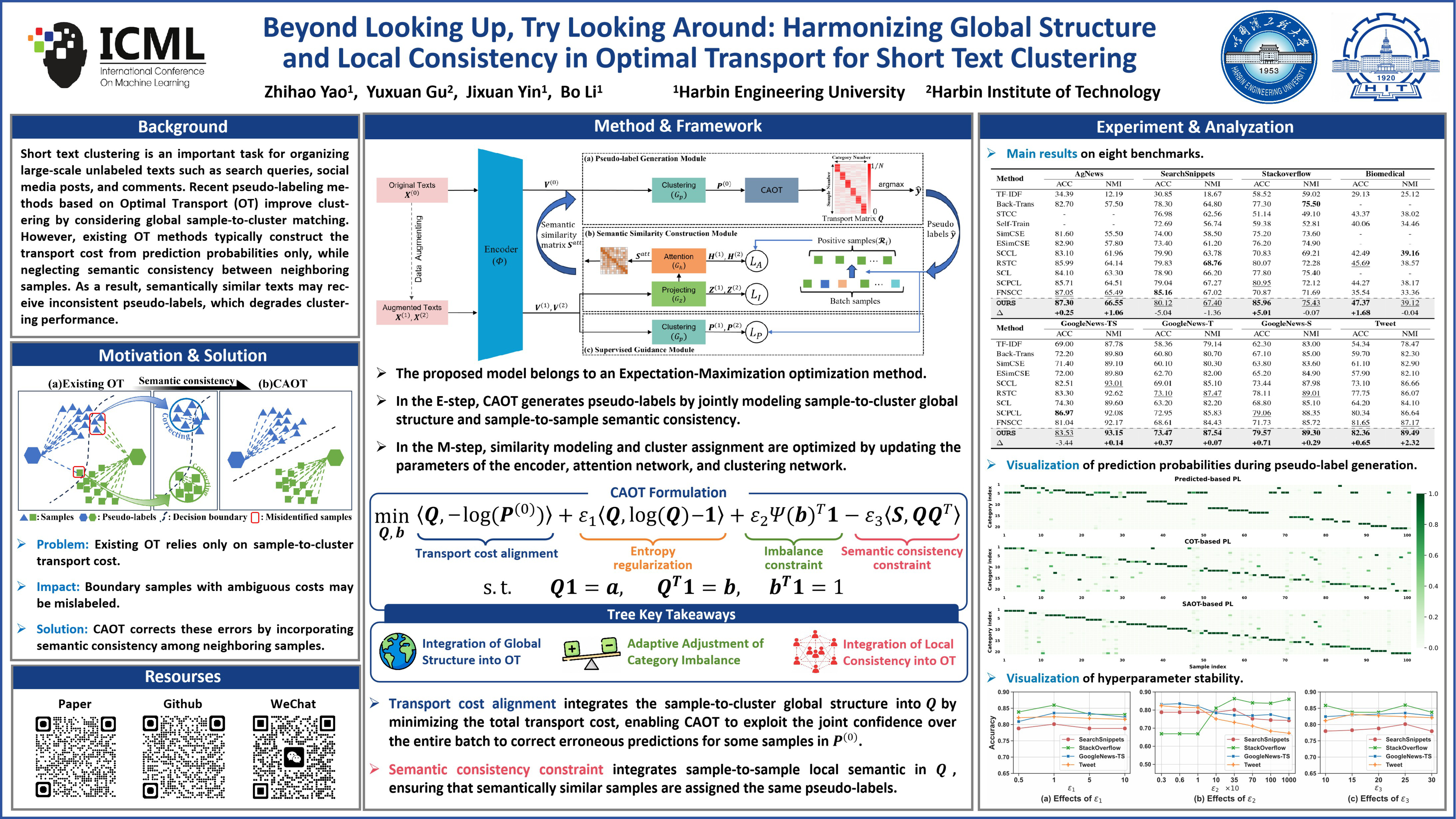
Pseudo-labeling based on Optimal Transport (OT) has become an effective mechanism for enhancing short text clustering. Existing OT methods are short in modeling semantic consistencies between samples, which may assign different pseudo-labels to semantically similar samples. These erroneous pseudo-labels can cause the model to produce inferior clusters. This paper proposes a novel short text clustering framework, which remedies the neglect of semantic consistency in existing OT methods, generating reliable pseudo-labels to facilitate clustering. Specifically, the proposed approach first designs an instance-level attention mechanism to capture semantic relationships between samples, which are then integrated into the OT formulation to endow the transport process with neighborhood semantic awareness. By solving the proposed OT formulation, reliable pseudo-labels are obtained that simultaneously account for sample-to-sample semantic consistency and sample-to-cluster global structure information. These pseudo-labels are then used as supervisory signals to guide the model to achieve accurate clustering. Extensive experiments demonstrate that the proposed approach outperforms state-of-the-art methods. The code is available at: https://github.com/YZH0905/CAOT-STC.
Lay Summary
Every day, people produce huge amounts of short text, such as search queries, social media posts, comments, and user feedback. Automatically grouping these short texts by meaning can help discover public trends, understand user needs, and organize information more efficiently. However, short texts often contain very limited words, making it difficult for computers to judge whether two texts are talking about the same topic. This paper studies how to improve automatic short text grouping without relying on large amounts of human-labeled data. Existing methods often assign temporary labels to texts during training, but they may give different labels to texts that actually have similar meanings. To address this problem, we design a method that not only considers which group each text should belong to, but also checks whether nearby texts are semantically consistent with each other. In this way, texts with similar meanings are more likely to be grouped together. Experiments show that our method produces more reliable temporary labels and leads to more accurate text grouping than existing approaches. This research can support applications such as topic discovery, online comment analysis, search result organization, and intelligent information management.