
Reliability-Aware LLM Alignment from Inconsistent Human Feedback
Jingyi Huang ⋅ Ruohan Zong ⋅ Yujun Feng ⋅ Liran Ma ⋅ Lanyu Shang ⋅ Yang Zhang
Abstract
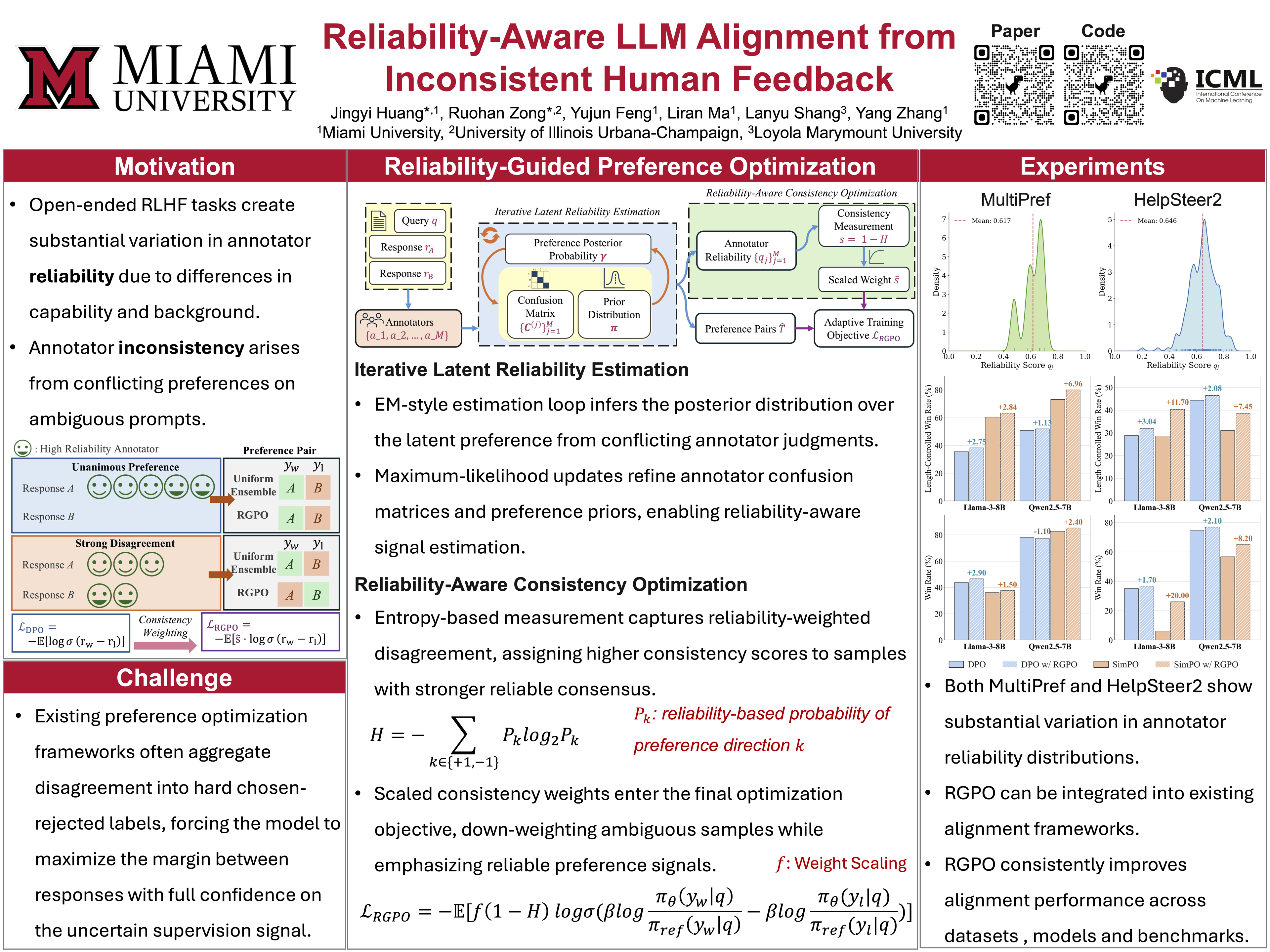
Reinforcement Learning from Human Feedback (RLHF) is critical for aligning Large Language Models (LLMs) with human preferences. However, its efficacy is often compromised by the inherent inconsistency and subjectivity of human annotations. Existing preference optimization frameworks, such as Direct Preference Optimization (DPO), typically treat ambiguous pairs with high annotator disagreement identically to those with unanimous consensus, forcing models to overfit to inconsistent supervision signals and leading to suboptimal alignment. In this work, we propose $\textit{Reliability-Guided Preference Optimization}$ (RGPO), a robust framework designed to mitigate the impact of inconsistent human feedback. RGPO estimates annotator reliability and infers latent ground truth labels from noisy human feedback to identify robust preferences. Furthermore, we introduce a reliability-aware consistency optimization that dynamically modulates the training objective based on the consensus level of annotations, ensuring the model prioritizes high-consensus supervision signals. Extensive experiments on LLM alignment benchmarks demonstrate that RGPO effectively reduces inconsistency and noise in training data and achieves superior performance compared to widely adopted RLHF baselines. Our code and configurations are available at https://github.com/GenieHuang/RGPO.
Lay Summary
AI assistants are often trained with feedback from humans. However, some tasks are subjective, and different people may have different standards. As a result, people may not always agree on which AI response is better. If a model treats all feedback as equally reliable, it may learn from conflicting examples, making its behavior less aligned with human preferences. We propose a method to reduce the impact of inconsistent human feedback. Our method estimates how reliable the feedback is, infers a more robust underlying preference, and allows the model to focus more on examples where people show strong agreement. The proposed framework can help build more robust and consistent AI systems that align better with human preferences.
Video
Chat is not available.
Successful Page Load