
SciAgentGym: Benchmarking Multi-Step Scientific Tool-Use in LLM Agents
Abstract
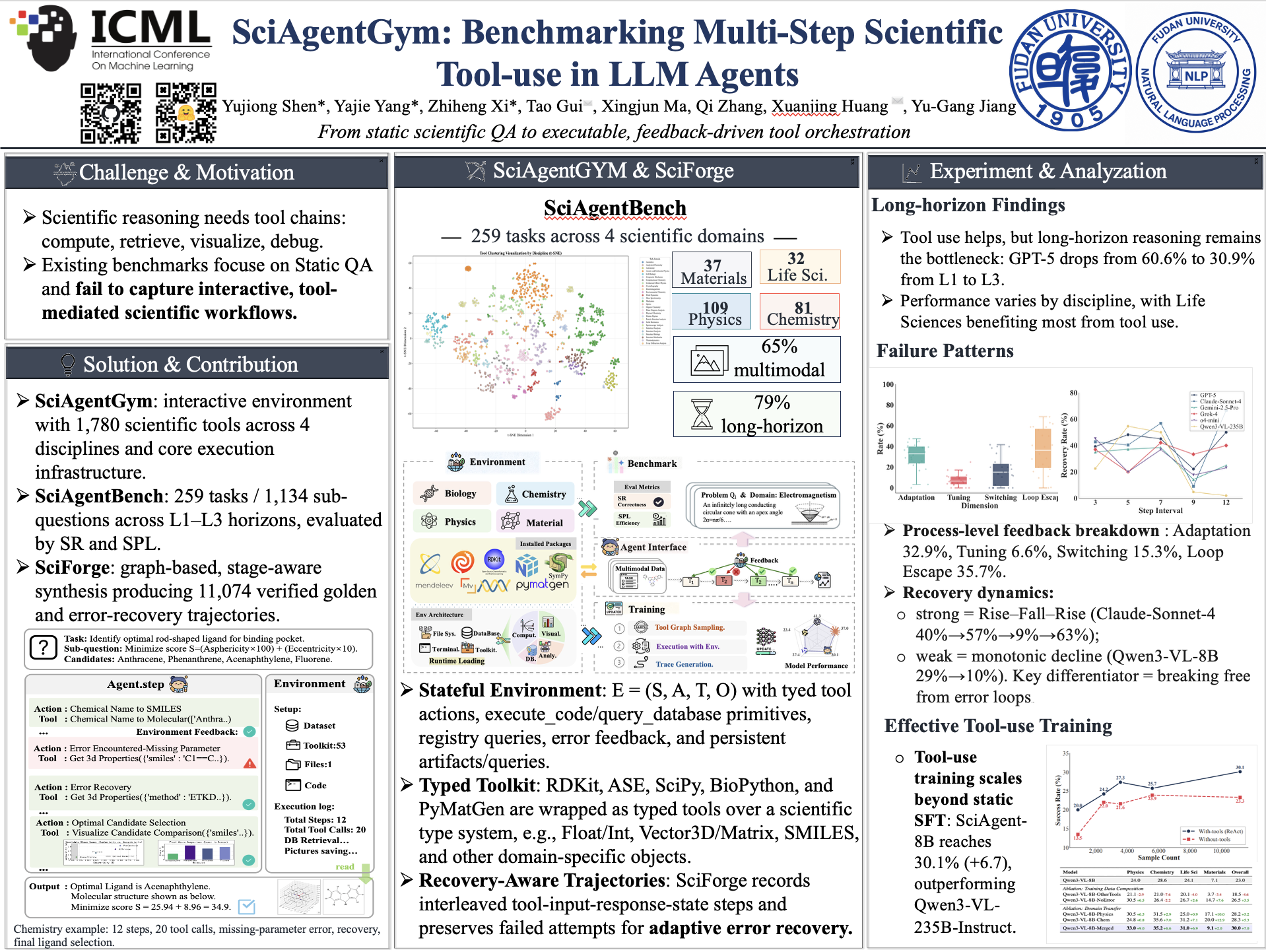
Scientific reasoning inherently demands integrating sophisticated toolkits to navigate domain-specific knowledge. Yet, current benchmarks largely overlook agents' ability to orchestrate tools for such rigorous workflows. To bridge this gap, we introduce SciAgentGym, a scalable interactive environment featuring 1,780 domain-specific tools across four natural science disciplines, supported by a robust execution infrastructure. Complementing this, we present SciAgentBench, a tiered evaluation suite designed to stress-test agentic capabilities from elementary actions to long-horizon workflows. Our evaluation identifies a critical bottleneck: state-of-the-art models still struggle with complex scientific tool-use, and their performance degrades substantially as interaction horizons extend. To address this, we propose SciForge, a data synthesis method that models the tool action space as a dependency graph to generate logic-aware training trajectories. By fine-tuning on these trajectories, our SciAgent-8B outperforms the significantly larger Qwen3-VL-235B-Instruct while exhibiting positive cross-domain transfer of scientific tool-use capabilities. These results underscore the promising potential of next-generation autonomous scientific agents.
Lay Summary
AI systems are beginning to help with scientific work, but real scientific problems often require more than giving direct answers. They involve using specialized tools, checking results, correcting mistakes, and combining many steps. We introduce SciAgentGym, an environment for testing whether AI systems can use scientific tools across physics, chemistry, biology, and materials science. We also build SciAgentBench to measure how well they handle both short and long scientific workflows. Our experiments show that current leading models still struggle when tasks become longer and more complex. We further propose a way to create verified training examples from successful tool-use workflows, helping smaller models better organize and execute scientific workflows.