
Phy-CoSF: Physics-Guided Continuous Spectral Fields Reconstruction and Spectral Super-Resolution for Snapshot Compressive Imaging
Abstract
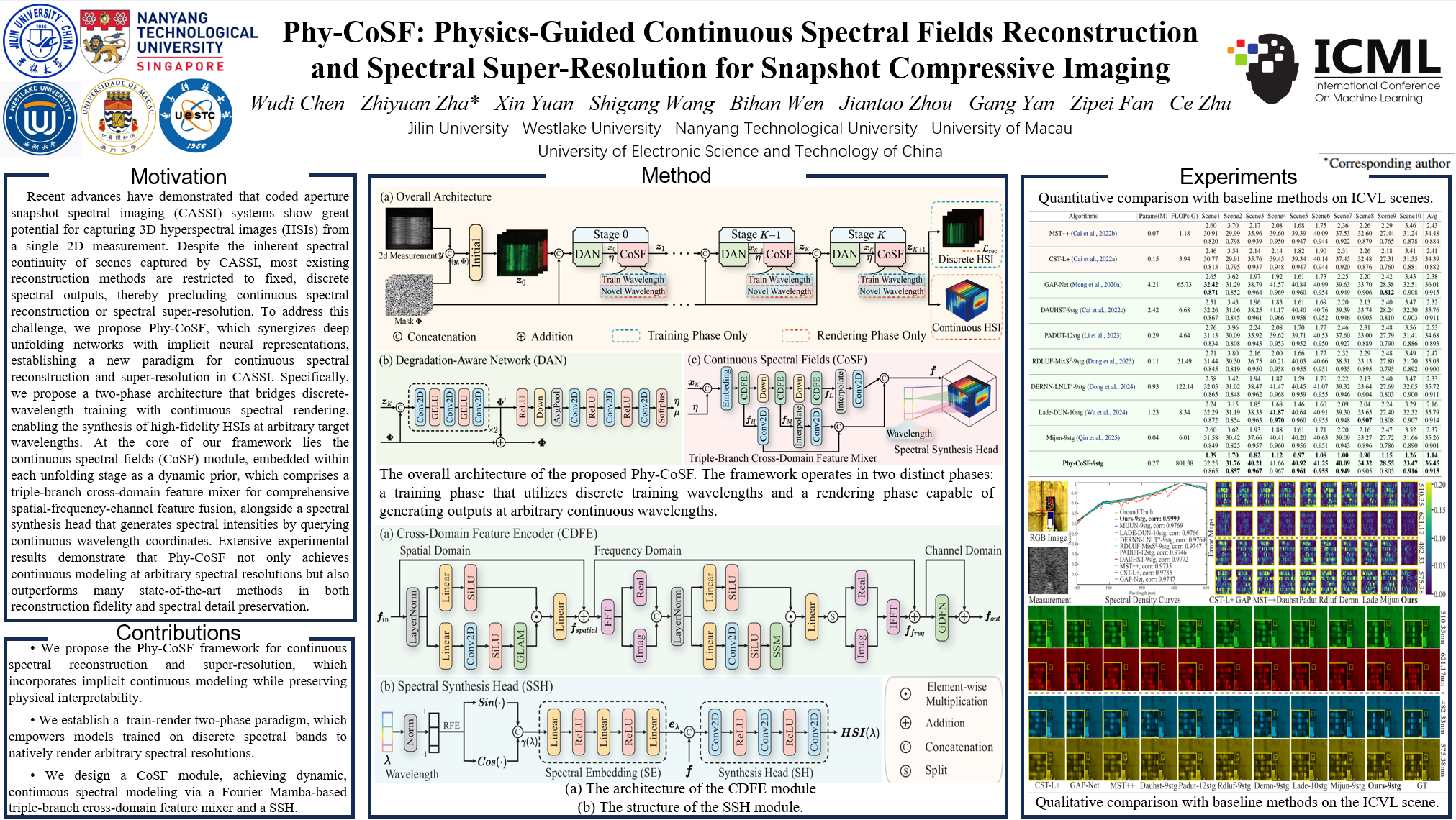
Recent advances have demonstrated that coded aperture snapshot spectral imaging (CASSI) systems show great potential for capturing 3D hyperspectral images (HSIs) from a single 2D measurement. Despite the inherent spectral continuity of scenes captured by CASSI, most existing reconstruction methods are restricted to fixed, discrete spectral outputs, thereby precluding continuous spectral reconstruction or spectral super-resolution. To address this challenge, we propose Phy-CoSF, which synergizes deep unfolding networks with implicit neural representations, establishing a new paradigm for continuous spectral reconstruction and super-resolution in CASSI. Specifically, we propose a two-phase architecture that bridges discrete-wavelength training with continuous spectral rendering, enabling the synthesis of high-fidelity HSIs at arbitrary target wavelengths. At the core of our framework lies the continuous spectral fields (CoSF) module, embedded within each unfolding stage as a dynamic prior, which comprises a triple-branch cross-domain feature mixer for comprehensive spatial–frequency–channel feature fusion, alongside a spectral synthesis head that generates spectral intensities by querying continuous wavelength coordinates. Extensive experimental results demonstrate that Phy-CoSF not only achieves continuous modeling at arbitrary spectral resolutions but also outperforms many state-of-the-art methods in both reconstruction fidelity and spectral detail preservation.
Lay Summary
Natural light contains rich, continuous spectral information crucial for fields like industrial inspection and remote sensing. Scientists often use special cameras to compress complex 3D hyperspectral data into a single 2D photo, but perfectly recovering all the spectral details from this single snapshot is incredibly challenging. Existing AI models act like a limited box of crayons, they can only reconstruct a fixed number of discrete bands, ignoring the continuous physical nature of light. To solve this, we built Phy-CoSF, a new system that seamlessly combines physical principles with artificial intelligence. Instead of memorizing fixed spectral channels, our model first grasps the overall spatial structure of the scene. Then, it precisely renders a high-fidelity image for any specific wavelength you ask for. This approach allows the computer to accurately synthesize images even at entirely new wavelengths it has never seen during training. This breakthrough shatters the computational bottlenecks of previous rigid technologies, providing a highly efficient and practical tool for real-world applications that rely on precise spectral data, such as accurate defect detection and environmental monitoring.