
Cross-View Lewis Weight Fusion Empowering Exemplar Replay for Federated Class-Incremental Learning
Abstract
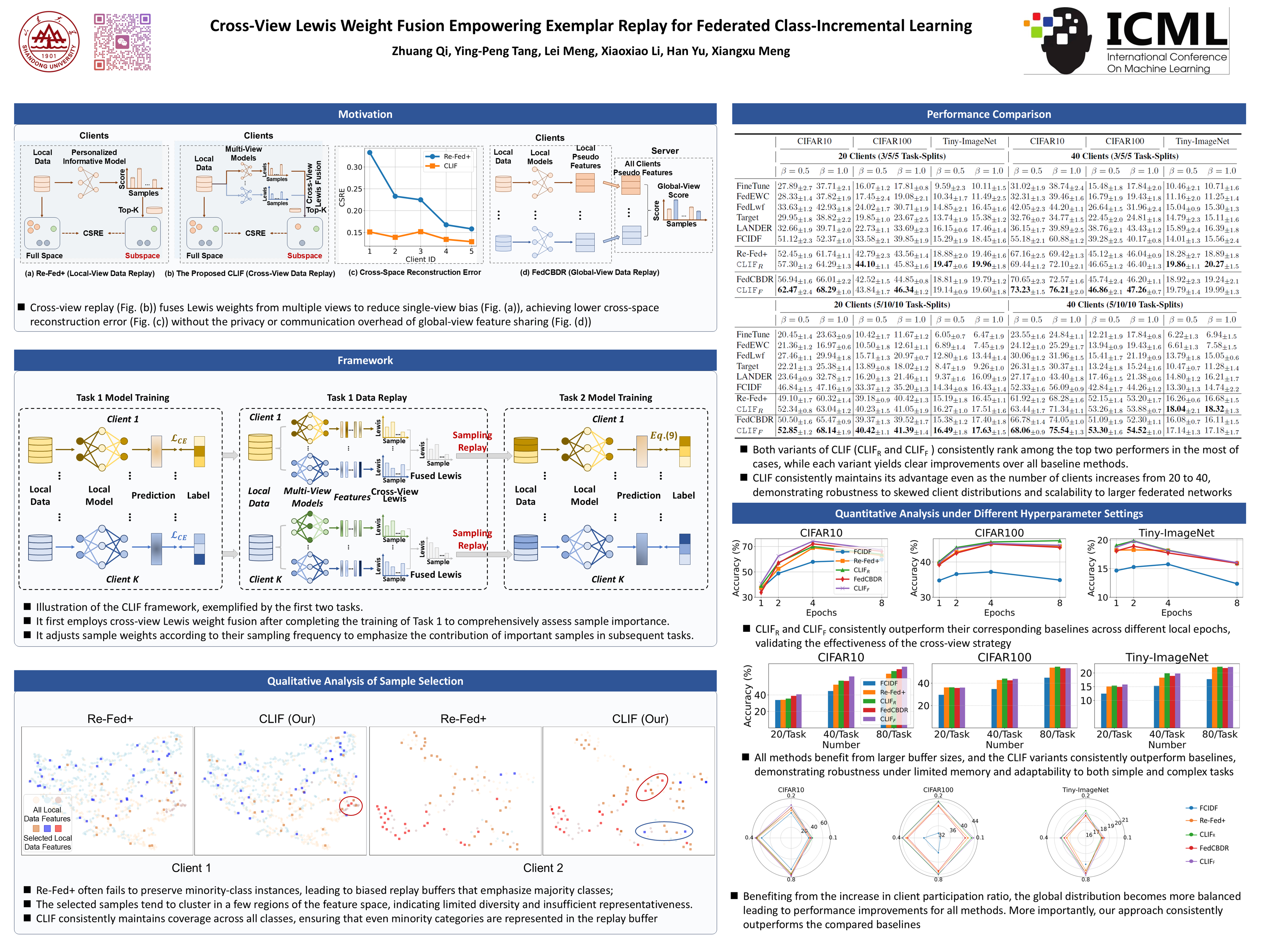
Federated Class-Incremental Learning (FCIL) aims to continually expand a model’s recognition capacity in a distributed environment, enabling it to learn new classes while retaining knowledge of previously seen ones. Exemplar replay has emerged as a promising strategy owing to its simplicity and effectiveness. Existing methods either select exemplars based on local dynamics or construct global feature spaces to identify representative samples. However, they face inherent challenges in striking a balance between effectiveness and privacy. To address this issue, this paper proposes a Cross-view Lewis weIght Fusion method for exemplar replay in FCIL, termed CLIF, which fuses multi-view importance scores to guide representative sample selection under federated settings. Specifically, CLIF consists of two main modules: 1) the cross-view Lewis weight fusion module computes and integrates Lewis weights from multiple feature perspectives to achieve consistent importance estimation, ensuring that the selected samples better reflect the global data distribution and thus enhancing the representativeness of the replay subset. Building on this, 2) the frequency-based weighted training module adjusts the loss contribution of each sample according to its selection frequency across views, which emphasizes the contribution of critical samples. Moreover, we provide a theoretical analysis to guarantee the soundness and effectiveness of CLIF. Extensive experiments on three datasets demonstrate that our method consistently improves baselines by 1%–6%, supporting the above claims.
Lay Summary
Machine learning systems often need to keep learning new things over time. For example, an image recognition model may first learn to identify several types of objects and later need to recognize new ones. However, when the model learns new categories, it may forget what it learned before. This problem becomes harder when data are stored across many users or organizations and cannot be collected in one place due to privacy concerns. In this work, we study how to help such models remember old knowledge while learning new classes. Our idea is to let each participant keep a small but useful set of examples from the past. Instead of choosing these examples from only one viewpoint, our method looks at the data from multiple perspectives and selects examples that are more representative of the overall data. It also gives more attention during training to examples that are repeatedly identified as important. Experiments on three datasets show that our method helps models retain knowledge better and improves performance over existing approaches. This can support more reliable learning systems in privacy-sensitive settings where data must remain distributed.