
Supervised Graph Contrastive Learning for Gene Regulatory Networks
Abstract
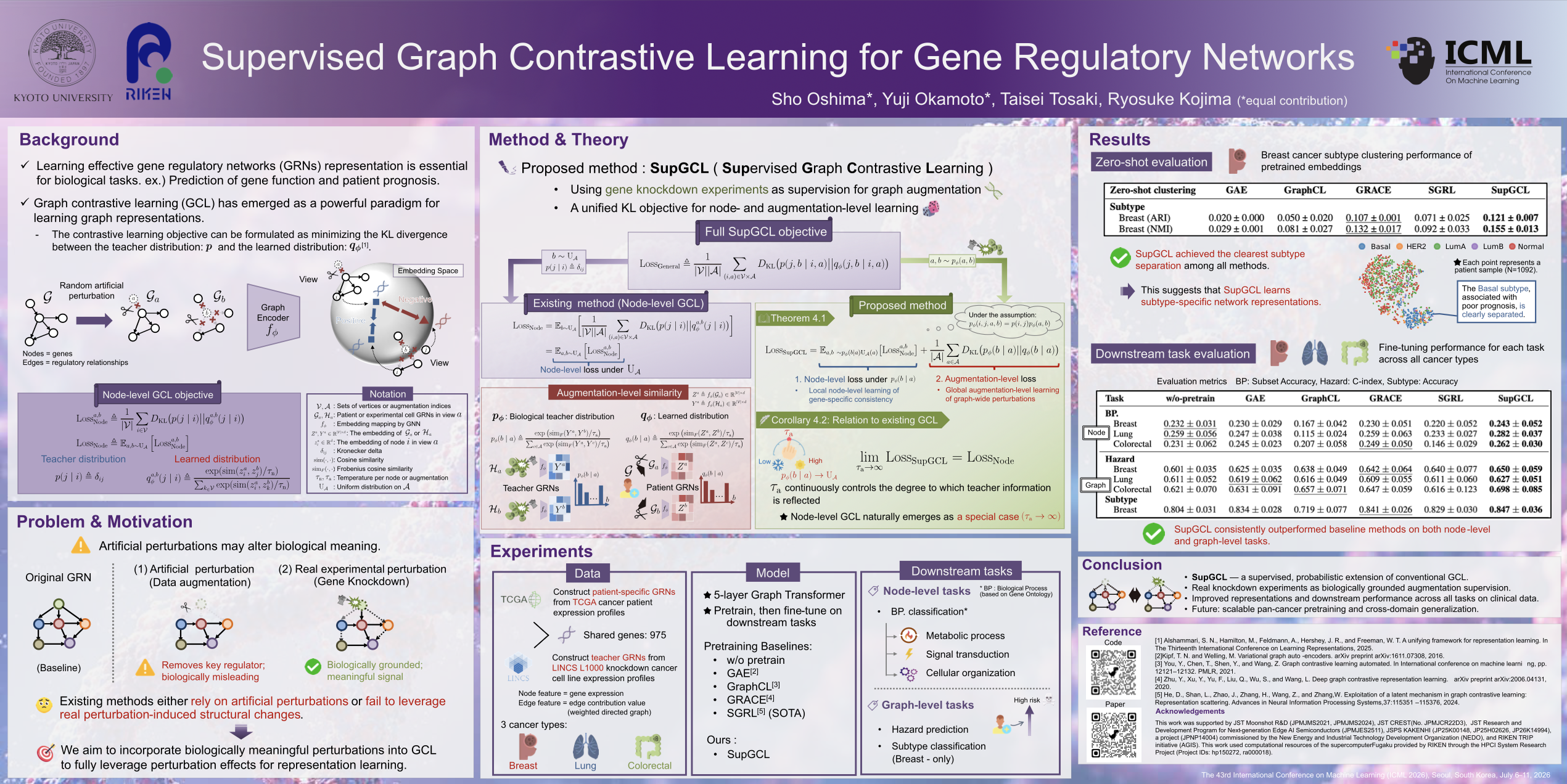
Graph Contrastive Learning (GCL) is a powerful self-supervised learning framework that performs data augmentation through graph perturbations, with growing applications in the analysis of biological networks such as Gene Regulatory Networks (GRNs). The artificial perturbations commonly used in GCL, such as node dropping, induce structural changes that can diverge from biological reality. This concern has contributed to a broader trend in graph representation learning toward augmentation-free methods, which view such structural changes as problematic and should be avoided. However, this trend overlooks the fundamental insight that structural changes from biologically meaningful perturbations are not a problem to be avoided, but rather a rich source of information, thereby ignoring the valuable opportunity to leverage data from real biological experiments. Motivated by this insight, we propose SupGCL (Supervised Graph Contrastive Learning), a new GCL method for GRNs that directly incorporates biological perturbations from gene knockdown experiments as supervision. SupGCL is a probabilistic formulation that continuously generalizes conventional GCL, linking artificial augmentations with real perturbations measured in knockdown experiments, and using the latter as explicit supervision. On patient-derived GRNs from three cancer types, we train GRN representations with SupGCL and evaluate it in two regimes: (i) embedding space analysis, where it yields clearer disease-subtype structure and improves clustering, and (ii) task-specific fine-tuning, where it consistently outperforms strong graph representation learning baselines on 13 downstream tasks spanning gene-level functional annotation and patient-level prediction.
Lay Summary
Genes form regulatory networks in cells, and some genes act as major control points. Many graph learning methods train by making small artificial changes to a network, such as deleting a gene (a node) or its links, and then treating the altered network as similar to the original. In gene networks, this is risky: deleting a minor gene may change little, but deleting one key control gene can reshape the network and create unrealistic training examples. We introduce SupGCL, which uses data from real gene knockdown experiments, not arbitrary deletions, to guide training. These experiments measure how a network changes when one gene’s activity is reduced. SupGCL uses these measurements as a teacher signal for simulated networks with removed genes or links. We tested SupGCL on networks from breast, lung, and colorectal cancer patients. It showed clearer subtype separation and achieved the highest score among the tested methods across all 13 evaluated tasks, including gene-function prediction, cancer-gene classification, breast-cancer subtype classification, and survival-risk ranking. With more cancer types and larger gene networks, this method can lead to general-purpose biological models that learn network changes across diseases.