
DTKG: Dual-Track Knowledge Graph-Verified Reasoning Framework for Multi-Hop QA
Abstract
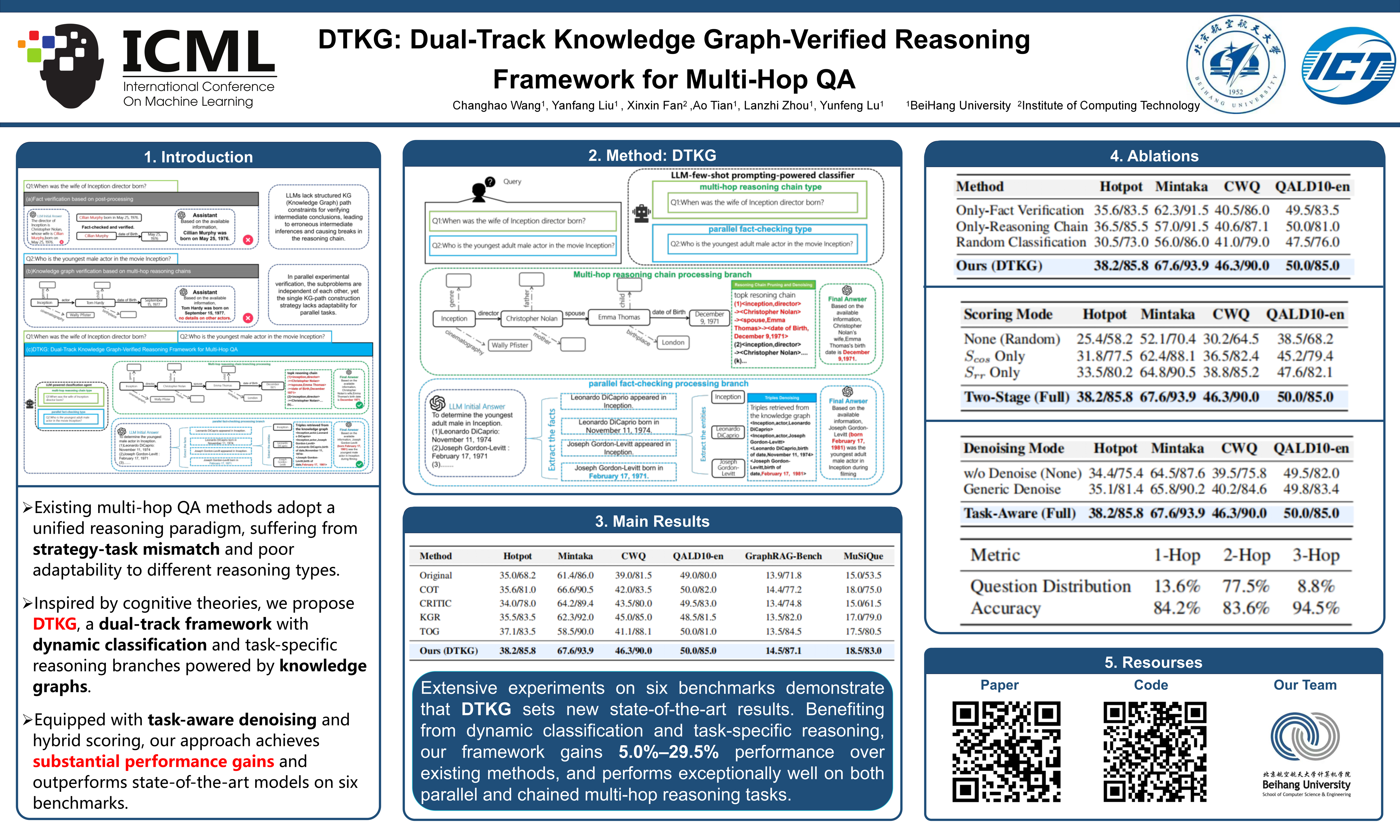
Multi-hop reasoning for question answering (QA) plays a critical role in retrieval-augmented generation (RAG) for large language models (LLMs). Based on inherent relation-dependency and reasoning patterns, it is categorized into parallel fact-verification (simultaneously verifying independent sub-questions) and chained reasoning (sequential multi-step inference). Existing approaches adopt either LLM-based fact verification or KG path-based chain construction, failing to handle both categories well: the former underperforms on chained reasoning, while the latter suffers from redundant paths in parallel tasks. Inspired by the Dual Process Theory in cognitive science and Stanovich’s Cognitive Misers Theory, we propose an effective multi-hop QA framework DTKG (Dual-Track Knowledge Graph) through building a two-stage pipeline: i) Classification Stage (dynamic question categorization via few-shot prompting, emulating "unconscious processing"); and ii) Branch Processing Stage (tailored reasoning paths, emulating "conscious processing"). Multi-facet experiments on six datasets show DTKG achieves 5.0\%-29.5\% performance improvement. The code is available at https://anonymous.4open.science/r/DTKG-621F
Lay Summary
When people ask complex questions that need connecting multiple facts—like “When was the wife of the director of Inception born?”—AI systems often struggle. Existing tools either check facts separately but break logical chains, or build long reasoning paths but waste effort on redundant steps. This leads to wrong answers or slow, inefficient computation. We created a simple, human-like solution called DTKG. It first quickly tells whether a question needs checking independent facts in parallel or following a step-by-step reasoning chain. Then it uses the best method for that type: verifying facts directly for parallel questions, and building clean, focused reasoning paths for chained ones. It also removes unhelpful information to stay accurate and efficient. Tests on six standard datasets show DTKG makes answers much more correct—improving performance by 5.0% to 29.5%—while working more reliably than current methods. This helps AI answer complex real-world questions more accurately and naturally for everyone.