
BALLAST: Bayesian Active Learning with Look-ahead Amendment for Sea-drifter Trajectories under Spatio-Temporal Vector Fields
Abstract
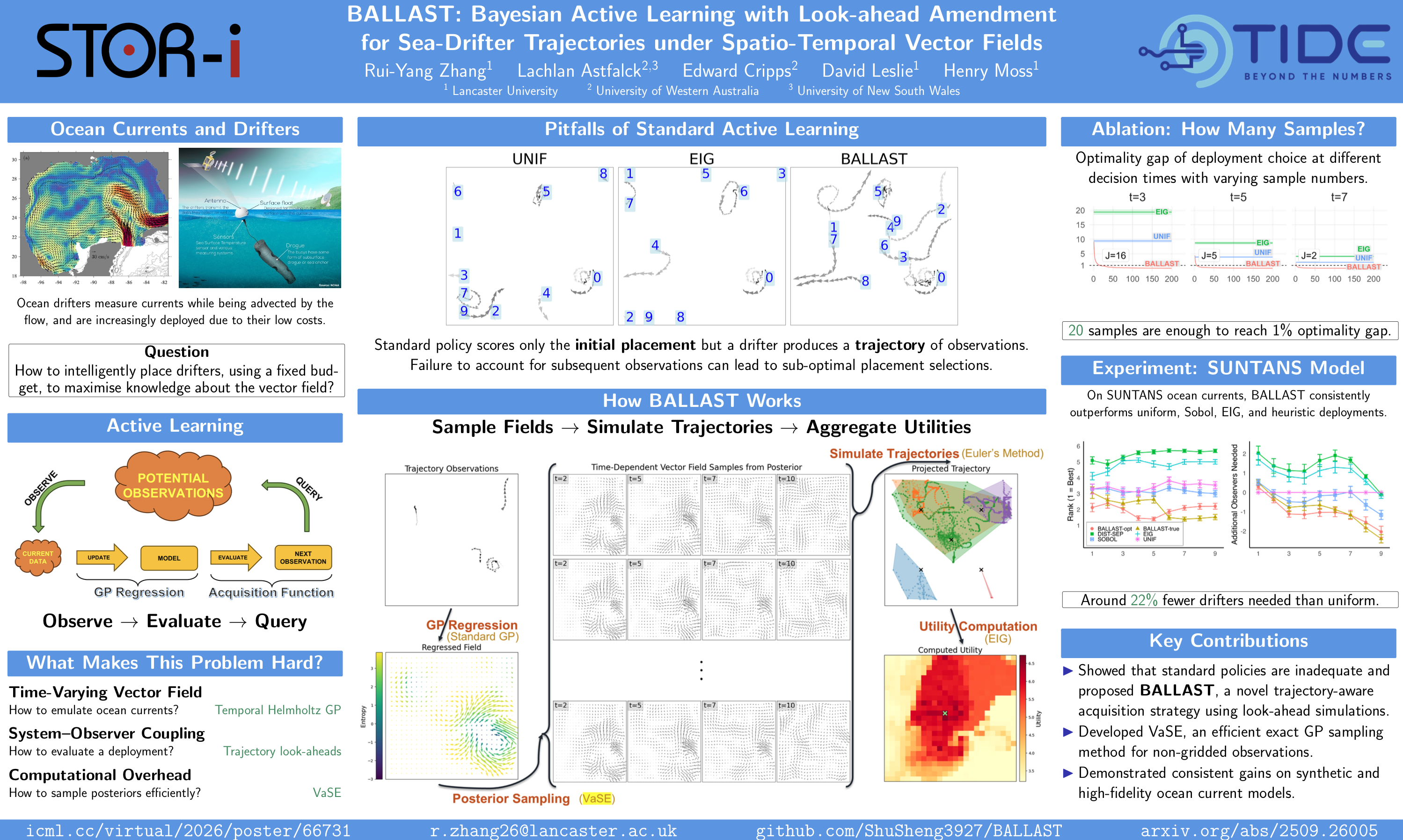
We introduce a formal active learning methodology for guiding the placement of Lagrangian observers to infer time-dependent vector fields -- a key task in oceanography, marine science, and ocean engineering -- using a physics-informed spatio-temporal Gaussian process surrogate model. The majority of existing placement campaigns either follow standard `space-filling' designs or relatively ad-hoc expert opinions. A key challenge to applying principled active learning in this setting is that Lagrangian observers are continuously advected through the vector field, so they make measurements at different locations and times. It is, therefore, important to consider the likely future trajectories of placed observers to account for the utility of candidate placement locations. To this end, we present BALLAST: Bayesian Active Learning with Look-ahead Amendment for Sea-drifter Trajectories. We observe noticeable benefits of BALLAST-aided sequential observer placement strategies on both synthetic and high-fidelity ocean current models. In addition, we developed a novel GP inference method -- the Vanilla SPDE Exchange (VaSE) -- to boost the GP posterior sampling efficiency, which is also of independent interest.
Lay Summary
Ocean currents play a central role in climate prediction, pollution tracking, marine ecosystems, and offshore engineering, but measuring them accurately remains difficult. Scientists often deploy floating sensors called drifters that move with the water, yet deciding where to place these instruments is still largely based on intuition or simple “spread-out” strategies. We introduce BALLAST, an AI-driven framework that chooses drifter deployment locations by accounting not only for where sensors are released, but also for how ocean currents will carry them over time. By combining physics-informed machine learning with forward-looking decision-making, BALLAST reconstructs evolving ocean currents more accurately than existing deployment strategies in both synthetic and realistic ocean simulations.