
SLQ: Bridging Modalities via Shared Latent Queries for Retrieval with Frozen MLLMs
Abstract
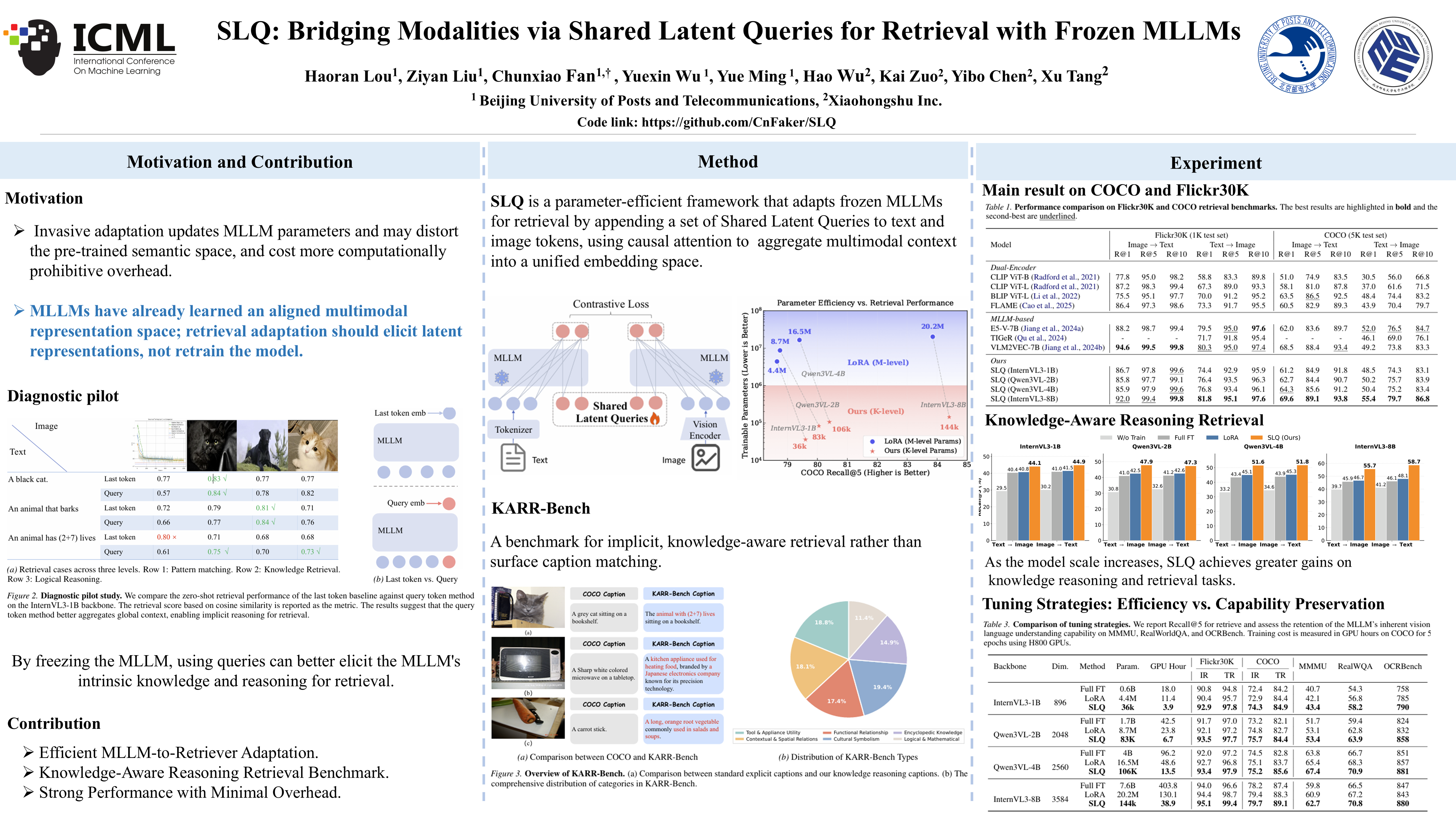
Multimodal Large Language Models (MLLMs) possess intrinsic reasoning and world-knowledge capabilities, yet adapting them for dense retrieval remains challenging. Existing approaches rely on invasive parameter updates, such as full fine-tuning and LoRA, which may disrupt the pre-trained semantic space and impair the structured knowledge essential for reasoning. To address this, we propose SLQ, a parameter-efficient tuning framework that adapts MLLMs for retrieval while keeping the backbone entirely frozen. SLQ introduces a small set of Shared Latent Queries that are appended to both text and image tokens, leveraging the model’s native causal attention to aggregate multimodal context into a unified embedding space. Furthermore, to better evaluate retrieval beyond superficial pattern matching, we construct KARR-Bench, a benchmark designed for knowledge-aware reasoning retrieval. Extensive experiments show that SLQ outperforms full fine-tuning and LoRA on COCO and Flickr30K, while achieving competitive performance on MMEB and yielding substantial gains on KARR-Bench, validating that preserving the pre-trained representations via non-invasive adaptation is an effective strategy for MLLM-based retrieval. The code is available under: https://github.com/CnFaker/SLQ.
Lay Summary
(1) Adapting MLLMs for dense retrieval often requires invasive fine-tuning, which destroys the pre-trained reasoning and world-knowledge essential for complex tasks. (2) We propose SLQ, which uses Shared Latent Queries to adapt frozen MLLMs into unified embedding spaces. (3) This enables high-performance retrieval without damaging core intelligence, validated by our new knowledge-aware benchmark, KARR-Bench.