
Order within Chaos: Capturing Intrinsic Energy Anomalies for AI-Manipulated Image Forgery Localization
Abstract
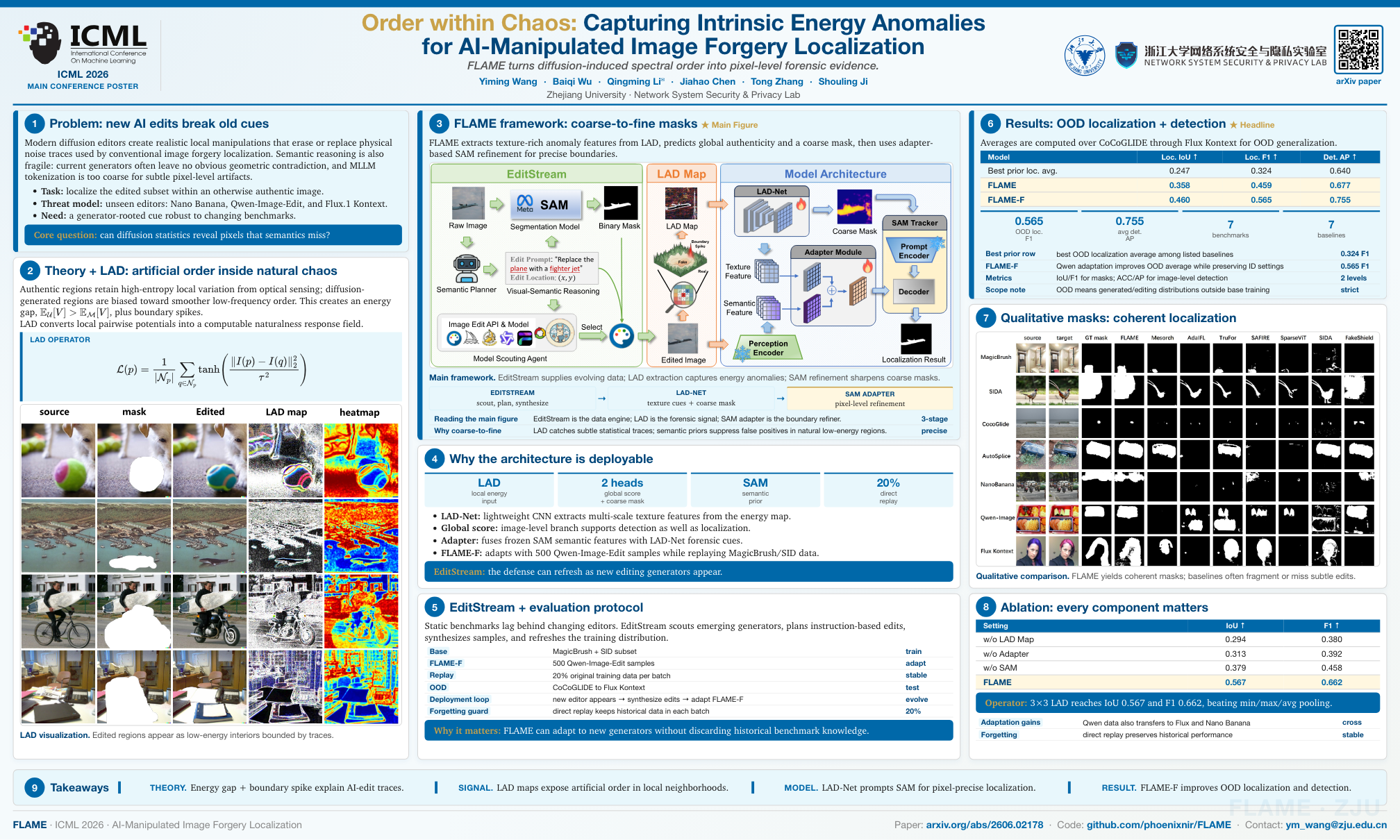
Recent advancements in generative AI have led to image editing models capable of producing realistic forgeries that evade traditional image forgery localization methods, as these approaches depend on physical noise absent in synthetic data. To address this challenge, we theoretically demonstrate that the diffusion process inherently suppresses local high-frequency variance, creating a statistical energy gap that is distinguishable from the natural entropy of optical imaging. Guided by this insight, we propose FLAME, a unified framework that utilizes a LAD map to capture these intrinsic anomalies, coupled with a parameter-efficient adapter for SAM to achieve precise, pixel-level forgery localization. Furthermore, to bridge the lag between forensic benchmarks and evolving generative models, we introduce EditStream, an automated pipeline for continuous, instruction-based training data synthesis. Extensive experiments demonstrate that FLAME establishes a new state-of-the-art, significantly outperforming previous methods on AI-generated forgery datasets while effectively generalizing to unseen generative architectures. Our code is available at https://github.com/phoenixnir/FLAME.
Lay Summary
Modern image-editing AI can change only part of a real photo, such as adding, removing, or replacing an object, while leaving the rest untouched. These edits can look convincing to people and can also fool older forensic tools that were designed for traditional copy-paste manipulation. Our work asks whether AI-generated regions leave more subtle clues. We found that, compared with camera-captured parts of an image, AI-edited regions often have different local texture patterns: they tend to be smoother inside and show small inconsistencies near the edited boundary. Based on this observation, we built FLAME, a system that first looks for these local statistical clues and then refines the result into a precise highlighted region showing which pixels were edited. We also built EditStream, a pipeline that automatically creates new training examples from recent image-editing models, helping the detector keep up as generative AI changes. This research can help journalists, platforms, and forensic analysts identify where an image has been manipulated, supporting safer and more trustworthy use of visual media.