
PhaseAlign: Complex Phase Alignment for Stable Open-Vocabulary Semantic Segmentation
Abstract
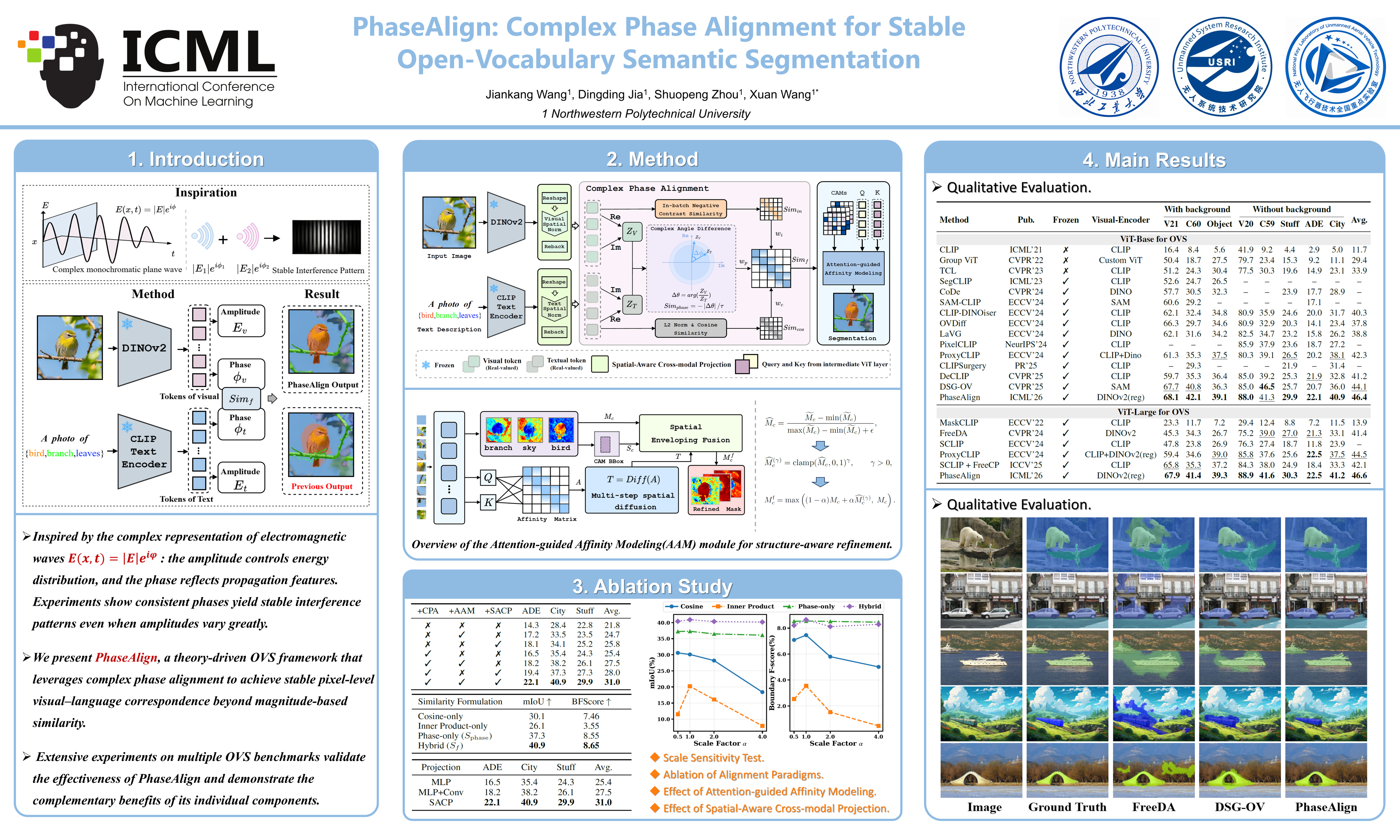
Open-Vocabulary Segmentation(OVS) aims to achieve pixel-level semantic recognition from arbitrary text queries. Existing large-scale visual-linguistic models, such as CLIP, perform well in zero-shot generalization, but their image-level training objectives and real-valued cross-modal alignment mix amplitude and phase information, limiting fine-grained segmentation and often causing blurred boundaries and fragmented structures. Inspired by the ability of electromagnetic wave phase to control interference independently of amplitude, we propose PhaseAlign, an OVS framework based on Complex Phase Alignment (CPA). CPA explicitly decouples the magnitude and phase of visual and textual embeddings in the complex domain, refining effective features for stable cross-modal alignment. To further enhance structural awareness, we introduce spatial-aware cross-modal projection, which models local neighborhood relations via multi-scale spatial contrast normalization, and attention-guided affinity modeling, which leverages pre-trained ViT self-attention to propagate category activations, improving boundary clarity and region integrity. Experiments show that PhaseAlign achieves state-of-the-art performance on multiple OVS benchmarks.
Lay Summary
Open-vocabulary segmentation allows computers to identify image regions using flexible text descriptions, even for categories not fixed in advance. Existing vision-language models are good at matching whole images with text, but they often struggle to produce accurate pixel-level results, leading to blurry boundaries or incomplete regions. We propose PhaseAlign, a method that improves this matching process by using a more stable way to compare image and text features, inspired by how wave patterns can align through phase. It also uses local image structure and attention cues to better preserve object shapes. Experiments show that PhaseAlign improves segmentation accuracy and produces clearer, more complete results across multiple benchmarks.