
DC-LA: Difference-of-Convex Langevin Algorithm
Abstract
Lay Summary
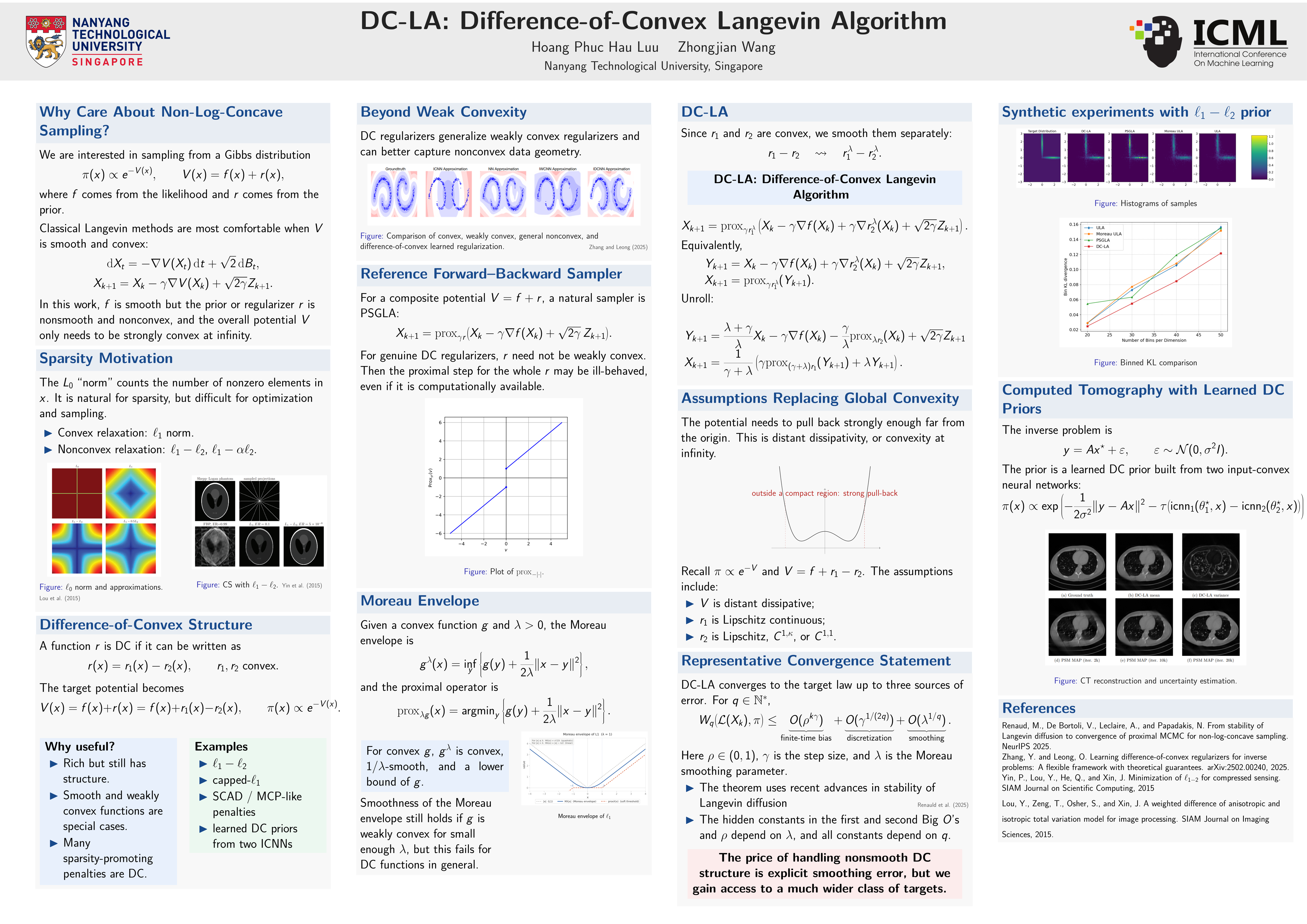
In applications like reconstructing a CT scan from limited X-ray measurements, a single "best guess" image isn't enough — doctors also need to know how uncertain that guess is. This means drawing random samples from a probability distribution that combines the measurements with prior assumptions about realistic images. Many useful priors make this distribution mathematically awkward, breaking standard sampling algorithms. We designed a new algorithm, DC-LA, for a broad class of such cases. The key idea: many practical priors can be written as the difference of two simpler, well-behaved pieces. We smooth each piece separately, rearrange the terms, and then run a standard sampling procedure -- and we prove mathematically that it converges, up to some smoothing and discretization erros, to the correct distribution. Numerical experiments show that DC-LA produces accurate distributions in synthetic settings and provides qualitatively reasonable uncertainty quantification in a real-world CT application.