
Online Bayesian Experimental Design for Partially Observed Dynamical Systems
Abstract
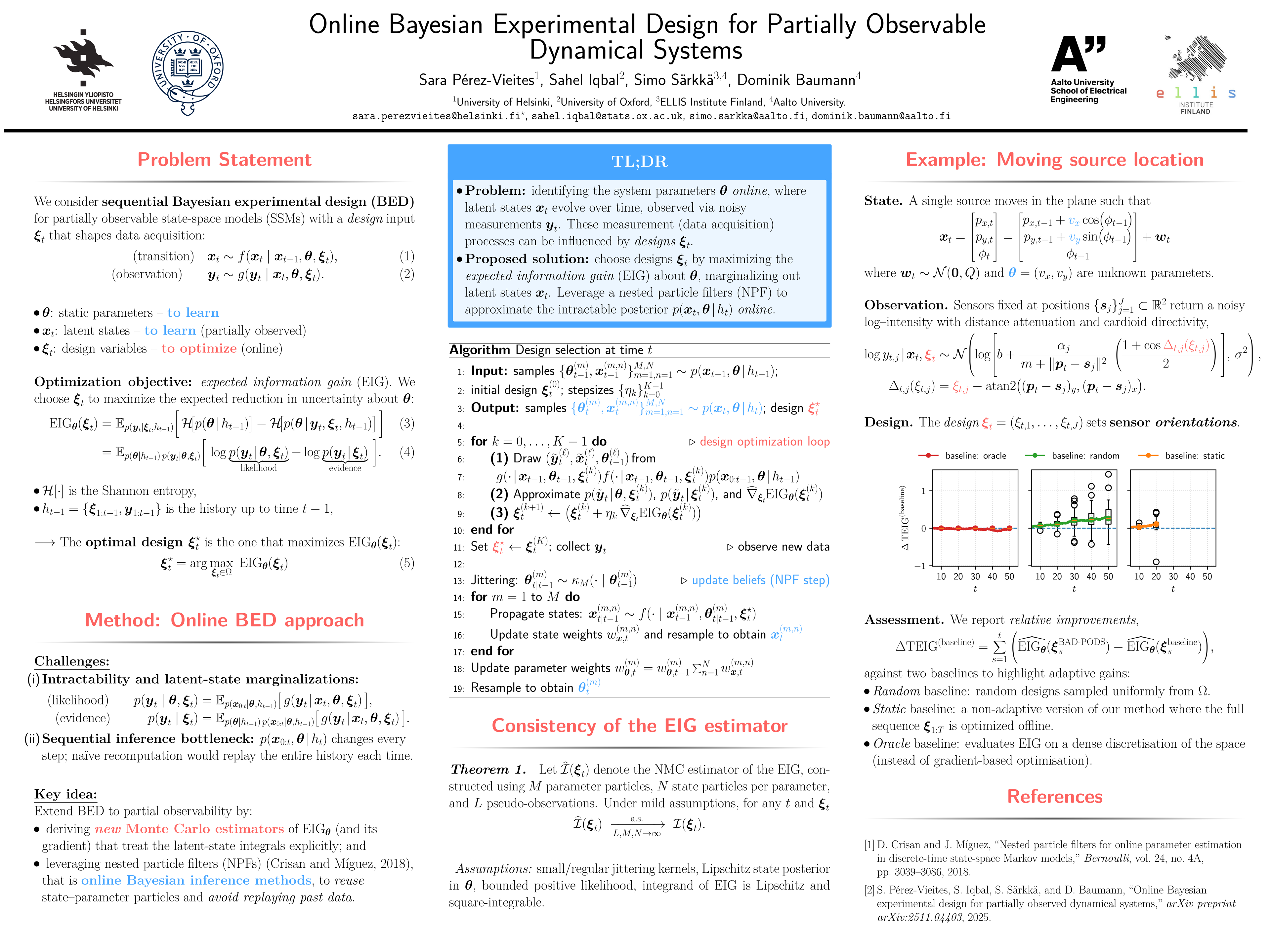
Bayesian experimental design (BED) provides a principled framework for optimising data collection by choosing experiments that are maximally informative about unknown parameters. However, existing methods cannot deal with the joint challenge of (a) partially observable dynamical systems, where only noisy and incomplete observations are available, and (b) fully online inference, which updates posterior distributions and selects designs sequentially in a computationally efficient manner. Under partial observability, dynamical systems are naturally modeled as state-space models (SSMs), in which latent states mediate the link between parameters and data, making the likelihood---and thus information-theoretic objectives like the expected information gain (EIG)---intractable. We address these challenges by deriving new estimators of the EIG and its gradient that explicitly marginalise latent states, enabling scalable stochastic optimisation in nonlinear SSMs. Our approach leverages nested particle filters for efficient online state-parameter inference with convergence guarantees. Applications to realistic models, such as the susceptible–infectious–recovered (SIR) model and a moving source location task, show that our framework successfully handles both partial observability and online inference.
Lay Summary
In many scientific studies, researchers must choose what experiment or measurement to run next while the system they are studying changes over time. Examples include monitoring an epidemic, locating a moving source, or tracking an ecological population. This is difficult because the most important parts of the system are often hidden: we only observe noisy measurements, not the full underlying state. We develop a method for choosing informative experiments in such partially observed dynamical systems. The method updates its beliefs as new data arrive and then selects the next measurement to be as useful as possible. Unlike methods that require a policy to be trained in advance to choose future experiments, our approach works online and avoids repeatedly reprocessing the full history of past observations before making a new decision. We show how to estimate the value of candidate experiments in this setting, even when the hidden state makes the likelihood difficult to compute. In experiments on epidemiological, source-tracking, and ecological models, the proposed method selects more informative measurements than random or preselected designs while remaining feasible over long sequences of decisions.