
TAG: Tangential Amplifying Guidance for Hallucination-Resistant Sampling
Abstract
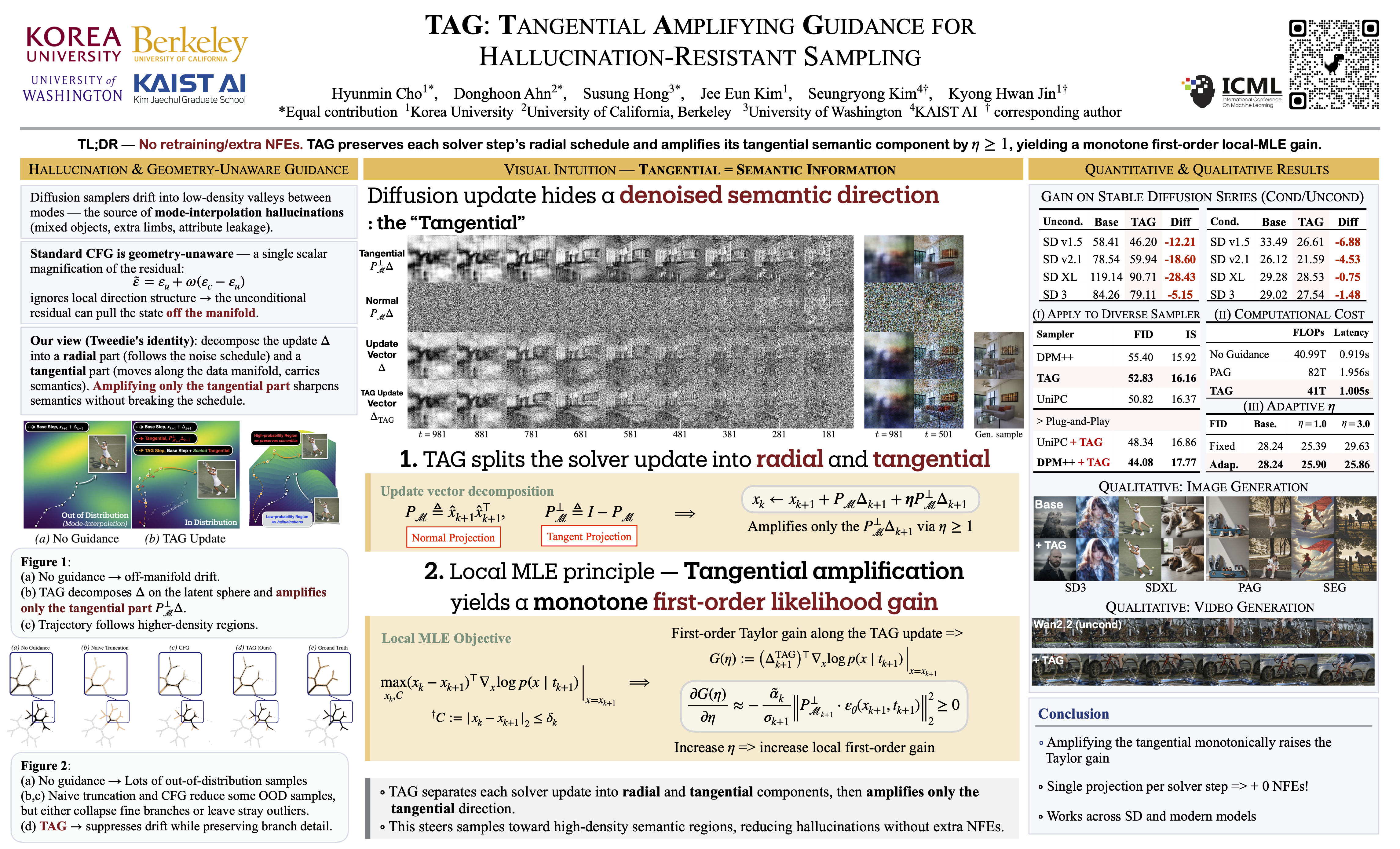
Diffusion models achieve state-of-the-art image generation but often produce semantic inconsistencies, or hallucinations. Existing inference-time guidance methods rely on external signals or architectural modifications, adding computational overhead. We propose Tangential Amplifying Guidance (TAG), a training-free, architecture-agnostic, plug-and-play guidance method that operates purely on trajectory signals. TAG uses an intermediate sample as a projection basis and amplifies the tangential components of the estimated score to correct the sampling trajectory. A first-order Taylor analysis shows that this steers the state toward higher-probability regions of the data manifold, reducing inconsistencies and improving fidelity while adding negligible overhead to existing samplers. Code is available at our Project Page (https://hyeon-cho.github.io/TAG/).
Lay Summary
Many image and video generation models create results through a gradual process: they start from random noise and repeatedly update it until a realistic sample appears. Although this process often works remarkably well, it can sometimes go wrong in subtle but visible ways. Objects may be mixed up, body parts may become implausible, or the generated scene may not match the intended structure. These failures are often called hallucinations. We study these errors from the perspective of the path followed during generation. At each step, a diffusion model updates the current sample in some direction. Some parts of this update mainly follow the model’s noise schedule, while other parts refine the content of the image, such as object shape, layout, and semantic structure. We show that selectively strengthening these content-refining, or tangential, directions can guide the generation process toward more coherent samples. Based on this idea, we propose Tangential Amplifying Guidance (TAG), a simple method that can be added to existing diffusion samplers without retraining the model or requiring extra model evaluations. TAG decomposes each update into radial and tangential components, then amplifies the tangential component while preserving the rest of the update. Across image and video generation experiments, this lightweight adjustment improves fidelity, perceptual quality, and structural consistency. More broadly, our work suggests that improving generative models is not only about collecting more data or training larger models. It is also important to understand and control the geometry of the generation process itself. By shaping the direction of each sampling step, TAG offers a practical step toward more reliable and interpretable generation.