
ArenaRL: Scaling RL for Open-Ended Agents via Tournament-based Relative Ranking
Abstract
Lay Summary
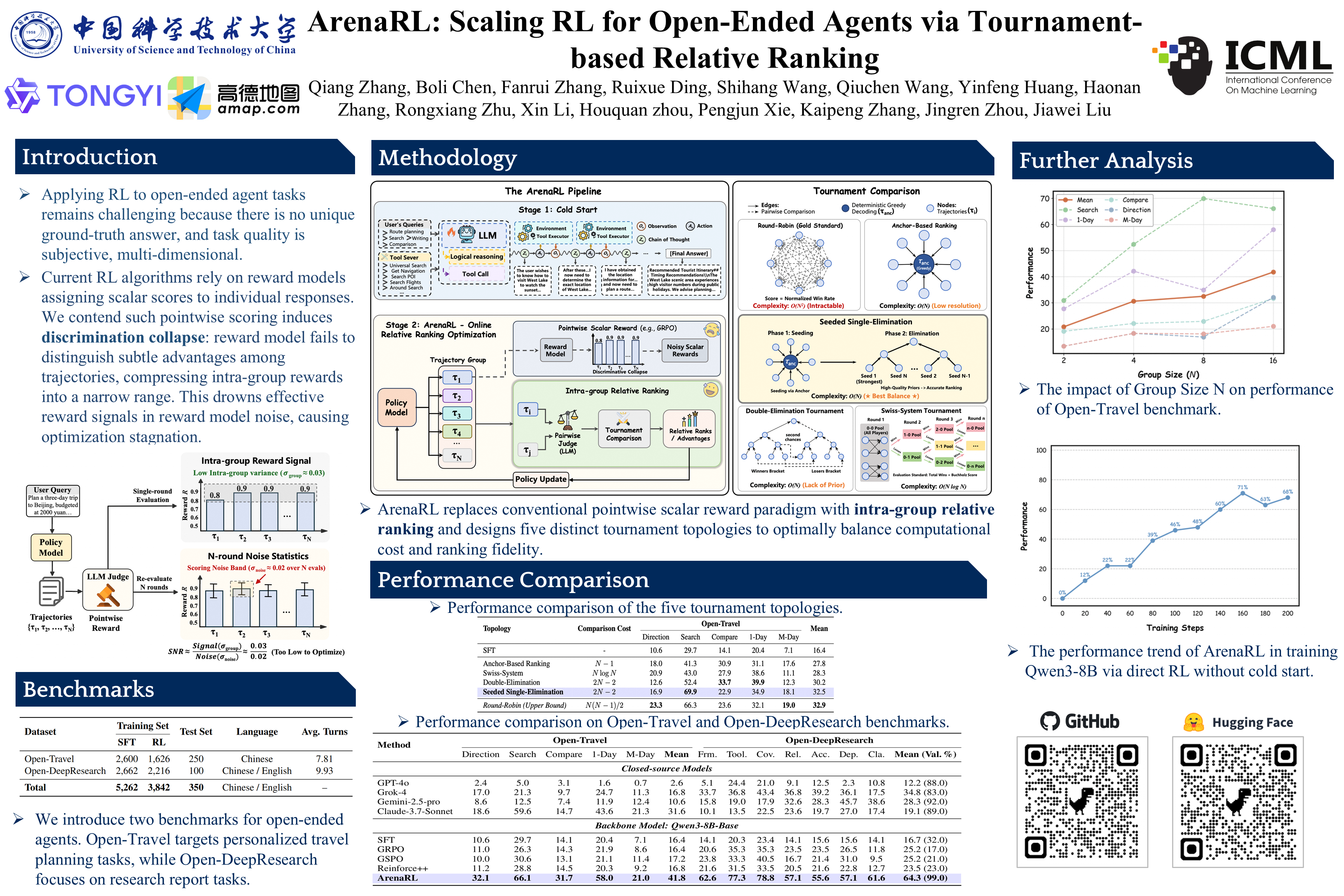
Large language model agents are increasingly used to solve complex open-ended tasks, such as planning a personalized trip or conducting deep research on the web. However, training these agents is difficult because there is often no single correct answer, and current reinforcement learning methods often rely on judge models to give each answer a scalar score. When many candidate answers are similarly good, these scores can be noisy and may hide the real differences between solutions. ArenaRL addresses this problem by replacing individual scalar scores with relative comparisons. Instead of asking how good each answer is on its own, ArenaRL lets candidate solutions compete in a tournament and learns from their relative rankings. The comparison also considers the agent's intermediate reasoning and tool use, not only the final answer. To support future research, we build two benchmarks: Open-Travel, which tests personalized travel planning, and Open-DeepResearch, which tests long-form web research. Our experiments on these benchmarks and open-ended writing tasks show that ArenaRL gives agents more reliable learning signals, helping them become better at complex real-world problem solving.