
Refining Dual Spectral Sparsity in Transformed Tensor Singular Values
Abstract
Lay Summary
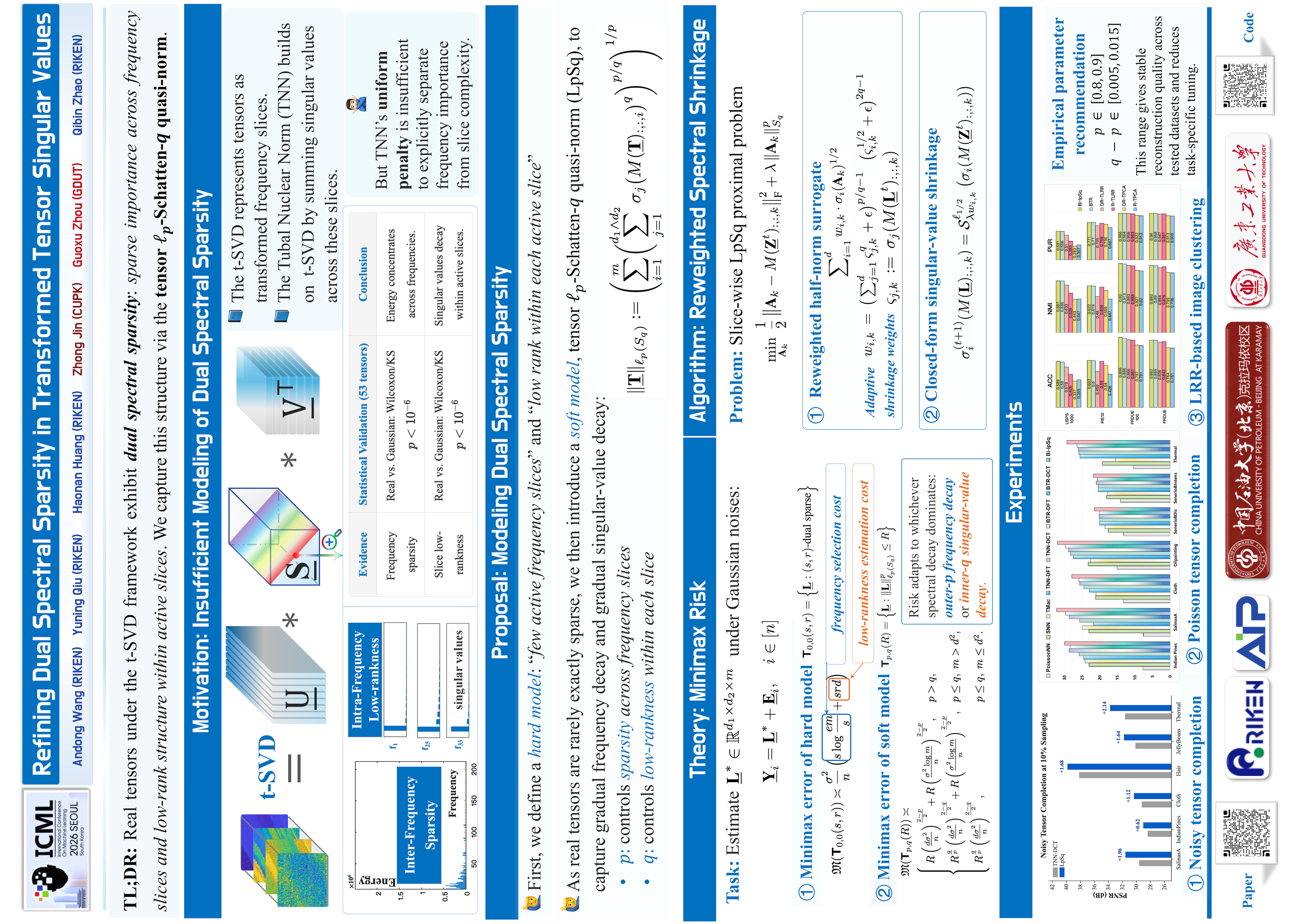
Modern AI systems often organize data as large multi-dimensional arrays, called tensors. Examples include videos, hyperspectral images, medical scans, and even the internal memory states used in large language models. A common strategy is to compress these tensors by assuming that their information is concentrated in a simpler hidden structure. Our work studies a new type of structure that appears in transformed tensor representations. We observe that useful information is often concentrated in only a small number of transformed components, while each important component itself still contains strong internal redundancy. To model this behavior, we introduce a new mathematical regularization framework that jointly captures these two effects. We also develop a practical optimization algorithm and provide theoretical results describing the statistical difficulty of recovering tensors with this type of structure. Experiments on image recovery, scientific imaging, and clustering tasks show that the proposed approach can recover tensor data more accurately than several widely used existing methods, particularly when observations are limited or noisy.