
An Interactive Paradigm for Deep Research
Abstract
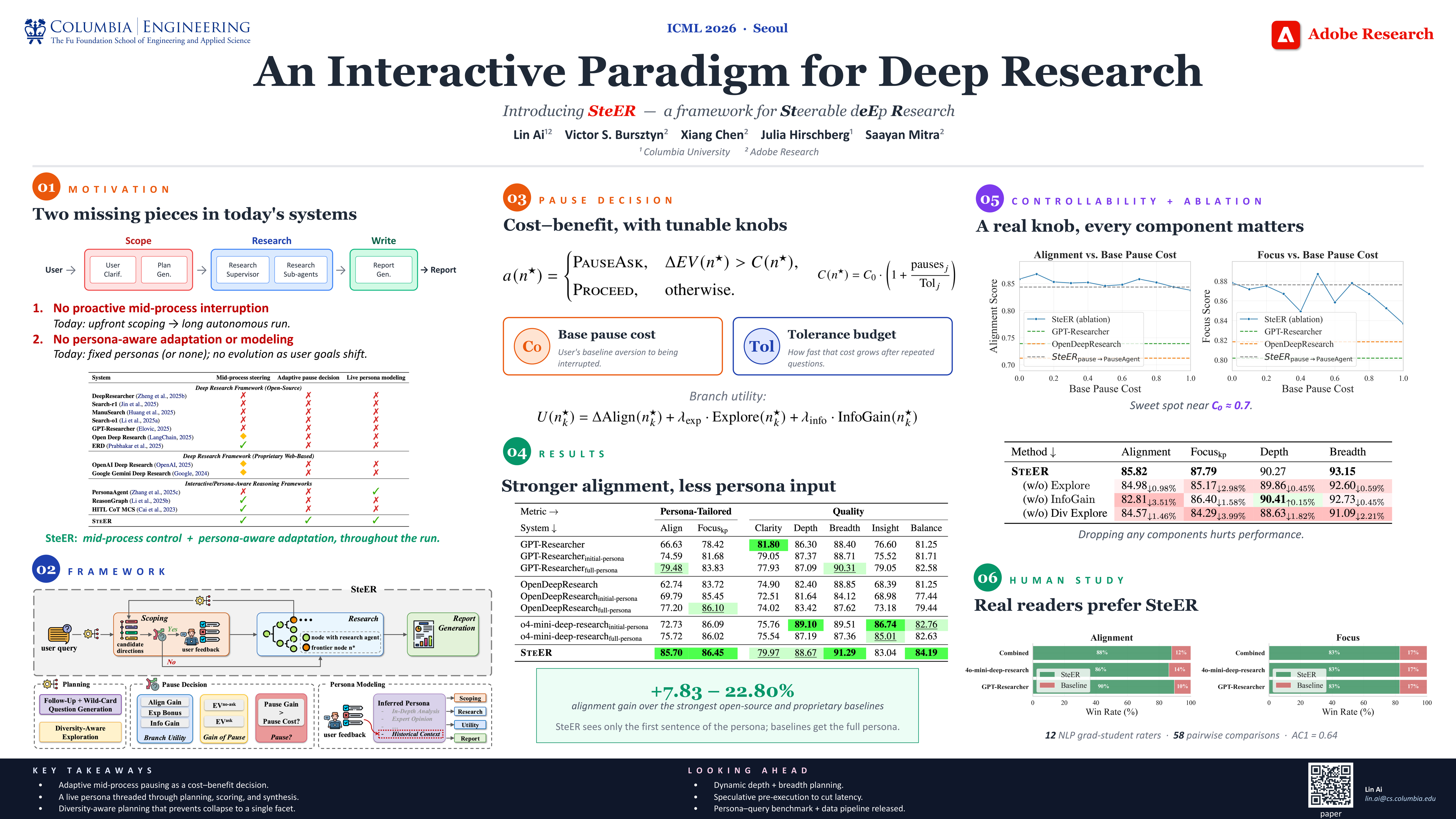
Recent advances in large language models (LLMs) have enabled deep research systems that synthesize comprehensive, report-style answers to open-ended queries by combining retrieval, reasoning, and generation. Yet, most frameworks rely on rigid workflows with one-shot scoping and long autonomous runs, offering little room for course correction if user intent shifts mid-process. We present SteER, a framework for steerable deep research that introduces interpretable, mid-process control into long-horizon research workflows. At each decision point, SteER uses a cost–benefit formulation to determine whether to pause for user input or proceed autonomously. It combines diversity-aware planning with utility signals that reward alignment, novelty, and coverage, and maintains a live persona model that evolves throughout the session. SteER outperforms state-of-the-art open-source and proprietary baselines by up to 22.80% on alignment, leads on quality metrics such as breadth and balance, and is preferred by human readers in 85%+ of pairwise alignment judgments. We also introduce a persona–query benchmark and data-generation pipeline. To our knowledge, this is the first work to advance deep research with an interactive, interpretable control paradigm, paving the way for controllable, user-aligned agents in long-form tasks.
Lay Summary
When you ask an AI to do "deep research" on a complex question — like "what's the competitive landscape for opening a yoga studio in my area?" — it might take ten minutes to come back with a long report. Over so many small decisions made along the way, keeping that report aligned with what you actually care about is hard. We designed SteER, a new approach built on two ideas. First, it figures out when a check-in with you would actually help: SteER weighs the cost of interrupting against how much your input could change the research direction, and pauses only when stepping in truly matters. Second, it maintains an evolving picture of your interests as the work unfolds, so its planning, exploration, and final report stay tuned to you rather than to a frozen version of the question. In our experiments, SteER produced reports significantly better aligned with what users wanted — and human readers preferred them over leading systems from OpenAI and others in over 85% of comparisons. Beyond research assistants, this paradigm of "ask only when it matters" could make AI agents in finance, law, and scientific discovery more transparent and accountable to the people using them.