
OPTION: Optimal Transport–Guided Flow Matching for Incomplete and Unaligned Multi-View Clustering
Abstract
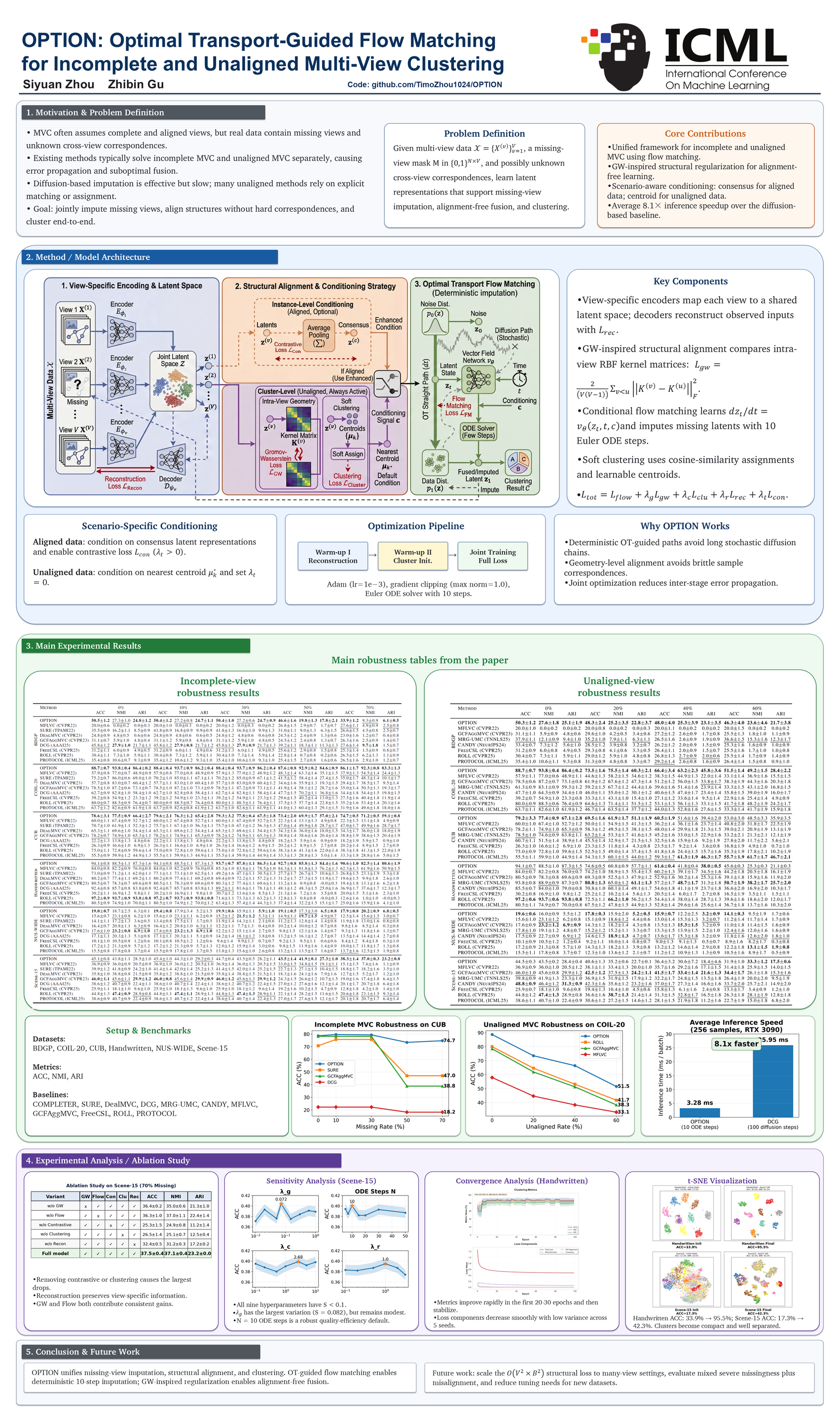
Multi-view clustering effectively exploits rich information from multiple views, yet real-world applications are frequently challenged by missing views and cross-view sample misalignment, hindering cross-view modeling and resulting in inferior clustering performance. To address these challenges, this paper presents a novel method, OPtimal Transport–GuIded flOw MatchiNg for incomplete and unaligned multi-view clustering (OPTION). Specifically, OPTION employs conditional flow matching to learn deterministic transport paths for missing-view imputation, enabling stable manifold-preserving recovery and more discriminative representations. To support alignment-free fusion, we introduce a Gromov-Wasserstein-inspired structural regularization that aligns intra-view geometric structures in the latent space without solving hard correspondences. Furthermore, an optional contrastive regularization is incorporated to enhance cross-view consistency specifically for aligned settings. Extensive experiments demonstrate that OPTION outperforms state-of-the-art methods across ideal, incomplete, and unaligned scenarios evaluated separately. Code: https://github.com/TimoZhou1024/OPTION.
Lay Summary
Many real-world datasets describe the same objects from different sources. For example, a patient may have several types of medical tests, or a person may appear across multiple online platforms. In practice, some information is often missing, and records from different sources may not line up correctly. These issues make it difficult for computers to group similar objects together accurately. Therefore, we present OPTION, a new method that can handle both missing information and mismatched records within a single framework. Instead of relying on slow step-by-step generation processes or requiring exact matches between data sources, OPTION learns efficient ways to recover missing information while preserving the overall structure of the data. It also compares patterns within each data source to discover common structures, allowing information from different sources to be combined even when direct matches are unavailable. Experiments on several benchmark datasets show that OPTION consistently produces more accurate groupings than existing approaches under ideal, incomplete, and mismatched conditions. In addition, it runs substantially faster than recent generation-based methods, making it more practical for large-scale real-world applications.