
Correctness-Optimized Residual Activation Lens (CORAL): Transferrable and Calibration-Aware Inference-Time Steering
Abstract
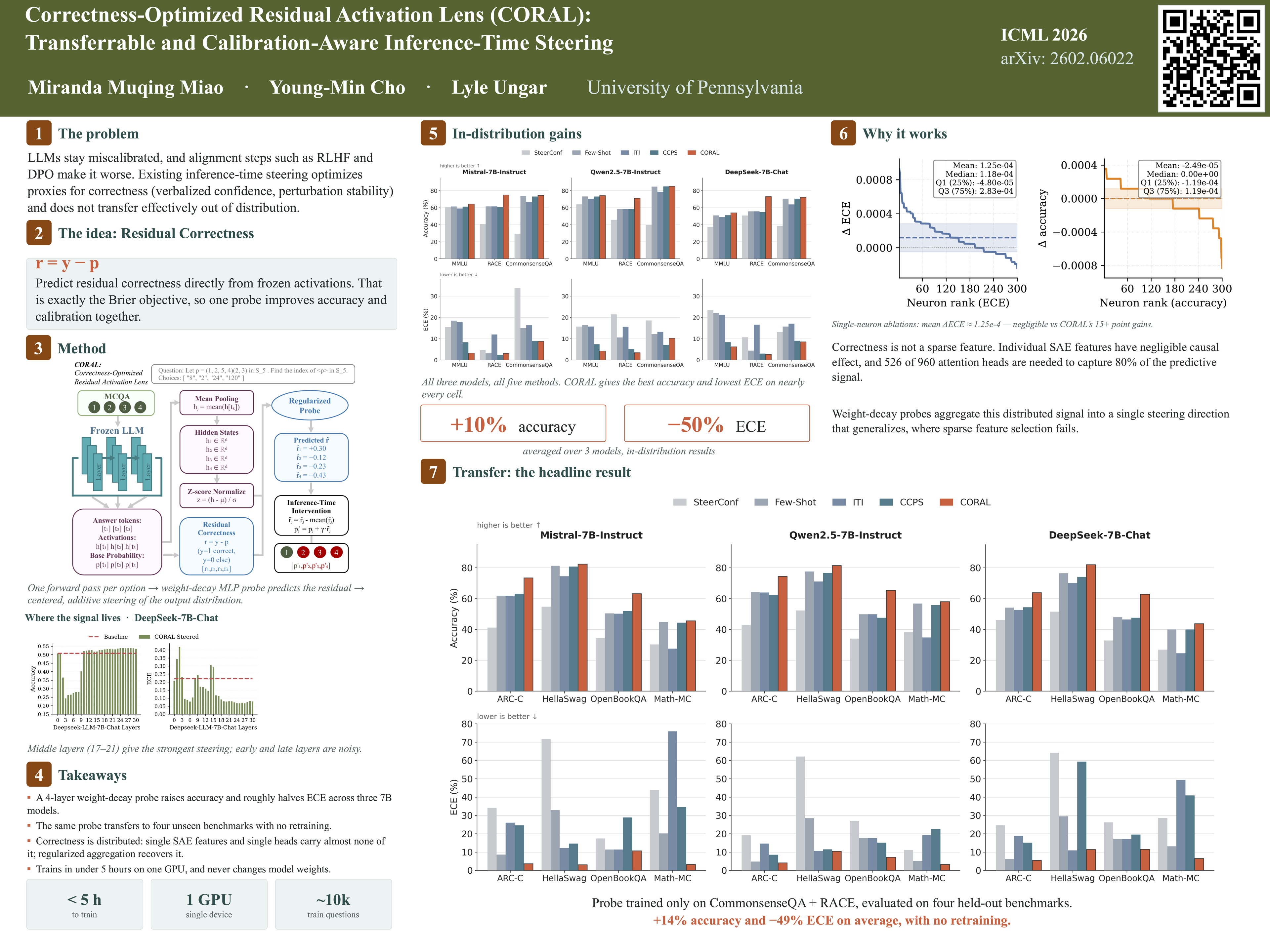
Large language models (LLMs) exhibit persistent miscalibration, especially after instruction tuning and preference alignment. Modified training objectives can improve calibration, but retraining is expensive. Inference-time steering offers a lightweight alternative, yet most existing methods optimize proxies for correctness rather than correctness itself. We introduce CORAL (Correctness-Optimized Residual Activation Lens), a regularized inference-time steering method that captures distributed correctness signals from model internal activations using weight-decay MLP probes. We evaluate CORAL across three 7B-parameter models and find that it consistently improves accuracy by 10\% and expected calibration error (ECE) by 50\% on average. We additionally demonstrate that these gains transfer without retraining to the complete published test sets of four held-out benchmarks (ARC-Challenge, HellaSwag, Math-MC, OpenBookQA), averaging 14\% accuracy improvements and 49\% ECE improvements. Our results support the hypothesis that distributed information in model internals can be extracted using regularized probes when individual neurons are insufficient. CORAL thus provides a compute-efficient, transferable, and calibration-aware approach to improve MCQA performance during inference.
Lay Summary
Large language models often express high confidence in wrong answers, making it difficult for users and downstream systems to judge when to trust their outputs. Existing methods for fixing this problem either require expensive retraining or rely on indirect signals that do not target correctness directly. We developed CORAL, a lightweight method that reads a model's internal activity patterns to predict where its confidence is misplaced, then adjusts answer probabilities at the moment the model responds. CORAL requires no changes to the model itself and trains in under five hours on a single consumer GPU. Across multiple models and question-answering tasks, CORAL improved accuracy by 10% and reduced confidence errors by 50% on average, with these gains carrying over to new tasks the system was never trained on. Our approach offers a practical, low-cost way to make language model outputs more reliable for high-stakes applications like medical and legal decision support.