
Kuramoto Oscillatory Phase Encoding: Neuro-inspired Synchronization for Improved Learning Efficiency
Abstract
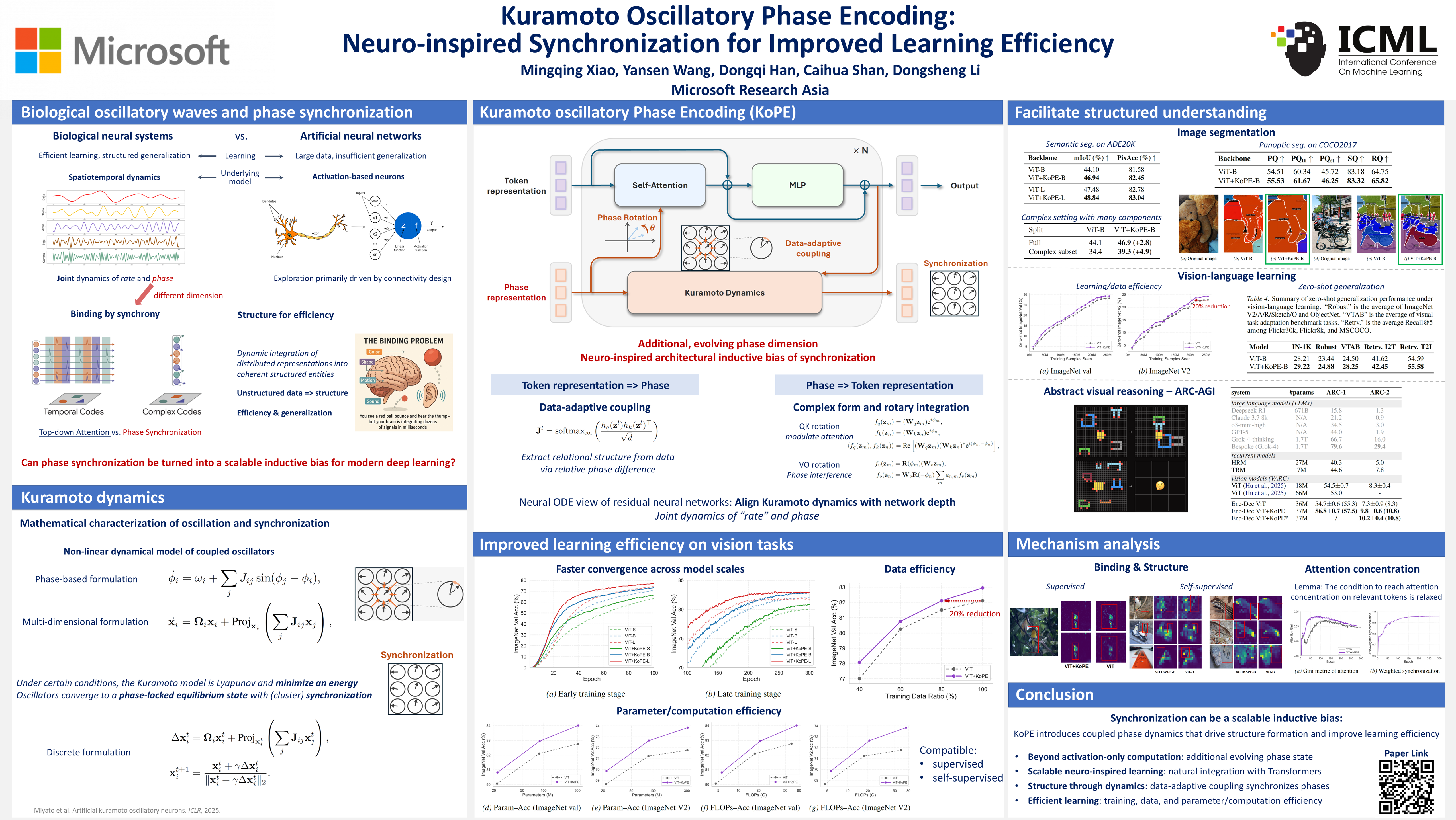
Spatiotemporal neural dynamics and oscillatory synchronization are widely implicated in biological information processing and have been hypothesized to support flexible coordination such as feature binding. By contrast, most deep learning architectures represent and propagate information through activation values, neglecting the joint dynamics of rate and phase. In this work, we introduce Kuramoto oscillatory Phase Encoding (KoPE) as an additional, evolving phase state to Vision Transformers, incorporating a neuro-inspired synchronization mechanism to advance learning efficiency. We show that KoPE can improve training, parameter, and data efficiency of vision models through synchronization-enhanced structure learning. Moreover, KoPE benefits tasks requiring structured understanding, including semantic and panoptic segmentation, representation alignment with language, and few-shot abstract visual reasoning (ARC-AGI). Theoretical analysis and empirical verification further suggest that KoPE can accelerate attention concentration for learning efficiency. These results indicate that synchronization can serve as a scalable, neuro-inspired mechanism for advancing state-of-the-art neural network models.
Lay Summary
In the brain, neurons do more than fire strongly or weakly: their activity also unfolds as spatiotemporal waves, whose phases can synchronize when neurons process related information. Neuroscientists have suggested that such synchronization may help bind scattered visual features into coherent objects and concepts, supporting flexible learning from limited experience. Most modern vision models including Vision Transformers, however, represent image parts mainly through activation values, leaving out this phase-based form of coordination. We introduce KoPE (Kuramoto oscillatory Phase Encoding), which gives each image token an additional evolving phase. The phases interact through the Kuramoto model, a standard model of synchronization, so related tokens can become more aligned while unrelated ones remain distinct. These phases are then used inside the model's attention mechanism, helping it learn useful visual structure more efficiently. Across supervised and self-supervised vision experiments, KoPE improves training, parameter, and data efficiency, and it helps on tasks that require structured understanding, including image segmentation, vision-language alignment, and few-shot abstract visual reasoning on ARC-AGI. More broadly, the results suggest that phase synchronization can be a practical and scalable ingredient for building more efficient AI systems.