
Debate2Create: Robot Co-design via Multi-Agent LLM Debate
Abstract
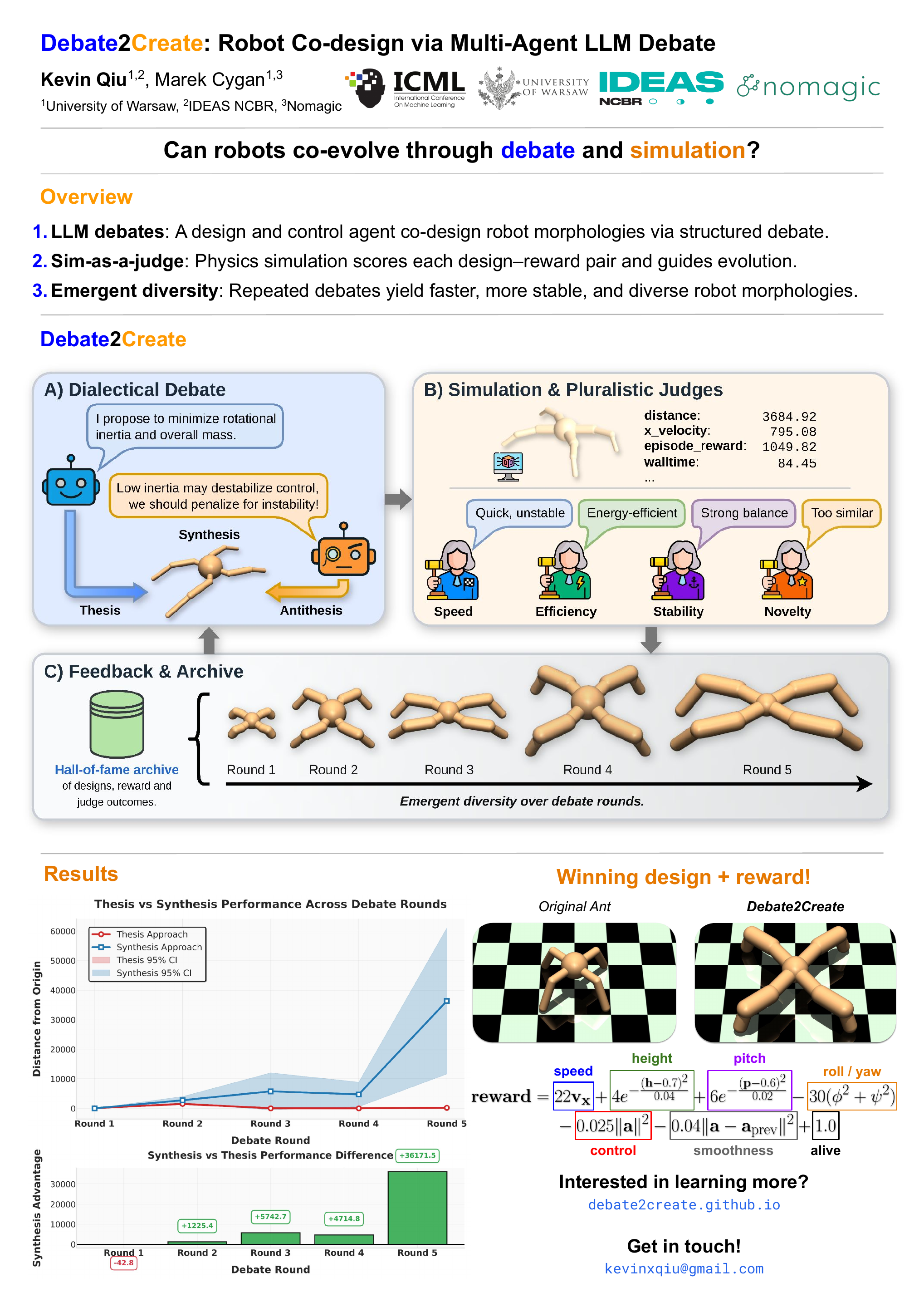
We introduce Debate2Create (D2C), a multi-agent LLM framework that formulates robot co-design as structured, iterative debate grounded in physics-based evaluation. A design agent and control agent engage in a thesis-antithesis-synthesis loop, while criterion-specific LLM judges provide multi-objective feedback to steer exploration. Across five MuJoCo locomotion benchmarks, D2C achieves the highest default-normalized score among the evaluated LLM-based and black-box baselines, with gains up to 3.2x on Ant and nearly 9x on Swimmer. Iterative debate yields 18-35% gains over compute-matched zero-shot generation, and D2C-generated rewards transfer to default morphologies in 4/5 tasks. These results suggest that structured, simulator-grounded multi-agent interaction is a useful mechanism for joint morphology-reward optimization under a fixed-topology, per-candidate-RL protocol. Project page: debate2create.github.io.
Lay Summary
Robots are hard to design because their bodies and control software depend on each other: changing a leg or joint can make a previous training goal stop working. We built Debate2Create, a system in which several AI agents help design both pieces together. One agent proposes changes to the robot's body. Another writes and critiques the reward, the rule that tells the robot what behavior to learn, while a small panel of judges comments on trade-offs such as speed, stability, and efficiency. Each proposal is tested in a physics simulator, so designs are chosen by measured performance rather than by what the AI predicts will work. In five simulated walking and swimming tasks, Debate2Create found body-and-reward combinations that outperformed designs made in one attempt and other automated search methods we tested, with gains up to about 3.2 times on a walking task and nearly 9 times on a swimming task. The results suggest that structured AI debate can help researchers explore robot designs more systematically, while still using simulation to check whether those designs actually move well.