
Task-Aware Structured Memory for Dynamic Multi-modal In-Context Learning
Abstract
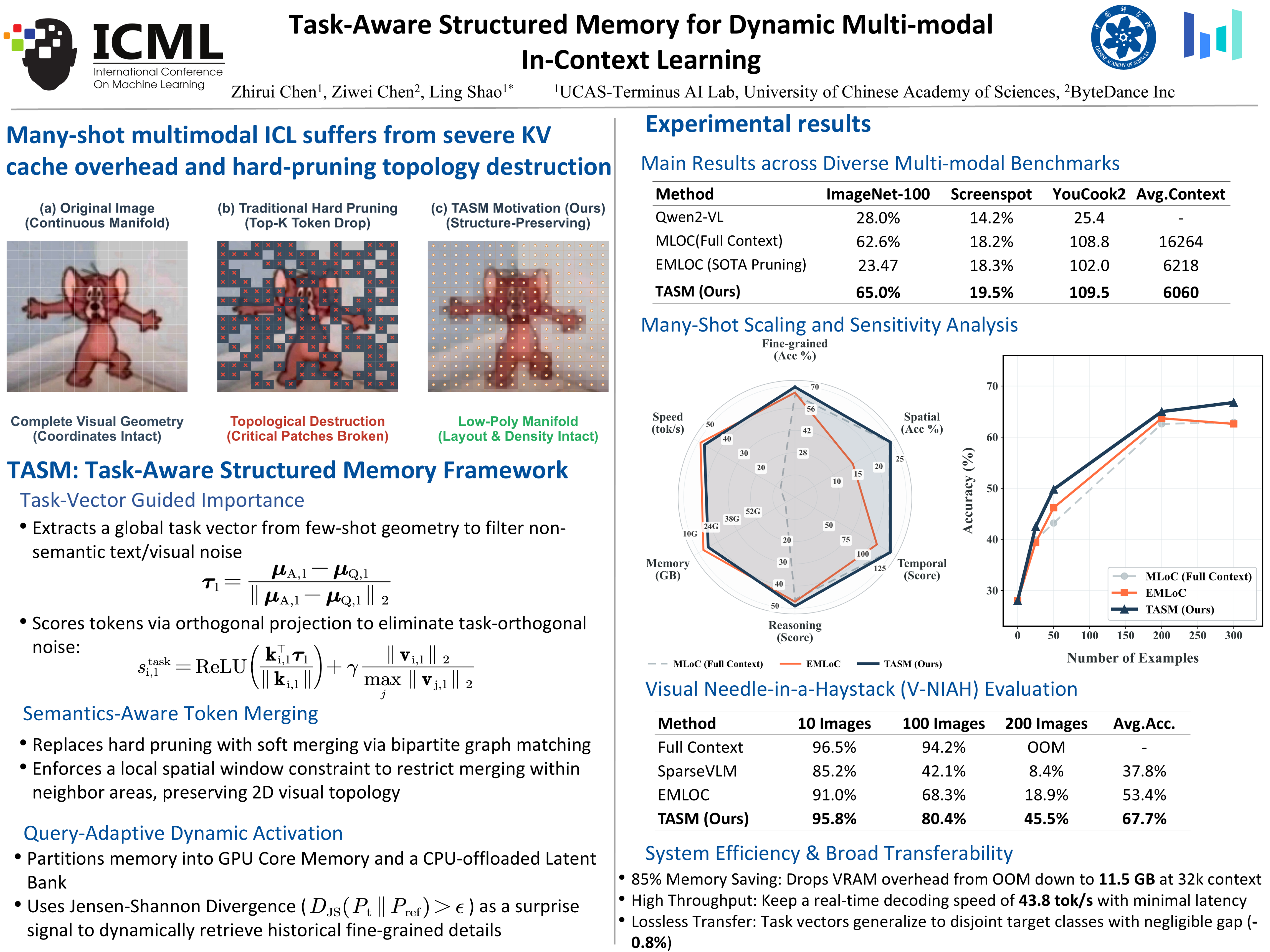
Multi-modal large language models (MLLMs) depend on in-context learning (ICL) for rapid task adaptation, but their scalability is severely limited by finite context windows and the growing cost of key–value (KV) caches in long multi-modal sequences. Existing memory compression approaches typically rely on rigid token removal or sample-dependent importance estimation, which introduces bias, disrupts semantic structure—particularly for visual representations—and yields static memories that cannot adapt to new queries. We introduce TASM (Task-Aware Structured Memory), a training-free framework that addresses these limitations through task-aware, structure-preserving, and dynamically accessible memory construction. TASM employs Task-Vector Guided Compression to replace sample-specific signals with a task-level direction that captures shared relevance across demonstrations. To preserve the underlying information manifold, it further applies Semantics-Aware Token Merging, formulating compression as a Bipartite Graph Matching problem that merges tokens without destructive pruning. Finally, TASM organizes compressed representations into a multi-resolution hierarchy consisting of a compact Core Memory and a Latent Bank, enabling Query-Adaptive Dynamic Activation and Dynamic Retrieval at inference time. Empirical evaluations show that TASM sustains strong multi-modal ICL performance under high compression ratios, demonstrating an effective balance between efficiency, adaptability, and semantic fidelity.
Lay Summary
When AI models learn from many texts and images, they consume massive memory, slowing them down. Previous solutions simply deleted "unimportant" information, which ruins image structures and permanently loses details needed later. We introduce TASM, a smarter memory system. First, it understands the overall "goal" of a task to identify truly useful information, rather than guessing from specific examples. Second, instead of deleting less important image parts, it intelligently merges them. This saves space while preserving the picture's original layout. Finally, TASM uses a two-tier memory: a fast active memory and a deeper backup storage. When faced with complex questions, it automatically retrieves hidden details from the backup. TASM drastically reduces memory usage while keeping the AI highly accurate, making powerful multimodal models much easier and cheaper to run.