
Hierarchical Causal Abduction: A Foundation Framework for Explainable Model Predictive Control
Abstract
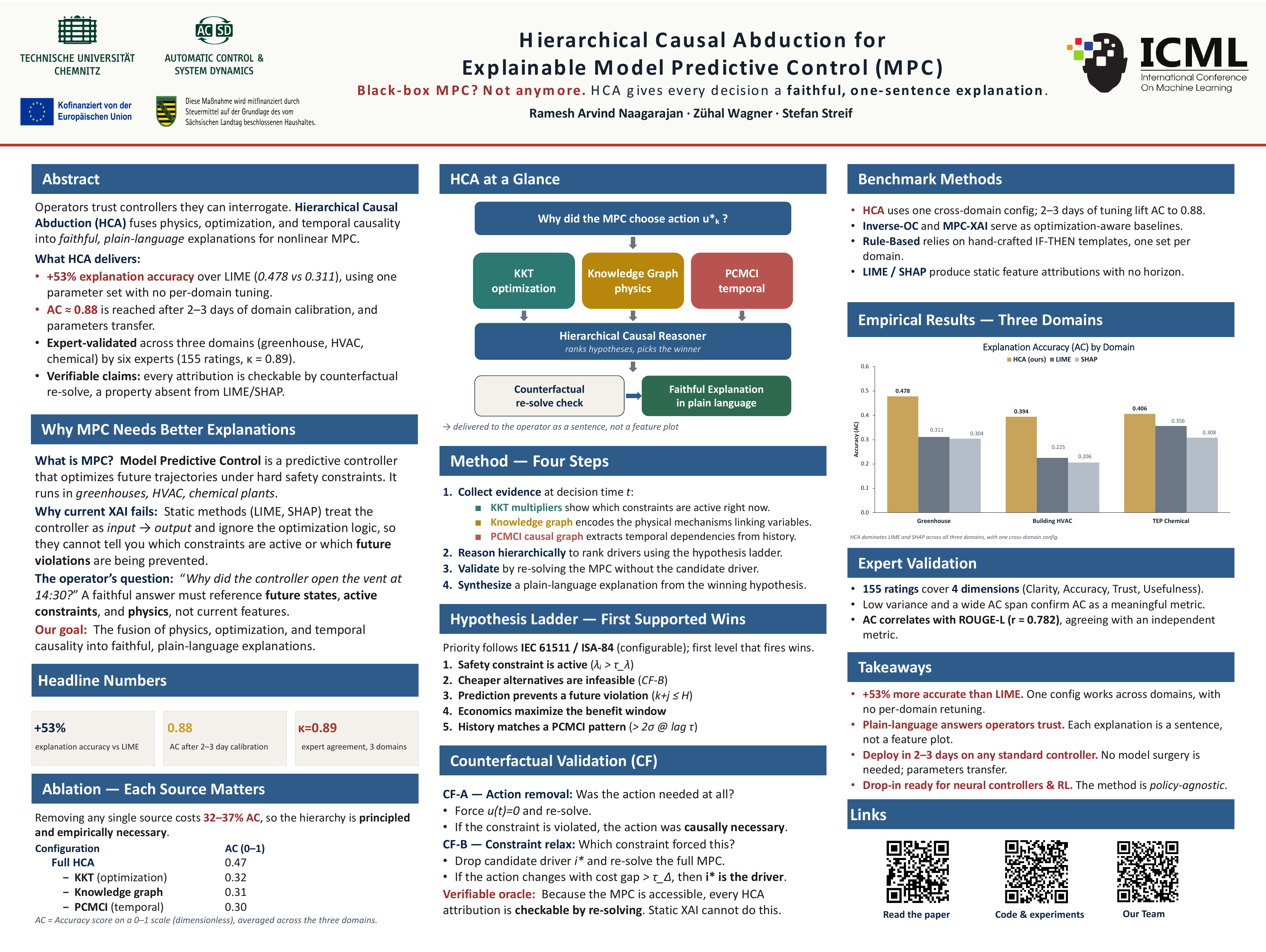
Model Predictive Control (MPC) is widely used to operate safety-critical infrastructure by predicting future trajectories and optimizing control actions. However, nonlinear dynamics, hard safety constraints, and numerical optimization often render individual control moves opaque to human operators, undermining trust and hindering deployment. This paper presents Hierarchical Causal Abduction (HCA), which combines (i) physics-informed reasoning via domain knowledge graphs, (ii) optimization evidence from Karush--Kuhn--Tucker (KKT) multipliers, and (iii) temporal causal discovery via the PCMCI algorithm to generate faithful, human-interpretable explanations for control actions computed by nonlinear MPC. Across three diverse control applications (greenhouse climate, building HVAC, chemical process engineering) with expert validation, HCA improves explanation accuracy by 53\% over LIME (0.478 vs. 0.311) using a single set of cross-domain parameters without per-domain tuning; domain-specific KKT-threshold calibration over 2--3 days further increases accuracy to 0.88. Ablation studies confirm that each evidence source is essential, with 32--37\% accuracy degradation when any component is removed, and HCA's ranking-and-validation methodology generalizes beyond MPC to other prediction-based decision systems, including learning-based control and trajectory planning.
Lay Summary
Many critical systems, such as greenhouses that grow our food, HVAC systems that keep buildings comfortable, and chemical plants that produce medicines, are run by a "look-ahead" controller called Model Predictive Control (MPC). Like a chess player planning several moves, MPC chooses today's actions based on what it predicts will happen hours from now. This foresight can make its decisions confusing: a greenhouse may switch on cooling even when the temperature is still fine, leaving operators puzzled about why. Standard AI-explanation tools only look at the current moment, so they cannot reveal the future-driven reasoning behind these decisions. In regulated industries, this opacity has become a barrier to deployment. Operators are often required to justify every automated action, and unexplained automation has slowed MPC adoption for decades. We developed Hierarchical Causal Abduction (HCA). This method reconstructs why a predictive controller acted by combining three perspectives: the system's physics (captured in a knowledge graph), the controller's optimization mathematics, and patterns of cause-and-effect discovered from time-series data. Together, these reveal which predicted future problem the controller was trying to prevent. For example, HCA can show that a greenhouse's pre-emptive cooling was triggered not by current warmth but by a solar radiation spike forecast several hours in advance, turning an opaque action into a verifiable claim about the future. When tested on greenhouses, buildings, and chemical processes, HCA matched expert-labeled explanations 53% more often than LIME, the most widely used post hoc explanation tool, and required no retraining across these very different domains. By making predictive control transparent, our work helps operators trust, audit, and deploy these systems in the safety-critical settings where unexplained automation has long blocked adoption.