
Prototype-Grounded Concept Models for Verifiable Concept Alignment
Abstract
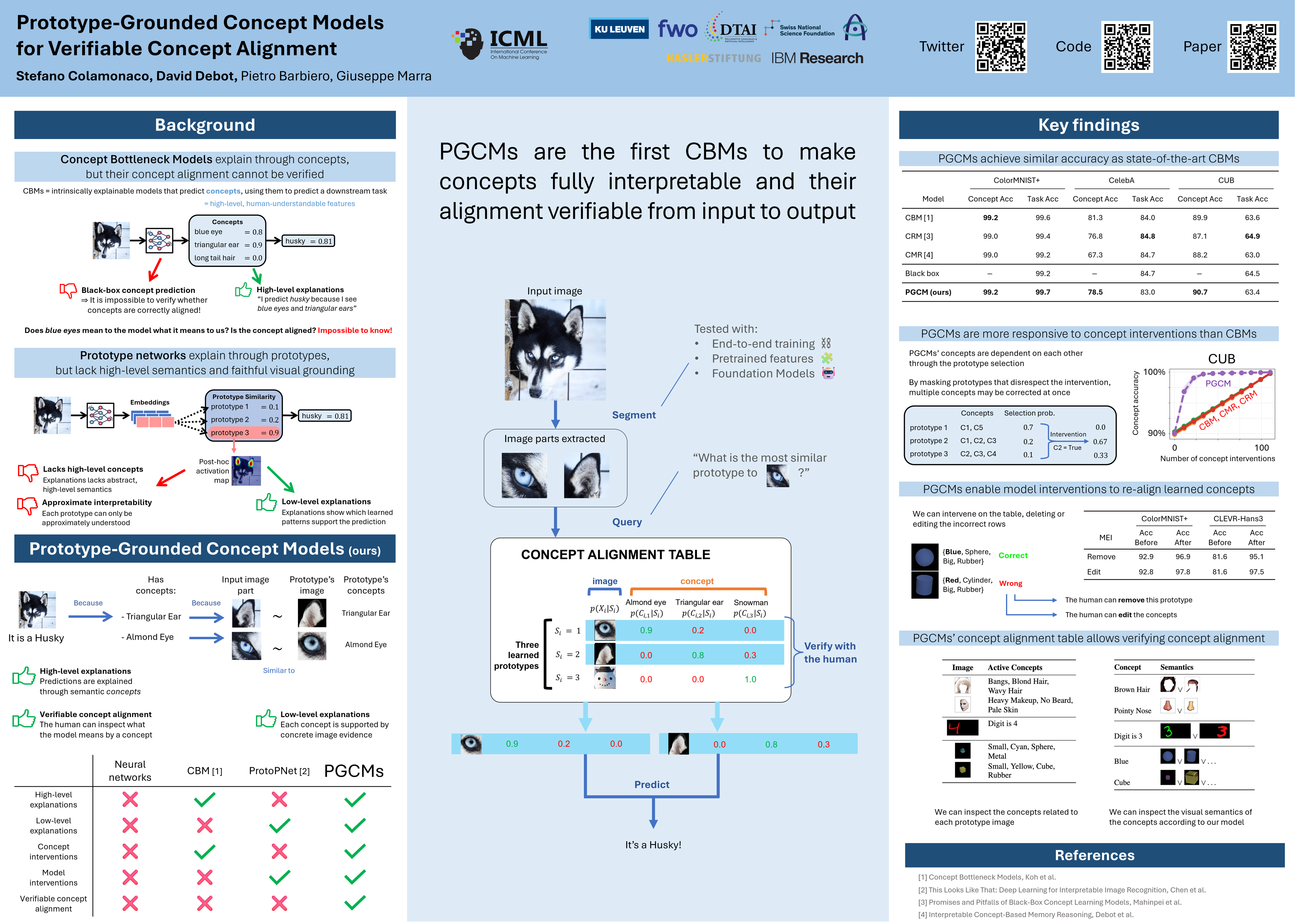
Concept Bottleneck Models (CBMs) aim to improve interpretability in Deep Learning by structuring predictions through human-understandable concepts, but they provide no way to verify whether learned concepts align with the human's intended meaning, hurting interpretability. We introduce Prototype-Grounded Concept Models (PGCMs), which ground concepts in learned visual prototypes: image parts that serve as explicit evidence for the concepts. This grounding enables direct inspection of concept semantics and supports targeted human intervention at the prototype level to correct misalignments. Empirically, PGCMs achieve similar predictive performance as state-of-the-art CBMs while substantially improving transparency, interpretability, and intervenability.
Lay Summary
Artificial intelligence systems often lack transparency, making them hard to trust. Some models try to explain their decisions using human concepts like "grey hair," but users cannot verify if the AI actually understands what grey hair looks like, or if it is just relying on irrelevant background textures. To solve this, we created Prototype-Grounded Concept Models (PGCMs), a framework that explicitly links these abstract concepts to concrete visual examples. Instead of just outputting a text label, our model points to specific parts of an image to show exactly what visual patterns it considers as proof for that concept. This gives each concept a dual nature: a descriptive word and a small gallery of actual images that define what that word means to the model. This visual grounding allows people to look at a simple table, directly inspect the AI's visual vocabulary, and easily step in to correct the model by editing or removing misleading images if it misinterprets a concept. Ultimately, this approach makes AI systems significantly more transparent and verifiable without sacrificing their accuracy.