
Vision-DeepResearch: Incentivizing DeepResearch Capability in Multimodal Large Language Models
Abstract
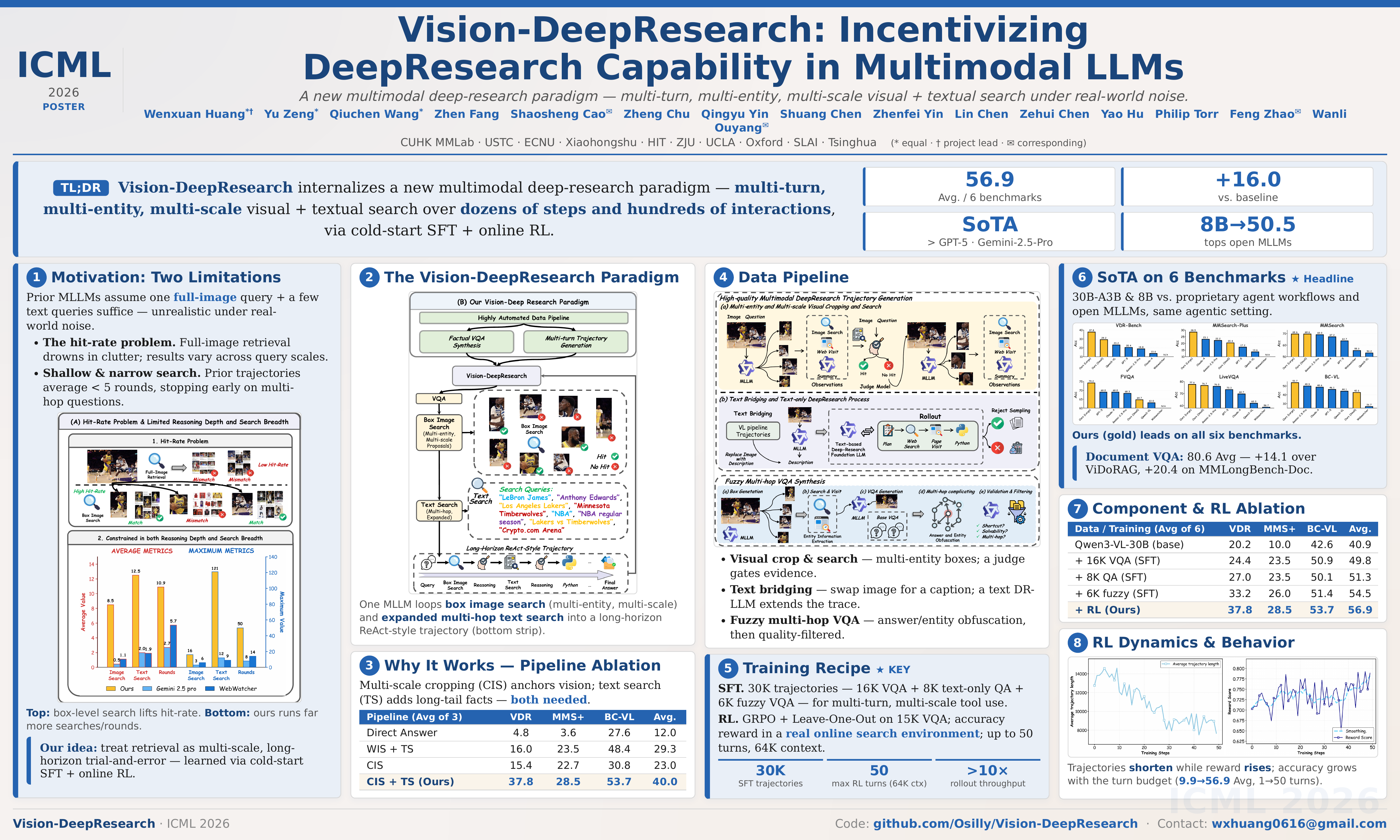
Multimodal large language models (MLLMs) have achieved remarkable success across a broad range of vision tasks. However, constrained by the capacity of their internal world knowledge, prior work has proposed augmenting MLLMs by ``reasoning-then-tool-call'' for visual and textual search engines to obtain substantial gains on tasks requiring extensive factual information. However, these approaches typically define multimodal search in a naive setting, assuming that a single full-level or entity-level image query and few text query suffices to retrieve the key evidence needed to answer the question, which is unrealistic in real-world scenarios with substantial visual noise. Moreover, they are often limited in the reasoning depth and search breadth, making it difficult to solve complex questions that require aggregating evidence from diverse visual and textual sources. Building on this, we propose Vision-DeepResearch, which proposes one new multimodal deep-research paradigm, i.e., performs multi-turn, multi-entity and multi-scale visual and textual search to robustly hit real-world search engines under heavy noise. Our Vision-DeepResearch supports dozens of reasoning steps and hundreds of engine interactions, while internalizing deep-research capabilities into the MLLM via cold-start supervision and RL training, resulting in a strong end-to-end multimodal deep-research MLLM. It substantially outperforming existing multimodal deep-research MLLMs, and workflows built on strong closed-source foundation model such as GPT-5, Gemini-2.5-pro and Claude-4-Sonnet.
Lay Summary
When people encounter a complex visual question — such as identifying a person in a crowded photo and finding their biographical details — they naturally search the web repeatedly, trying different crops and queries until they piece together the answer. Today's AI vision models lack this persistent, exploratory research ability: they typically perform one or two quick searches and give up if the first attempt fails, much like a student who closes the textbook after a single glance. We built Vision-DeepResearch, a system that teaches AI models to conduct deep, multi-step investigations on images. Our model can zoom into different parts of an image, search visual and textual databases dozens of times, and iteratively refine its queries — mirroring how a human researcher would work. To train it, we designed an automated pipeline that generates realistic research trajectories and verifies them against ground-truth answers, then applied reinforcement learning so the model learns to explore rather than guess. Even at a relatively small scale, our model outperforms much larger commercial AI systems (including GPT-5 and Gemini-2.5-Pro) on factual visual question-answering tasks. This work brings AI closer to performing genuine investigative research over visual information, which could benefit applications such as journalism fact-checking, scientific literature review, and accessibility tools that help visually impaired users understand complex images.