
Information Geometry Loss for Time Series Forecasting
Abstract
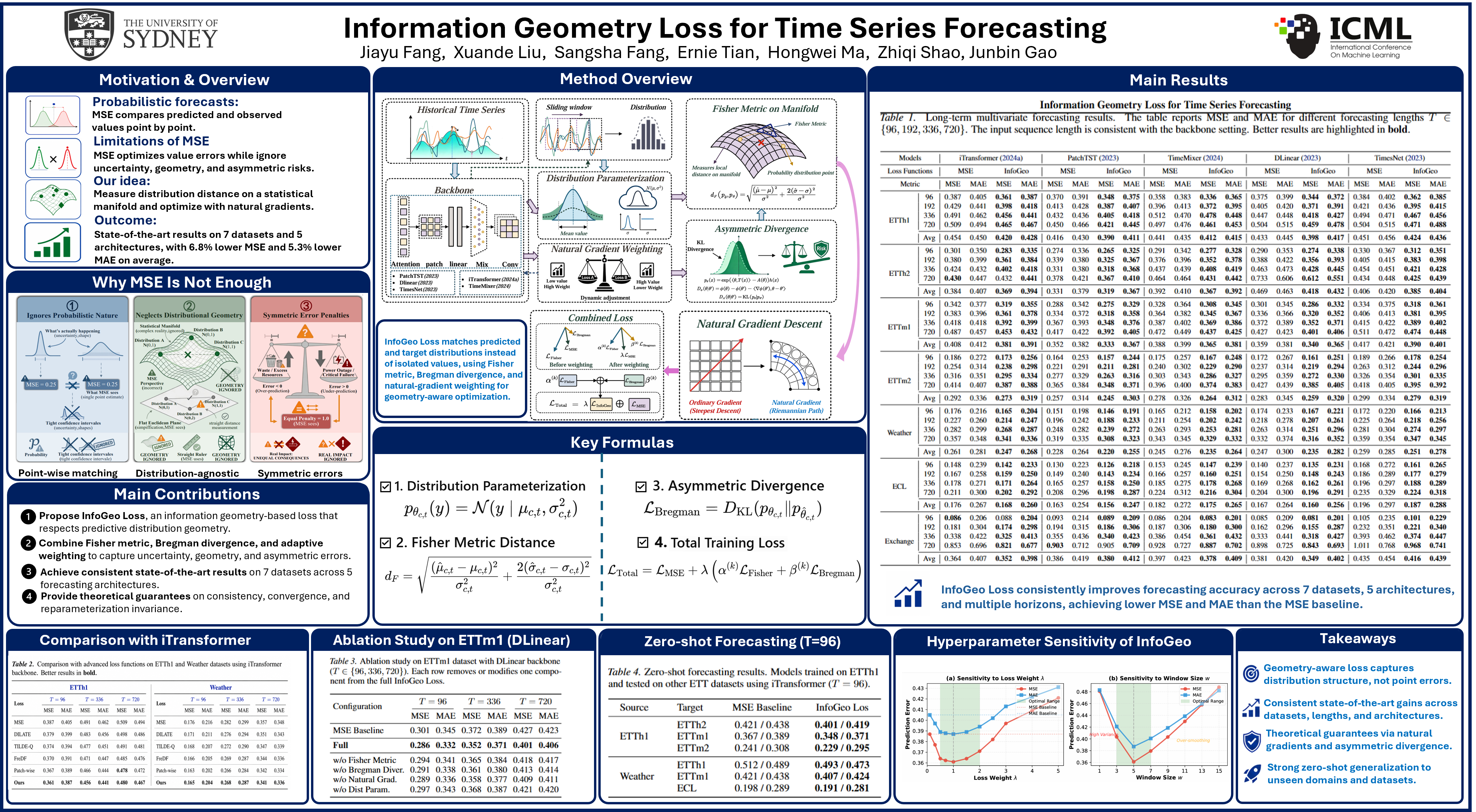
Time series forecasting fundamentally involves learning probability distributions over future observations. However, existing loss functions rely on point-wise Euclidean metrics, neglecting the intrinsic geometric structure of probability distributions. This leads to suboptimal alignment between predicted and true distributions, particularly for uncertainty quantification. We propose InfoGeo Loss, a principled loss function grounded in information geometry that measures distributional discrepancies on statistical manifolds. Our approach comprises three key components: (1) a distribution parameterization module that models predictions with learnable sufficient statistics, (2) a Fisher information metric that quantifies intrinsic distributional distance, and (3) a Bregman divergence component that captures asymmetric prediction errors. We further introduce a natural gradient weighting strategy for efficient optimization on statistical manifolds. Theoretically, we prove statistical consistency and establish convergence guarantees. Extensive experiments on seven datasets with five architectures show that InfoGeo Loss consistently outperforms existing losses, achieving average improvements of 6.8% in MSE and 5.3% in MAE.
Lay Summary
Forecasting future values from data recorded over time is important in areas such as weather, electricity demand, traffic, and finance. Most current forecasting methods are trained by simply comparing the predicted number with the true number, but this can miss an important point: the future is uncertain, and different forecasting mistakes may have different consequences. This paper introduces InfoGeo Loss, a new training objective that helps forecasting models compare not only single predicted values, but also the range and shape of possible future outcomes. In this way, the model can better understand uncertainty and make more reliable predictions. InfoGeo Loss can be added to many existing forecasting models without redesigning their architectures. Experiments on seven real-world datasets and five popular forecasting models show that it consistently improves prediction accuracy compared with standard training losses. These results suggest that better ways of measuring forecasting errors can lead to more accurate and trustworthy time series prediction systems.