
Hyper-LLaVA: Hyperbolic Uncertainty-aware Modality-Balanced Routing for Multimodal Continual Instruction Tuning
Abstract
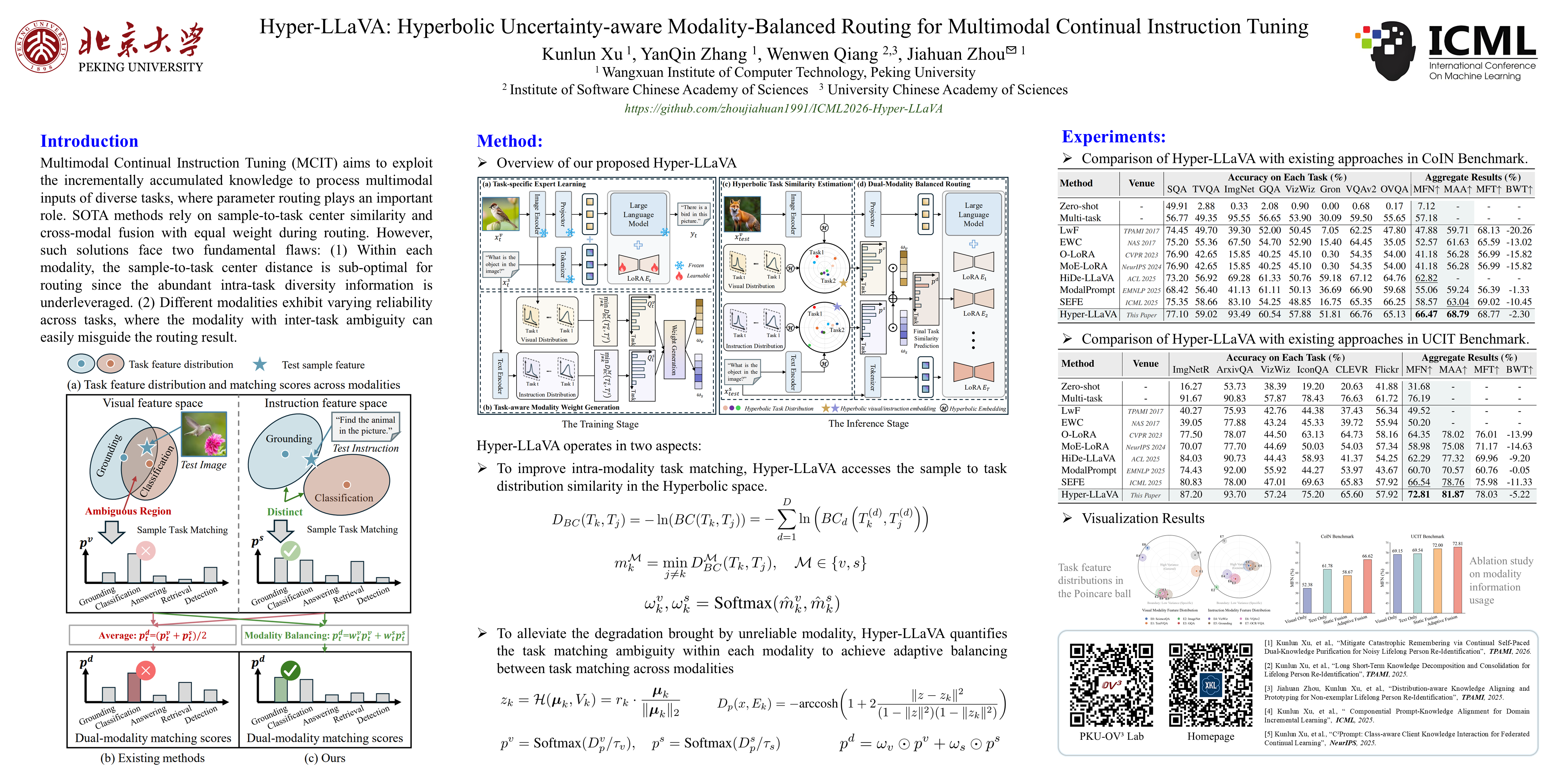
Multimodal Continual Instruction Tuning (MCIT) aims to exploit the incrementally accumulated knowledge to process multimodal inputs of diverse tasks, where parameter routing plays an important role. State-of-the-art methods rely on sample-to-task center similarity and cross-modal fusion with equal weight during routing. However, such solutions face two fundamental flaws: (1) Within each modality, the sample-to-task center distance is sub-optimal for routing since the abundant intra-task diversity information is underleveraged. (2) Different modalities exhibit varying reliability across tasks, where the modality with inter-task ambiguity can easily misguide the routing result. To address these problems, we propose Hyperbolic Uncertainty-aware Modality-Balanced Routing (Hyper-LLaVA) to improve parameter routing capacity based on cross-modality task feature uncertainty modeling. Specifically, to improve intra-modality task matching, Hyper-LLaVA accesses the sample to task distribution similarity in the Hyperbolic space. Besides, to alleviate the degradation brought by unreliable modality, Hyper-LLaVA quantifies the task matching ambiguity within each modality to achieve adaptive balancing between task matching across modalities. Based on the complementary intra- and inter-modality task matching enhancement, our Hyper-LLaVA outperforms state-of-the-art approaches by large margins. Our source code is available at https://github.com/zhoujiahuan1991/ICML2026-Hyper-LLaVA
Lay Summary
(1) Existing MCIT methods suffer from limited routing capacity due to the neglect of intra-task diversity and inter-task ambiguity. (2) We build Hyper-LLaVA to improve parameter routing capacity based on cross-modality task feature uncertainty modeling. (3) Hyper-LLaVA achieves complementary intra- and inter-modality task matching enhancement, outperforming state-of-the-art approaches by large margins.