
Asymptotic Universal Alignment: A New Alignment Framework via Test-Time Scaling
Abstract
Lay Summary
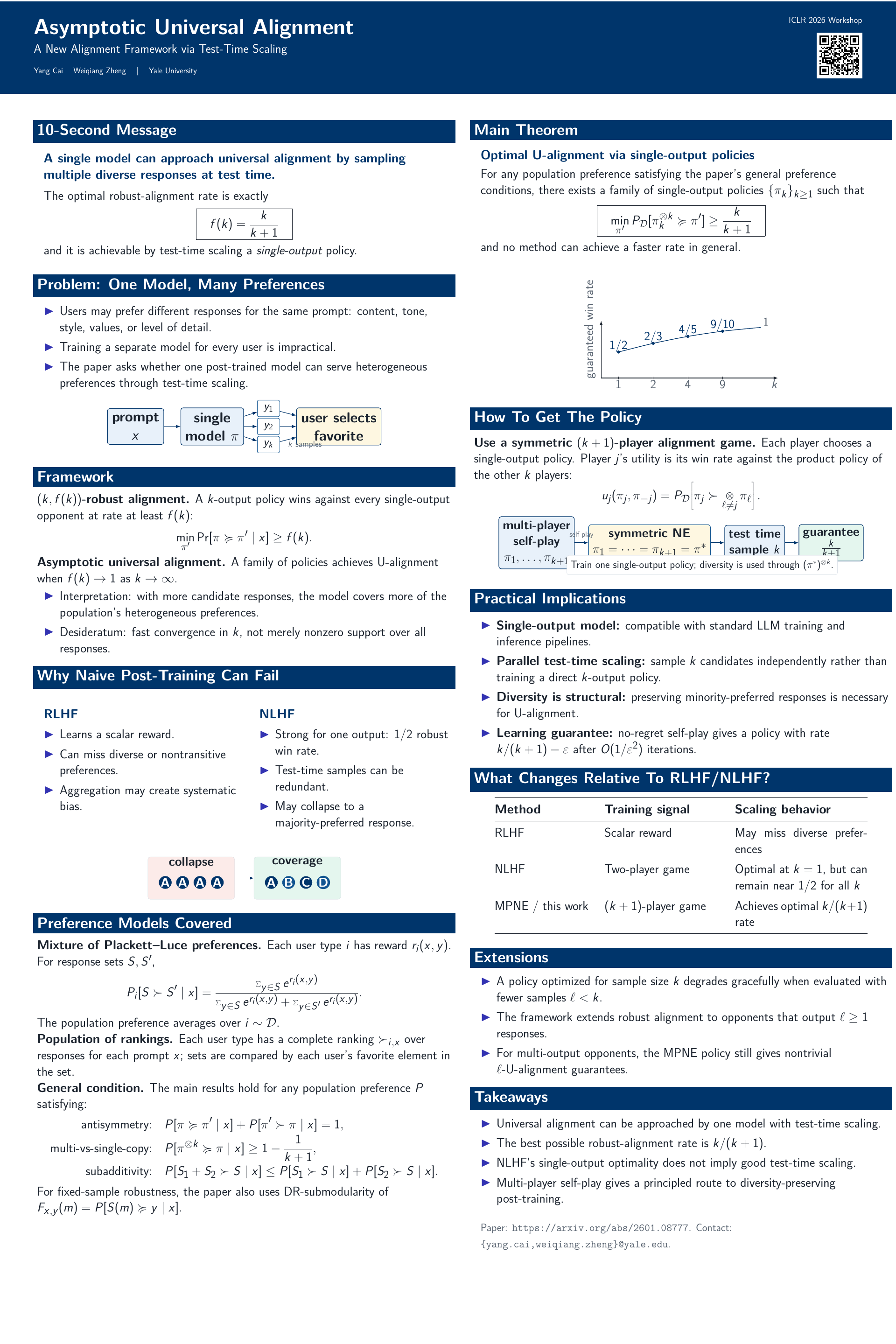
AI assistants increasingly need to serve people who want different things: one user may prefer a short answer, another may want detail, and another may value a different tone or viewpoint. We ask whether one language model can better serve many such users without training a separate model for each person. The key idea is to have the model produce several possible answers at test time and let the user, or a lightweight helper system, choose the one they like best. We show mathematically that, with the right kind of training, this approach can get closer and closer to satisfying almost everyone as the number of answer options increases. For example, the best possible guarantee improves from one out of two with one answer to three out of four with three answers, and continues to approach full coverage as more answers are shown. Existing alignment methods can miss this benefit because they often learn to give the single answer preferred by the majority, reducing variety and leaving minority preferences unsupported. We propose a new game-based training framework that preserves diversity, so sampling more answers gives users meaningfully different choices. This matters because future AI systems may need to be both reliable and pluralistic: not just good on average, but able to adapt to different people’s needs and values.