
MEDUSA: Motion Elimination in Diffusion Using Spectral Attack
Abstract
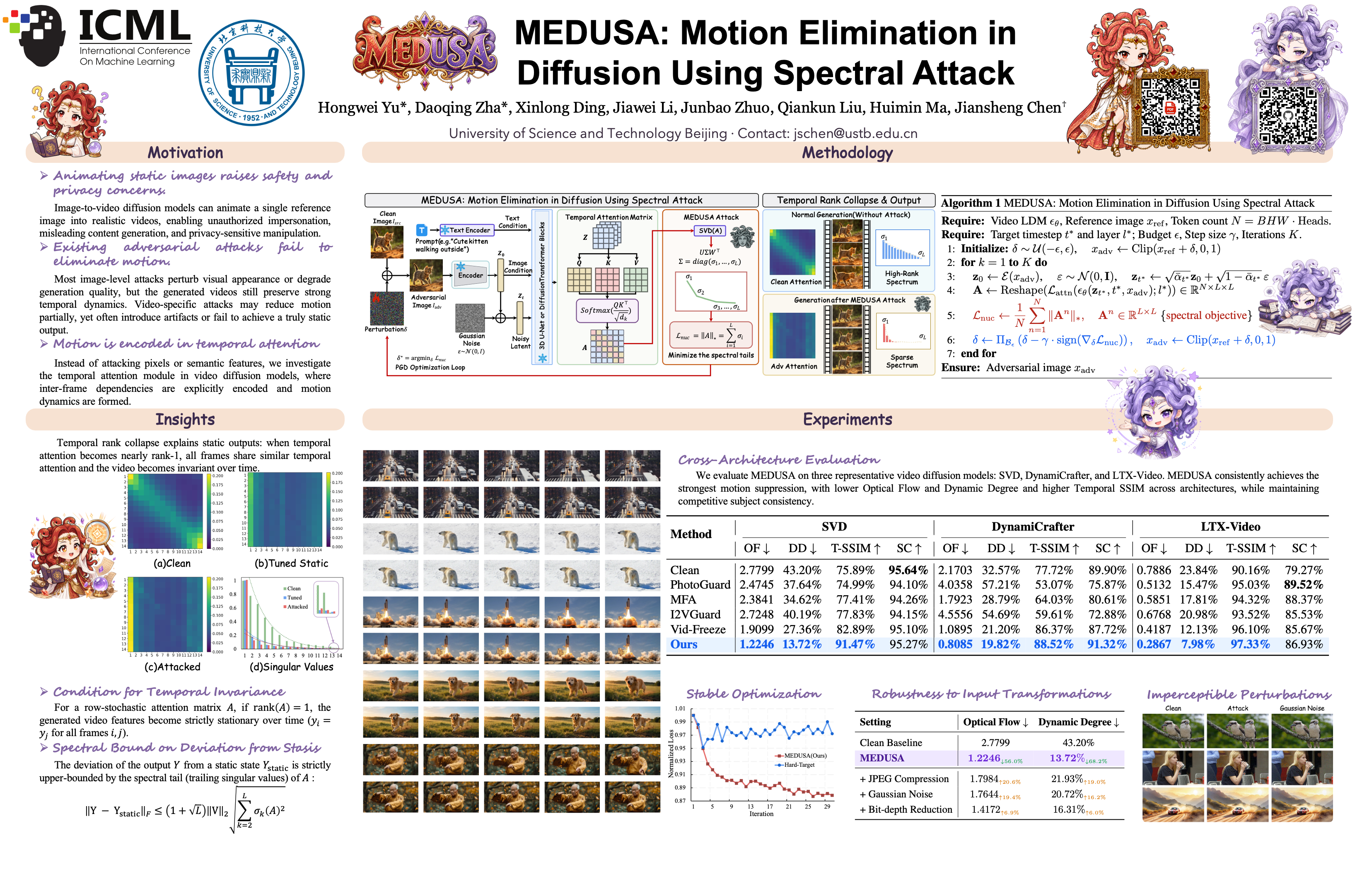
With the widespread application of Video Diffusion Models (VDMs), video synthesis has achieved remarkable temporal dynamics. Image-to-Video (I2V) generation allows users to provide reference images, which enables attackers to inject adversarial noise into these conditions. Due to the robust spatio-temporal priors in VDMs, conventional frame-level attacks merely induce superficial artifacts and struggle to suppress the synthesis of motion semantics. In this work, we approach the problem by exploring the underlying mechanism of temporal dynamics. We reveal that the static video manifests as a temporal rank collapse, a degenerate state characterized by rank-1 degeneracy within the temporal attention matrix. Guided by this insight, we propose Motion Elimination in Diffusion Using Spectral Attack (MEDUSA) to freeze the video. It minimizes the nuclear norm of the attention matrix to induce the temporal rank collapse. This objective circumvents the vanishing gradient problem encountered when directly imposing a rigid temporal mapping on the attention matrix. Furthermore, we provide a mathematical analysis of this phenomenon and the gradient vanishing problem during the optimization. Experiments confirm that MEDUSA achieves excellent performance and validates the effectiveness of spectral constraints.
Lay Summary
Modern AI systems can make a still picture move: a dog can start running, clouds can drift, or a portrait can become animated. While impressive, this creates a safety problem. If someone wants an image to stay still, current protection methods often fail once the image is given to a video generation model. This paper asks a simple question: what makes these models create motion in the first place? We find that motion depends heavily on how the model links different video frames together internally. If those links are pushed into a simpler pattern, the model tends to repeat almost the same visual content across frames, producing a video with little or no motion. We introduce MEDUSA, a method that makes a tiny change to the input image, small enough to be difficult to notice, but large enough to disrupt the model’s ability to animate it. Across multiple video generation systems, MEDUSA freezes motion more reliably than previous defenses while keeping the image recognizable. The result improves our understanding of video generation and points toward better safeguards for image-to-video AI.