
Beyond Logits: Metastable Latent Dynamics for Sample-Efficient Best-of-N Selection in LLMs
Abstract
Lay Summary
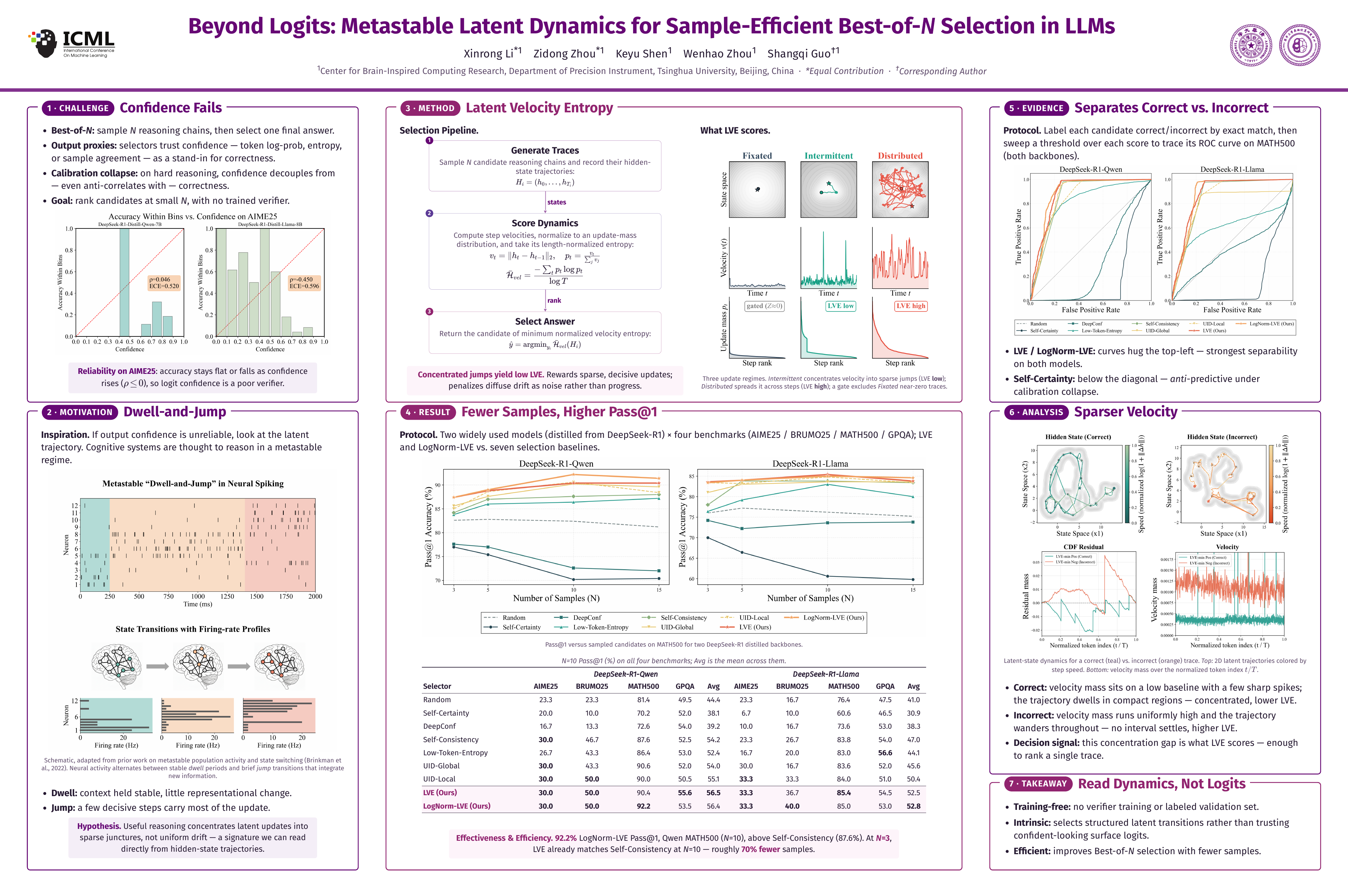
Large language models can solve harder reasoning problems by generating several candidate answers and picking the best one, but this only works well if we can reliably tell which candidate is correct. Common ways to do this, such as using the model’s confidence scores or comparing many sampled answers, can fail when confidence is misleading or when agreement is hard to measure. We propose a new training-free method, Latent Velocity Entropy, which looks at how strongly the model’s internal representations change during generation. The main idea is that successful reasoning often shows a more concentrated pattern of internal updates than unsuccessful reasoning. Across four reasoning benchmarks, our method stays useful even when confidence-based baselines fail, and it performs especially well on mathematical tasks. On MATH500, our normalized variant nearly matches much more expensive majority voting while using far fewer samples.